
 •
Rating:
•
Rating:
THE REVIEW
There was a brief period, spanning the late '80s and early '90s, when a band that drew its name from an Andalusian anarchist body, Mano Negra, became one of the greatest Mediterranean rock groups, if not the greatest. A brief period during which a young Franco-Spanish artist named Manu Chao invented a genre (the "patchanka"), whose sole foundation lay in one varied word: eclecticism.
The essence of the sound of this magnificent all "family" trio (Manu on guitar, brother Tonio on trumpet, and the lively cousin Santiago Casiriego on drums) lies indeed in a unique blend of English rock (especially punk), Latin American rhythms ranging from ska-reggae to salsa, and even flamenco-dub, merged with the urgency of texts committed to reflecting on the world and its troubles. But the allure of the group lies precisely in this pursuit of unclassifiability, of universality (with lyrics sung in multiple languages, mainly Spanish and French, but over time also in English and Italian), global bearers of a message of political and social solidarity. For this reason, they did not hesitate to embark on exhausting world tours, targeting not only the capitals of every place and flag but also inventing real musical pilgrimages to the most remote and struggling countries (memorable was the "Cargo Tour," for which they rented a boat that toured the entire western coast of South America, with the band playing in the ports of every small village).
Unfortunately, as everyone knows, it is difficult to stay afloat without the support of major labels, and even Mano Negra had to comply (albeit not too much) with the wishes of Virgin, which wanted to launch them commercially following the excellent debut of "Patchanka" (1988) by reissuing the album in a thousand ways ("Puta's Fever," "Amerika Perdida"...) adding or removing English songs depending on Mediterranean or Anglo-American destinations.
Subsequently, the confused Mano Negra would release the modest "King Of The Bongo" (1991), which, even achieving greater success than previous releases, was a product below expectations (explicitly aimed at the American market).
At this point, the band's journey, after a fantastic tour along the Colombian coast (this time aboard a train!), faced a crossroads: continue their mission as a militant and gypsy band wanting to raise awareness and entertain within the limits of a passionate but limited group of dedicated fans or expand their horizons to conquer the UK/States, the musical heart of the world.
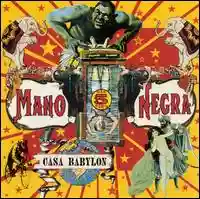
The choice is "Casa Babylon." Not just an album, not merely the sum of the entire Mano Negra story, not just their densest and most complete masterpiece. Conceived as a sort of free and independent radio ready to broadcast all the sounds of the first, second, or third world, without ethnic distinctions or expressive prejudices, Casa Babylon is set to become the London Calling of the '90s. Indeed, 15 years after the seminal international melting pot of their mentors Clash, the miracle repeats: a concept album that aims to unite all the souls of the world, starting this time from Paris, but with the same desire for solidarity among peoples and traditions, like a great socio-cultural embrace.
It speaks of folk heroes (from Zapata to Maradona), of haunting global prophecies (the fantastic Hamburger Fields), stories of wars in defense of a homeland that must belong to everyone (Machine Gun or El Alakran), celebrations of motherhood as there's only one (Mama Perfecta), visions of utopia but lucid and full of Gypsy vitality (Sueño De Soletiname, This Is My World).
It's a journey within this enormous Babylon, where Manu Chao has now fully taken on the role of the mastermind of the band, bringing both political poetry and more boisterous hedonism to maturity and coherence, merging in this beautiful, colorful, and aromatic universe, hip-hop, electronica, rai, jazz mixed with trip-hop, multitracked collages, psychedelic accordions, and more, into his admirable socio-musical vision.
Unfortunately, Casa Babylon would be the swan song of this virtuous band: Manu Chao, exalted by the ever more unanimous acclaim of the audience, decided to embark on a solo career destined for implosion after good initial results, evidently due to a slow creative decline and a mistaken political overexposure. But let's listen to him here again, tireless solar and irreverent Robin Hood, intent on striking the dusty neo-global cosmos of popular music with his faithful companions through experimentation, fervent civil passion, and a great desire for joyous sonic fun.
Loading comments slowly
Summary by Bot
Mano Negra's 'Casa Babylon' is a landmark album that fuses punk rock with Latin American rhythms and world music influences, delivering a powerful political and social message. Led by Manu Chao, the album reflects the band’s mission of musical solidarity and cultural fusion. It stands as their most complete and ambitious work, blending genres and languages to create a global soundscape. Though it marked the band’s final chapter, 'Casa Babylon' remains an influential and spirited masterpiece.Tracklist Lyrics Videos
Mano Negra
Mano Negra were a French band formed in Paris in 1987 by Manu Chao, fusing punk, ska, reggae and Latin sounds into a high-energy style known as patchanka. They released influential albums including Patchanka, Puta’s Fever, King of Bongo and Casa Babylon before disbanding in 1995.05 Reviews
