
 •
Rating:
•
Rating: THE REVIEW
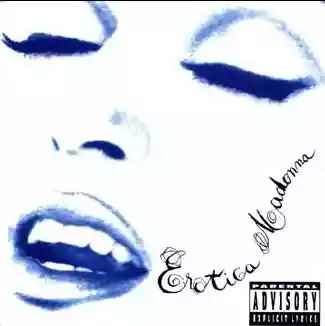
I don't think there is another work by Madonna Louise Ciccone that describes in minute detail her controversial ETHICS and everything related to it: sex, love, passion, sensuality.... In no other album (at least so far) has Miss Ciccone been able to musically express the dialectics of love/sex, passion/pain, pleasure/suffering. "Erotica" (and the title itself says a lot about the album's content, so anyone who might be shocked by such warmth should opt for another work - or even another artist) represents the pinnacle of the "scandal" function that Madonna has begun to portray concretely since as far back as 1982.
Having generally abandoned the frivolity of "True Blue", "Like a Virgin" and "Who's That Girl", which characterized the first part of her extremely long career, at least until "Like a Prayer", Madonna immerses herself completely in her world, a way characterized by satisfactions but also pains that, following her cry "Express Yourself", could not remain repressed.
And so it is that sex, conceived as a contrast of pleasure/suffering, becomes an integral part of her personal art. It starts with "Sex", much-talked-about coffee table book of photographs where Madonna expresses 100% her dreams regarding the theme already highlighted: it ranges from lesbian, to sadomasochism, to voyeurism and so on, an idea conceived with the collaboration of famous celebrities like Naomi Campbell who helped the Material Girl on her journey toward publicly rendering her intimacy.
If "Sex" was the visual-literary realization of this particular artistic path, "Erotica" can indeed be considered its special soundtrack. A large number of subjects have defined this work as a "Concept Album", that is, a monothematic record, a thought that can be both confirmed but also in certain aspects denied.
Songs where Madonna's voice is deliberately soft, muted, almost husky (Erotica, Where Life Begins, Waiting) represent the peak of sensuality on the record, almost intentionally wanting to immerse the listener in an imaginary embrace where the demon of pleasure and the demon of pain clash in a perpetual struggle. And this represents the worthy continuation of "Justify My Love" where Madonna imagines a personal erotic situation by speaking rather than singing with an almost unrecognizable voice compared to previous songs like "Live to Tell" or "Like a Prayer". An effect that, despite everything, works and convinces, succeeding in its initial intent of imparting warmth even without an excessive deployment of vocal cords.
Intended as a private and unrepeatable fantasy of Madonna, the album does not intend to fall into a banal and predictable frivolity, which makes it tastier than it already is. A mix of jazz melodies (Where Life Begins, Secret Garden), a bit of classic dance (Deeper And Deeper, Thief Of Hearts, Words), a fabulous and unforgettable ballad (Rain) make "Erotica" one of the most artistically successful experiments of her career, even though in terms of sales it represents a decline compared to the 7-digit numbers collected with "True Blue", "Like a Virgin" and "Like a Prayer".
In the album there are also anthems against homophobia and racial hatred (Why's It So Hard, In This Life) that give this work an important mark of current affairs and socio-political protest.
"Erotica" represents a milestone in Madonna's discography and is the apotheosis of her life philosophy. Recommended to everyone who intends to immerse themselves in her artistic world in a complete and in-depth way.
Loading comments slowly
Summary by Bot
Madonna's 'Erotica' is a bold and intimate exploration of sexuality, blending themes of pleasure and pain with socio-political commentary. The album marks a departure from her earlier pop frivolity, embracing a softer, husky vocal style and diverse musical influences including jazz and dance. It serves as the soundtrack to her provocative 'Sex' book and stands as a milestone in her career, despite lower sales. The work is recommended for those seeking a deep dive into Madonna's complex artistic vision.Tracklist Lyrics Videos
Madonna
Madonna (born Madonna Louise Ciccone, August 16, 1958) is an American singer, songwriter, actress and cultural icon who rose to prominence in the 1980s and has had a multi-decade career marked by stylistic reinventions.55 Reviews
Other reviews
By flood
Madonna abandons the idea of an album as a collection of potential hits, with a varied sound to reach the largest possible number of listeners, and for the first time decides to create an album with a well-defined sonic project, organic.
The sex addressed in Erotica is not joyful but appears almost as a diversion, an escape, a desperate necessity.
By M.Poletti
Erotica is an album that bets everything on the image but has little substance, little meat on the bones.
Cheap and pointless eroticism is not enough, contents are also, and above all, necessary. And good music is needed.
