
 •
Rating:
•
Rating:
THE REVIEW
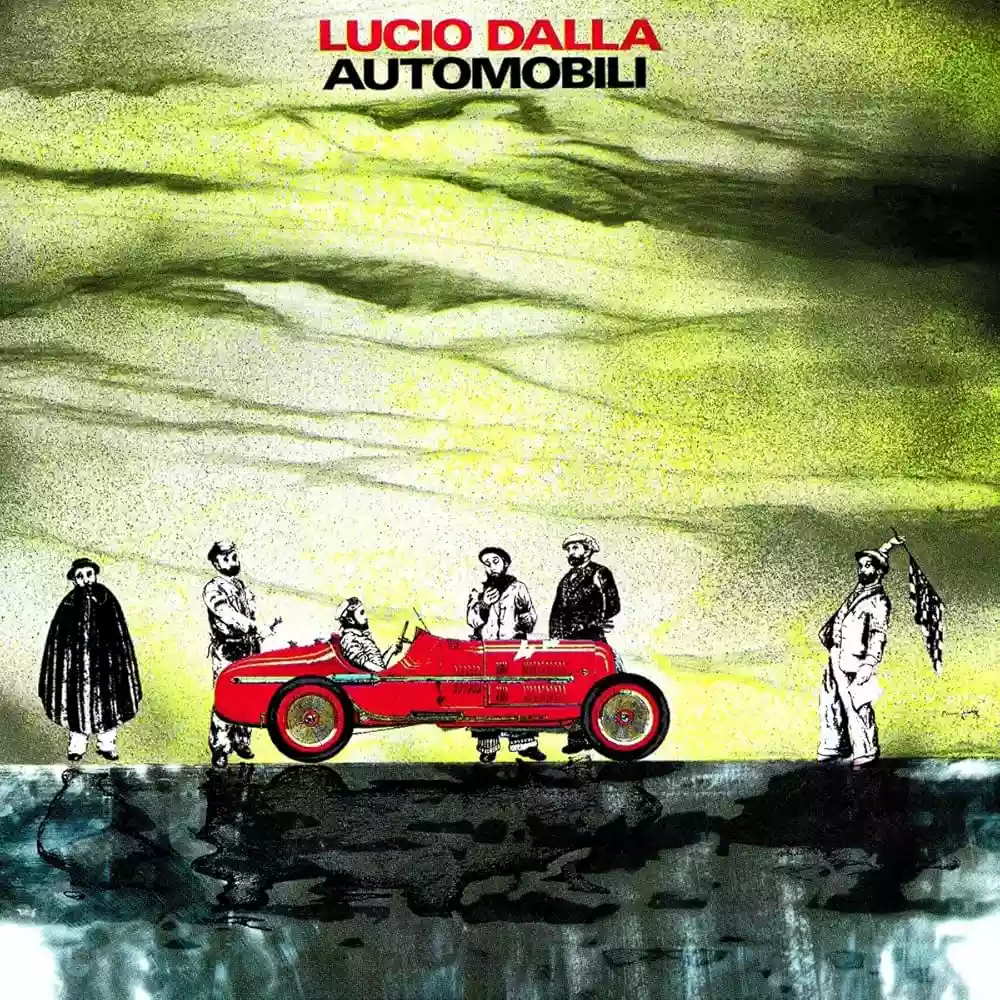
"The complex collaboration between Lucio Dalla and Roberto Roversi was laboriously coming to an end, essentially due to the conflict between the poet and RCA, which had grown tired of albums that very few understood and even fewer bought. It was on this territory that the album Automobili was born [...]" (Dario Salvatori, Il Dizionario della Canzone 2022)
The oblivion that fell (with Dalla being the main contributor) over the Roversi period is still a mystery today. In his live performances, apart from the everlasting "Nuvolari," he has never revisited any piece from the Roversi trilogy, as if that time was finished and buried with the release of "Com'è profondo il mare" (1977). And yet, while recognizing Dalla's considerable writing skills, I believe the post-Roversi era only lasted well for a few years, let's say until 1986: after "Caruso" he truly declined, among "Attenti al lupo" and "Canzone," two deadly ditties unworthy of his genius. So, the three records written with Roversi are, in my opinion, still magical today because they had something indecipherable that surprises me every time: of the three, I prefer the second, "Anidride solforosa," but the most famous is certainly this "Automobili." Which was born under a bad star.
In 1976, the Dalla-Roversi duo, possibly driven by the success of Gaber's theatrical songs, wrote a theatrical show titled "Il futuro dell'automobile e altre storie." Dalla deserves credit for always talking about sports (which is what motor racing is, in every respect) and for somehow identifying with the most mythical figures of every sports discipline, from Nuvolari to Baggio, passing through Ayrton Senna. Dalla genuinely practiced sports over the years, from basketball to the Mille Miglia, in which he participated four times. Speed, racing, the wind hitting your face thrilled him (but he also loved soccer, which he considered an art form not far from music or painting, for example). A show about the world of engines was, of course, a dream to fulfill. From that show, he decided to record some songs on a disc, but Roversi objected: it is a theatrical show, Roversi argued, and so it should remain. At most, a record that features the entire performance (just like Gaber, as mentioned above). The main point of friction between the two was this, essentially. Salvatori's theory that RCA would have been tired of (almost) unsellable records is correct up to a certain point: probably the two would have ended their relationship soon, or at least when Dalla (who claimed he couldn't write lyrics for a song) would have realized his own narrative talent.
(Oh, incidentally: the entire show is available for streaming on the Rai website. Which sometimes surprises us).
"But the album Automobili is not just a tribute to the most important automotive figures of this country. In the pieces that make up this mosaic, a harsh critique of the car civilization and society that was becoming faster and faster is visible. One example above all, the song Intervista con l’avvocato, which offers a merciless portrait of the economy, politics, and society of the times" (from the site Garage Italia)
It is a concept album divided into two parts: side A represents the past (apart from the beginning), and side B the present. Musically, Dalla still seems tied to the pop style (with some prog nuances) of the '70s, even though the level is decidedly superior to the easy listening pop production of the time (except for Battisti). He surprises with "Intervista con l'avvocato" in which Agnelli speaks with an irresistible scat, but dominating the first side is the mega-digression (8 and a half minutes) of "Mille Miglia" (originally divided into two parts): it is a literary and musical masterpiece. Roversi goes wild beyond all limits ("then the sun split against the iron of gasometers and from above left a red line of blood along the road for kilometers while on the Italian grass, dry death mowed the grain," not to mention the passage about the poplars in Lombardy) while Dalla invents a two-three rhythm change that segments the song in a surprisingly homogeneous way, perfectly conveying the idea of the continual alternation between breathless racing and moments of pause that were the very essence of the Mille Miglia. The context is that of 1947: the rural Italy and car races as redemption from a past still not passed.
The B side is the one, indeed, dedicated to the present. "L'ingorgo" that is tightening Paris like a vise is entertaining and is anthology-worthy, but perhaps even more so is the minimalism (in an album anything but minimalist) of "Il motore del 2000." The car of the future will have a clean, neat, and fragrant engine (well, sort of...) but what will the 2000 boy be like? Roversi philosophizes as he does best, mixing public and private in an era, 1976, when the year 2000 was still seen as something mysterious that would bury all the certainties of the 20th century and would quickly become the New Century, that of the Enlightened Humanity (then things would have gone differently). It harks back to that old saying of Umberto Saba: "The Twentieth Century seems to have only one desire: to reach the Millennium as soon as possible." But the boy, the man, of 2000 could not be pinned down, only imagined. And here emerges the last song, the most beautiful: "Due ragazzi." Two ordinary boys, in a car, young, making love:
"Look at me with love again
I know I am old
I know I'm already twenty
But, she replies, I'd marry you anyway"
I won't say more because it moves me every time, and tears stream down, leaving everything else behind, but there is a verse in this song, a prophetic passage (but back then, no one knew):
"Life is so close
Everything is yet to be done
The future is green, it's cold, it's as deep as the sea"
Today it's hot, it's 38 degrees and I'm at home with the air conditioning on full blast. But how is it that listening to this album, I feel like going out, taking an Alfa from 1947, like Varzi's, and feeling like a Mille Miglia driver, wind in my face and heart racing at two thousand, and stopping, with a girl, to make love in a Deux Chevaux? Great Lucio, always.
Loading comments slowly
Summary by Bot
The review praises Lucio Dalla's album Automobili for its poetic lyrics and memorable melodies. It highlights the album as a significant work in Italian music with a strong artistic presence. The critique is appreciative and focuses on the album's classic appeal.
Lucio Dalla
Lucio Dalla (Bologna, 4 March 1943 – Montreux, 1 March 2012) was an Italian singer-songwriter, musician and actor. Clarinetist by training, he blended jazz roots with pop and canzone d’autore, rose with the Roversi trilogy (1973–76), and reached a peak with Com’è profondo il mare (1977), Lucio Dalla (1979) and Dalla (1980). He co-led the 1979 Banana Republic tour with Francesco De Gregori and wrote the classic Caruso (1986).50 Reviews
Other reviews
By Eneathedevil
"Automobili" is, despite everything, a small masterpiece.
The automobile no longer an element of redemption but of subjugation, of depersonalization.
