
 •
Rating:
•
Rating:
THE REVIEW
I (virtually) hand over the word to Mogol. Those who own the CD in the "Mogol Edition" version already know everything, for the others, I believe, there are some pleasant curiosities about an album that, in my opinion, is memorable (it is my absolute favorite by Battisti, including Panella).
"Prendila così":
"Prendila così is a song that expresses the pain often experienced by people who have relationships with married individuals. It's a story I have lived myself. A clandestine life, full of a few good moments and many bad ones. [...] For this album, Battisti created about fifty melodies; then together, we selected a first batch of tracks on which I later worked on the lyrics. Another novelty is that in the studio, Battisti, for the first time, did not play an instrument. He delegated everything to session men, whom he deemed incredible: from Gerry Conway, Cat Stevens' drummer, to producer and guitarist Pip Williams" (Mogol)
"Donna selvaggia donna":
"It talks about a wild, untamable yet childish woman. It's a slightly ironic text [...] It's a song in which there is a bit of paternal spirit and a bit of brotherly spirit. He is more mature than her. Regardless of the relatively small age difference, she loved the disco and was still very much a young girl" (Mogol)
"Aver paura di innamorarsi troppo":
"The lyrics tell the story of two people who are afraid of love because love involves, makes one suffer. They fear losing their independence, their defenses, fear becoming victims of each other. An unusual topic. This topic has never been addressed so precisely, so openly... Repressing one's feelings to not be vulnerable. [...] A very romantic song with great keyboard work by Geoff Westley" (Mogol)
"Perché no":
"Perché no is about two people who set off on a mountain trip, stop during the journey at an inn with accommodation, and decide to spend the weekend there without proceeding further, happy in their love. It captures the life of an urban couple: what they do during the day, grocery shopping, and self-ironic games ('excuse me, do you love me or not?') they enjoy in their city where they pretend to be English tourists" (Mogol)
Here I intervene, recalling that in the original LP there appeared text with two verses that do not exist in the song, but that were actually written by Mogol but were eliminated during recording for various opinions. Some say they were not suitable for the tone of the song, others say that the song, already almost 6 minutes long, would have exceeded 8 minutes, perhaps too long. Here are the missing stanzas:
"Suddenly ask you how much money you want/then haggle over the price and finally give you half/and rip off your bra, as if drunk. And then stand up and coldly say, I don't feel like it.
A boat on the lake, me rowing slowly/the smiling silence, the little umbrella and you,/a fish jumps, just a splash/and you, for vanity, look absent towards the shore and don't look at me anymore"
"Nessun dolore":
"It was a letter I had to write, which instead became a song. Nessun dolore is a song about love and the possibility of it corroding due to a series of insensitivities. Slowly, slowly, due to a series of repeated misunderstandings. [...] No emotion in observing the end of a love already finished" (Mogol)
"Una donna per amico":
"Una donna per amico is about my friend named Adriana. We often hung out, we were like companions, friends. We frequented the same company. She was particularly close to me, and we shared our stories of solitude, of love, to encourage and console each other. Adriana said to me: Make me happy, I'm your dearest friend, dedicate a song to me in my name. About nine months later, it happened that Lucio wrote this music, and I dedicated this song to her. When I told her: Look, I wrote a song for you with Lucio, she replied: Oh great, is it titled Adriana? and I: No, it's called Una donna per amico, and she: But why didn't you name it Adriana? And every time she heard it on the radio, she'd tell everyone: That's me. It's a song about the friendship between a woman and a man and the little implications. If you read the text carefully, there's a bit of jealousy and a bit of mutual protection, but there's no sexual implication. [...] Renzo Stefanel identified in the musical part of this song a transition from the Roman stornello ("Nino der Tufello") to disco funky that also corresponds to the protagonist's evolution, becoming modern with his different relationship with the woman" (Mogol)
"Maledetto gatto":
"Maledetto gatto was a real character, a refined type who tried to court my girlfriend at the time. [...] It's the game of recalling the spoken phrases and then telling the thoughts of those who hear them [...] He would come to disturb even when we were alone [...] A peculiarity: the electric guitar is treated with the so-called talk box, an effect that in Italy would later be used by Pino Daniele" (Mogol)
"Al cinema":
"Al cinema is a song - I hope - is funny. There are two lovers who accuse each other while watching a movie. They reproach each other, looking at the characters and commenting each in their favor. He gave her that car, but for me, it's the Mini... Then suddenly they buy ice cream and realize it's gone up in price, so it's all a story beyond the cinema, real, daily, lived on the edge of cinema's fiction. It's a simple story of light everyday polemics" (Mogol)
Quickly, Rapetti also tells us something about the (beautiful) cover:
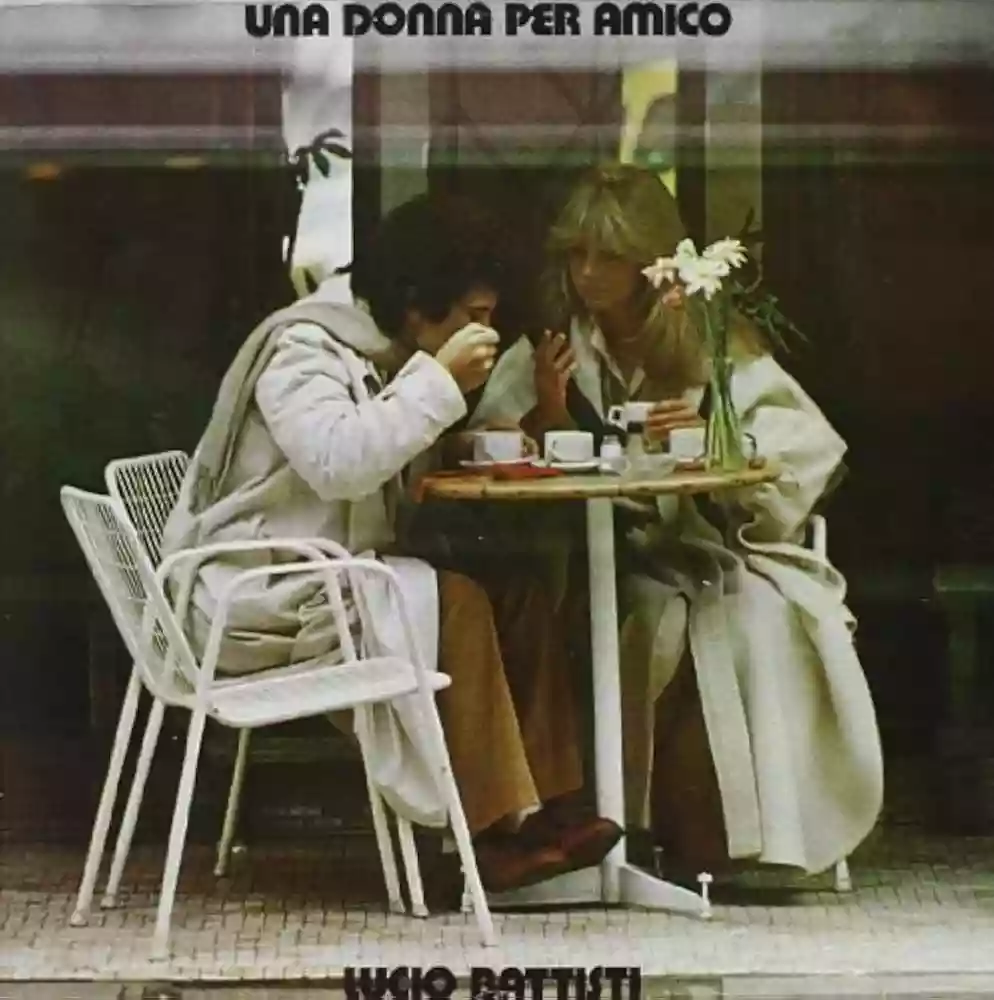
"The cover perfectly represents the album's title. A friend with whom you go for a coffee to chat. The photo was taken in England, in London, and is very elegant, fascinating. A beautiful image conceived by an English photographer featuring an English model and our dear Lucio who doesn’t appear at all" (Mogol)
Loading comments slowly
Summary by Bot
This review praises Lucio Battisti's album Una donna per amico as a flawless and timeless classic. The reviewer highlights its exceptional melodies and deeply emotional lyrics that continue to resonate. Rated a full 5 stars, the album stands out in Italian pop music history for its artistic brilliance and enduring appeal.Tracklist Lyrics Videos
Lucio Battisti
Lucio Battisti (1943–1998) was an Italian singer, composer and producer from Poggio Bustone. He rose to prominence in the late 1960s and 1970s with lyricist Mogol, crafting many of Italy’s most beloved songs, and later pursued a radical electronic and linguistic shift with Pasquale Panella (1986–1994). From 1980 onward he withdrew from concerts, TV and interviews, insisting the art should speak for the artist.104 Reviews
Other reviews
By Viva Lì
"Una donna per amico" will remain in the hit parade for almost six months and will not leave the charts at least until 1980.
Battisti finally finds the long-sought-after solution, making the song an eternal evergreen.
By cece65
This album represents, in my opinion, Lucio Battisti at one of his highest musical pinnacles, with some points of absolute excellence.
If Lucio had been English or American, his fame would have been worldwide.
By Martello
"A chocolate of dark hue, harmless in the wrapper and bitter on the tongue, like that little song."
"I still owe a lot for being the adult I am now. Wherever you are, take it as it is and don’t make a drama out of it."
