
 •
Rating:
•
Rating:
THE REVIEW
The legendary Lou Reed gives us a small masterpiece of music!
1972 bursts in with extraordinary force: it's the year the Pink Floyd are at the mercy of the wave, thinking about their famous album, or undoubtedly the most famous, "The Dark Side Of The Moon": indeed, this reasoning is flawless.
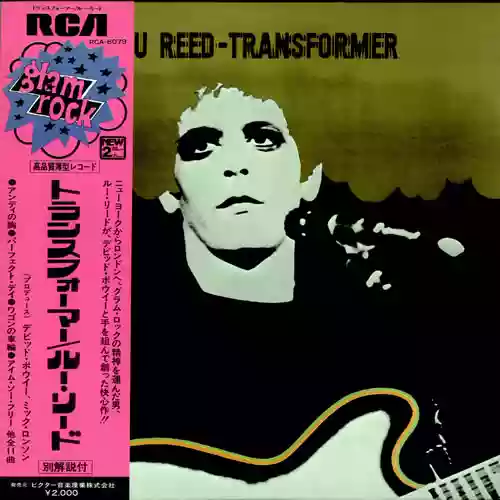
But going back to Lou, who was the famous guitarist of the Velvet Underground (if you don’t know them, get hold of that album with the banana on the cover or the completely black one which still isn't clear what it represents) and sang about sex, drugs, and rock 'n' roll, as later Iggy Pop, and much later Axl Rose, would also do, he records "Transformer", helped by the David Bowie of those years - no Brian Eno but we have him, just Bowie, with still one of his friends: the three cheerful undead boys (fortunately) make an incredible album, starting from the famous cover, a photo of Lou Reed with a guitar where he has completely white skin.
The album contains delightful songs including the subtle "Walk On The Wild Side" that tells a story where even an old muse of Warhol appears, named Candy, who seems to have had sex with other men in the background; there’s also a very anarchic line for those '70s times, talking about someone who shaves their legs and becomes a woman (a man, who becomes a woman, otherwise poor Lou would have written a senseless line). More could be said about the song, which in fact is rather sparse but still effective, with a very incisive, aggressive, and politically incorrect bass: indeed, the noise might be a bit loud but not enough to cover Lou's voice, plus the song has a noise of women doing a choir that seems to come from heaven: impossible to resist the force of the song.
And then, there's possibly Lou Reed's masterpiece, "Perfect Day", which talks about a perfect day.
It seems Lou wrote it for the wife he had back then, and unfortunately, she divorced Lou over the years: like Bob Dylan’s Sad Eyed Girl, namely his wife Sara, Lou's wife also didn't consider the beautiful songs her husband had written for her, and they separated, which shows that even rock is a somewhat sad story for some.
The title might be due to the fact that Lou wanted to suggest that he would change his sex from male to female, thus leaving enormous doubt about the sexual nature regarding the confused ideas the music public already had, but it seems Lou didn't care and did it anyway, naming his album just as he wanted, even though Bowie would have wanted to call it “Lou Reed The Second”.
Anyway, this album is psychedelic especially in the nonsense of "Vicious", where the singer is struck by another person with a flower, a rather strange event, but since the idea (so I read) came from Andy Warhol, it could have been worse!
A very rock 'n' roll album in its intentions, the final product is more about glam-rock, and anyway you can feel a bit of everything inside the grooves of the vinyl "Transformer": the ghost of the composition of "I'm Waiting For The Man" looms above the album, or there are evident references to the rock world of those years, like guitar riffs very devoted to The Who, see "New York Telephone Conversation", where Bowie also contributes with those persistent moans and squeaks of his that would set a trend among the followers of the American new wave; in fact, there’s nothing punk in this album, something we might notice only in "Rock'n'Roll Animal".
It is certainly not a cheap album; it competes with "The Idiot" by Iggy Pop and "Nevermind The Bollocks" (not in themes, perhaps in sound a little, but in attitude certainly). Indeed, Sid Vicious took his nickname from Lou Reed's song that now, after the review, we all know: this is the real magic of the great rockers, they know how to come from everywhere and influence everyone, seminal or not, original or not.
Loading comments slowly
Summary by Bot
Lou Reed's 1972 album Transformer is celebrated as a glam rock masterpiece, blending provocative themes and powerful storytelling. Backed by David Bowie’s collaboration, it includes iconic tracks such as ‘Walk On The Wild Side’ and ‘Perfect Day’. The album reflects Lou's edgy style and influence on rock and punk culture, making it a timeless classic.Tracklist Lyrics Videos
Lou Reed
Lou Reed (born Lewis Allan Reed, March 2, 1942 – October 27, 2013) was an American musician, singer-songwriter and founding member of the Velvet Underground. He had a long solo career noted for albums such as Transformer, Berlin and New York and for experimental works including Metal Machine Music.71 Reviews
Other reviews
By francis
An album still 'on the fringe' that simultaneously achieves success and reaches the masses without betraying his glorious past.
Under the festive and cheeky outfit of classics like 'Vicious' and 'Walk On The Wild Side,' there's a universe of alienated and eccentric freak artists, drugs, madness, and despite everything, hope and utopia.
By Giuseppe1
"The first track 'Vicious' can be understood as the manifesto of the entire album."
"Lou Reed represents the stereotype of the modern metropolitan poet."
