
 •
Rating:
•
Rating:
THE REVIEW
MOVING (1982) 7/10
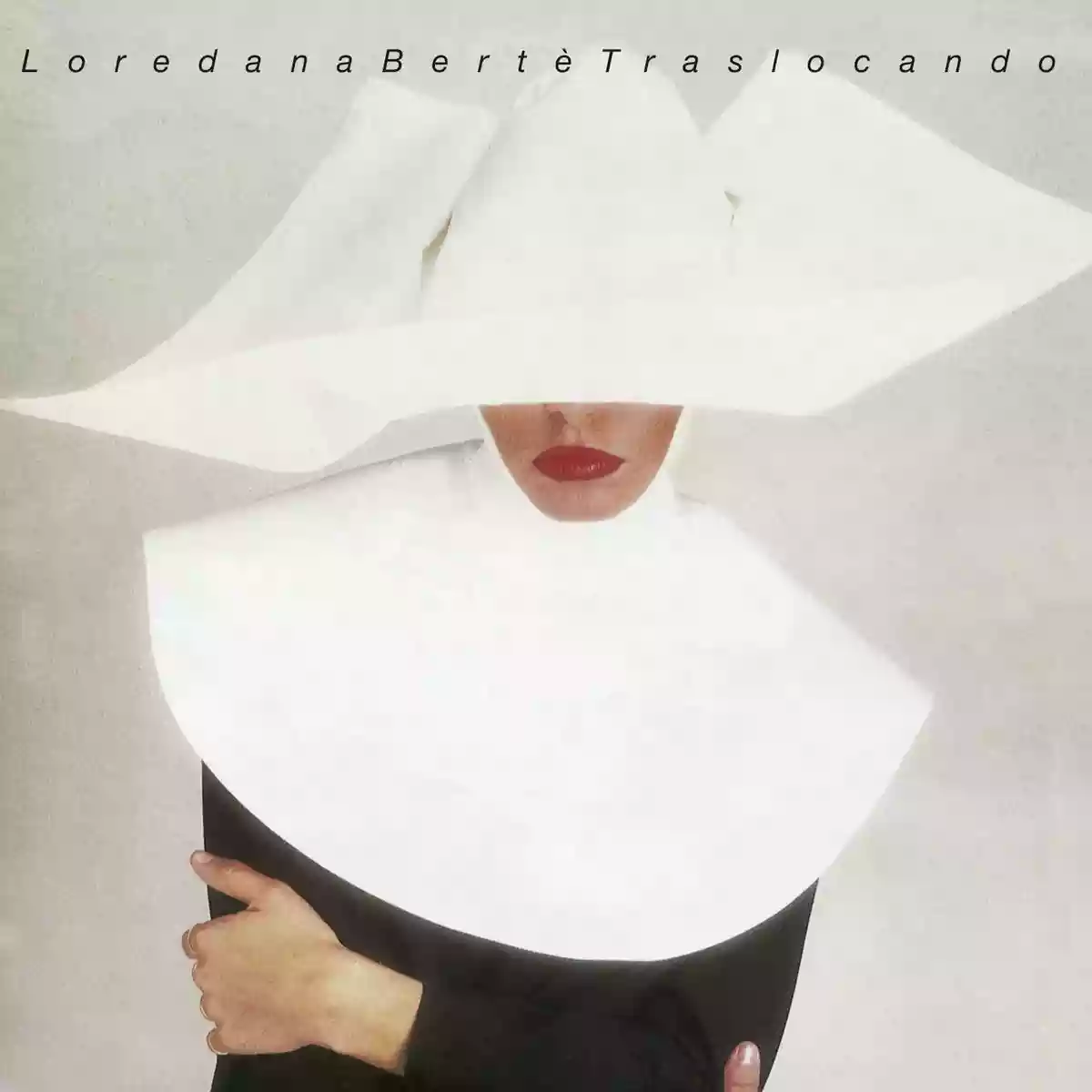
Maybe it has always been an Italian problem, since this is a country that is, at times, moralistic and prim by default, so when Berté appeared on the cover dressed as a nun in 1982 (not 1922), she stirred up quite a commotion and all sorts of prudish comments. It was a game, but as we know, not everyone always gets the joke. "Traslocando", which was recorded in the USA (and also released there), represents, I believe, the peak of the Berté persona, and from here (excluding the following "Jazz", 1983) the beginning of a ruinous decline.
The main track is "Non sono una signora". Here's how it happened: Berté was at Fossati's house and, as always, Mia Martini was with them; Fossati played a song on the piano and sang some lines he had written—these were from that very song. The piece, which is practically a spot-on autobiography of Berté herself (not to mention the song that will always represent her—and still does), immediately struck a chord with Loredana, but Fossati was doubtful and shyly asked her, "Do you feel offended?"—to which she shot back, "Let's go record it right now." In 1982, the song became a major hit (although it wasn't as explosive as one might expect looking back: the 45 rpm single reached a maximum of fifth place on the charts—though it stayed there for 13 weeks—while the LP never made it past seventh position, source: "Il Dizionario della Canzone"). Of course, winning at Festivalbar helped its success, but certainly the evocative power of the song played a big part: by putting herself "bare," Berté conquered the public with disarming sincerity—I am the one for whom "...the war has never ended."
Obviously, the album is more than just that, and it's not only about Fossati (though he certainly brings out the best here, also acting as producer). Being the 1980s, with electronics and synthesizers dominating, the album inevitably reflects that atmosphere, as well as some semi-rock excursions. The opener, "Per i tuoi occhi" (another song that did very well in the hit parade), is proof, with its explosive refrain and a tormented performance in which Berté leaves nothing out of her vocal arsenal; it was written by Maurizio Piccoli, and it's truly beautiful, even though, more than forty years later, some lines still remain utterly mysterious (what does "...with you on Mont Blanc/making love in stereo" even mean?). Back to Fossati. He gifts Berté two remarkable tracks: "J'adore Venise" (which Fossati himself recorded the year before on his album "Panama e dintorni", 1981), with its whisky bottles and shouted phrases, and the s-t-u-n-n-i-n-g title-track (which Fossati would "take back" the following year), one of the most beautiful pieces in Italian music (and anyone who has ever moved house, especially at a young age, will understand better than anyone), because the story of "Lucy la fredda" who moves, carrying away her hidden loves in drawers and tin boxes, is an image of rare beauty (though it's not without a sense of humor either: "Lucy la fredda sat on the stairs/and the moving guys, in their hurry, treated her roughly..."). And Lucy really existed: it's Lucy Morante, longtime girlfriend of Renato Zero, and the self-reference to Fossati in the lyrics doesn't feel out of place at all ("...And once again, I'm moving house, sang on the radio the voice of a friend of mine..."). Equally noteworthy is "Stella di carta" (again, a lot of real Berté life here too, written again by Maurizio Piccoli) with a line anyone can interpret as they like (even though, to me, there's not much to interpret): "...I don't know what it is about you that I crave/maybe just the pole, or the whole flag...." A Fossati in top shape also signs, together with Platinum Hook (the band playing on the whole album), "I ragazzi di qui", which couldn't be more '80s if it tried.
Other tracks are less convincing, which is a shame considering the songwriting credits. For example, Fossati's own "Stare fuori" drags on a bit too long, while the cover of "Les caves de l'amour" (originally by Jean Paul Dreau, and rewritten in Italian by Cocciante's long-time collaborator, Marco Luberti) is a kind of blues that tries to "climb" slightly tricky heights and is not really within Berté's wheelhouse. Sister Mia Martini (writing with her real name) authored "Notte che verrà", but despite a very weak lyric, is saved by an extremely intriguing musical arrangement. Closing track "Una": the stamp here is that of Renato Zero. But it leaves no mark.
Loading comments slowly
Summary by Bot
The review offers a measured perspective on Loredana Bertè's 'Traslocando' album, assigning it an average rating. It discusses the musical style and performance without overt praise or criticism. The reviewer provides context within Bertè's broader discography, making observations relevant to Italian pop enthusiasts. The analysis is structured and informative, aiding potential listeners in understanding the album's impact.Tracklist Videos
Loredana Berté
Loredana Berté is an Italian singer and performer known for a powerful voice, provocative imagery, and a run of major hits from the late 1970s to the early 1980s. Sister of Mia Martini, she helped inject reggae and rock into Italian pop and remains active on stage and in the studio.08 Reviews
Other reviews
By Fratellone
Loredana’s voice is as powerful today as it was when the record was released.
‘Traslocando’ remains a cornerstone of Italian pop.
By Fratellone
"'Traslocando' is a milestone, not only in Berté’s discography but in Italian pop at large."
"It’s pure energy, crafted with the passion and grit only Berté can deliver."
