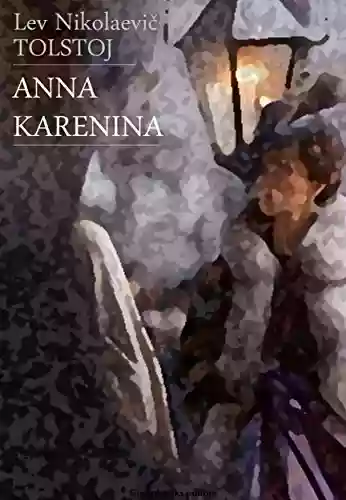

 •
Rating:
•
Rating:
THE REVIEW
"All happy families are alike, every unhappy family is unhappy in its own way." Tolstoy, Anna Karenina.
This is one of the best opening lines in the history of literature.
I read Anna Karenina when I had just moved from an 80 sqm house to one twice its size. At first, I felt so uncomfortable that I would retreat to my room to read… I couldn't get used to the vast spaces. I therefore enjoyed this magnificent novel in complete peace and silence.
Tolstoy's strengths lie in the lightness of the narrative, whether talking about love, politics, or even agriculture. The novel is collective, the characters are thoroughly developed, and each undergoes a careful psychological and social examination.
When talking about Anna Karenina or Madame Bovary, the beauty is that these two novels were written by two men capable of understanding, intuitively grasping, and superbly exposing the soul and torments of us women.
Anna Karenina, unlike the narcissistic Madame Bovary, is a woman who truly loves. Anna's arc is not so far from mine. Anna lacks nothing: social status, an adored son, and a husband who loves her for who she is—a bit frivolous but devoted.
Fate, during a party in Moscow, leads Karenina into the orbit of the handsome and womanizing Vronsky. The attraction is mutual. From here unfolds the entire story of the two lovers who, heedless of everything and everyone, love each other madly up to the conception of a daughter. Anna is, of course, stigmatized by all of society, loses custody of her son, and lives with Vronsky for a few years. When everything collapses on her, she begins to use alcohol and morphine and eventually commits suicide by throwing herself under a train.
Anna's arc is very current and prompts deep reflections. How can a woman/mother/wife manage to resist all the opportunities that present themselves? Only through a solid value system? But above all, how does Tolstoy write such a futuristic novel?
A few years after reading this masterpiece, the film comes out!
So, the scenography is brilliant, bringing the narrative to theatrical scene changes. Maybe Keira Knightley as Anna Karenina was not the wrong choice, but everything else is a complete disaster. The husband is much more charming than the handsome Vronsky… everything is contrived, the most beautiful part of the book, Anna's visit to her son, is banal and baroque. It all resolves into a brief melodrama that has nothing to do with the book.
The film's message is ultimately only those who "conform" to society's rules survive; those who don't "die," this is not Tolstoy's message. He speaks of love! The serious kind that offers no escape, that takes your breath away and the ground under your feet.
Loading comments slowly
Summary by Bot
This review praises Tolstoy's Anna Karenina as a masterpiece of literature, highlighting its deep psychological and social insights. The novel’s exploration of love and society remains deeply relevant today. The reviewer also critiques the recent film adaptation, finding it lacking compared to the novel's complexity. Anna’s tragic story invites profound reflections on societal norms and personal values.
Lev Nikolàevič Tolstoj
Russian author and central figure of realist literature, Tolstoy wrote major novels including War and Peace and Anna Karenina. His later period focused on moral and spiritual questions, influencing thinkers such as Mahatma Gandhi.03 Reviews
