
 •
Rating:
•
Rating:
THE REVIEW
"This album will be something truly new. If you base yourself only on a single pattern, you do nothing but repeat yourself." This is how Page spoke in 1972, illustrating what would become the fifth album by Led Zeppelin, then probably the most famous band on the planet. The Led had indeed reached a point in their career where it was necessary to embark on new paths: the first four fantastic albums that had definitively enshrined them in myth belonged to a too recent past and no longer allowed them to resort to the same formulas used previously. Now a renewal, a change was needed, which would inevitably involve risks but were nonetheless necessary to take.
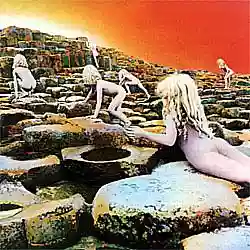
With these thoughts, the band returned to the studio in the early months of 1972 for the recording of "Houses Of The Holy", whose release scheduled for the end of the year was postponed to early 1973 due to issues that arose during the making of the cover. Indeed, right from the first track of the album, "The Song Remains The Same", you can feel that something has changed in Led's sound: no longer raw and dirty, but clean and crystalline. The song is sparkling, and Page initially wrote it as an instrumental; Plant would add the lyrics only at the last moment. "The Song Remains The Same" is built on an exceptional rhythmic fabric, which Page embellishes with continuous guitar overdubs, both 12 and 6-strings, giving brightness to the track. This is also thanks to a magnificent Jones in great shape, and a truly remarkable vocal performance by Plant. After this dazzling start, we arrive at the acoustic "The Rain Song", a masterpiece. The sweet melody paired with Jones' subtle mellotron and Plant's delicate singing is torn towards the end by a tempo shift that makes it a slightly more lively rock before returning it to its original form. We then arrive at "Over The Hills And Far Away", a track opened by Page's irresistible acoustic riff that then flows into the electric chorus. The song has a truly exceptional rhythm section, a testament to the solid rhythmic bond between Jones and Bonham, and is a cheerful and sunny track, which makes it even more enjoyable. After this brilliant episode, we reach "The Crunge", a fun track characterized by Page's funky riff, which continues to enter and exit from the rhythm played by Bonham, making the piece non-danceable. We proceed with the joyful "Dancing Days", which testifies to the band's particularly happy period. It is a track that once again finds its backbone in Page's guitar, but, despite everything, remains a minor episode in Led's discography. The playful atmosphere continues with the negligible "D'Yer Mak'er", a fun parody of reggae, whose title is a play on words between the resemblance of "Da ye make her" and "Jamaica". After this track comes the masterpiece of "Houses Of The Holy": "No Quarter". Here, Plant's filtered voice, Jones' keyboards, and Page's menacing riff give the piece tension, drama, mystery, and intensity, enveloping it in an unsettling fog. The dark and mysterious plot leads to the middle section of the track in a beautifully interpreted jazz solo by Page. The protagonist, as well as the main author of the piece, is however Jones with his keyboard. "No Quarter" indeed will become his showcase in live performances, just like "Dazed & Confused" was for Page and "Moby Dick" for Bonham. After this epic track, we return to a more upbeat conclusion with "The Ocean", a fine, decisive rock centered once again on Page's efficient riff, and the title is a metaphor for the ocean of heads of fans that the Led would find at their concerts.
The record was released on March 28, 1973, and it conquered the first position in both the US and UK charts, but was literally slammed by the critics, which deeply embittered the band, especially Page. "Houses Of The Holy" needs to be re-evaluated because it is truly a great album, but such re-evaluation has not yet fully occurred. It is the so-called transition album that sees the Led in search of something new: songs with more complex and less direct rhythmic structures, bright and clean sounds, less blues and hard-rock. "Houses Of The Holy" inaugurates the brightest period of the Led: that of their popularity, which in the following three years will reach the highest point, of artistic maturity and reflections on an uncertain future.
Loading comments slowly
Summary by Bot
Led Zeppelin's fifth album, Houses Of The Holy, represents a significant evolution from their earlier work. It features cleaner, brighter sounds and more complex rhythms. Standout tracks like 'The Song Remains The Same' and 'No Quarter' highlight the band's artistic maturity. Though initially criticized by some, the album has grown to be appreciated as a pivotal transition in their career. It marks the start of their most popular and creatively rich period.Tracklist Lyrics Videos
Led Zeppelin
Led Zeppelin were an English rock band formed in 1968 by Jimmy Page with Robert Plant, John Paul Jones and John Bonham. They became one of the most influential rock groups of the late 1960s and 1970s; the band disbanded after John Bonham's death in 1980.109 Reviews
Other reviews
By Antonino91
"Houses Of The Holy is none of that. It is more, much more, more. This album was underrated, and perhaps someone wanted it to be judged better."
"No Quarter, undoubtedly a milestone...Power and refined creativity characterize both 'No Quarter' and 'The Ocean.'"
By killrockstar76
"Houses of the Holy, for me, is certainly not a lesser album."
"No Quarter, a marvel that should instantly... drive you to recover it, buy it, steal it, listen to it!!!!"
By claudio carpentieri
The opening of the work is a complex activity of instrumental coordination with Page’s layered guitars and Bonham’s hard-hitting style taking center stage.
"No Quarter" offers seven minutes of immense auditory pleasure and showcases Page’s memorable finishing activity with a crystalline sound.
By Rax
The delusion of omnipotence and the desire for novelty result in the fourth-rate funk of "The Crunge" and the insipid reggae of "D’yer Maker."
"No Quarter" is saved, a delightful masterpiece of psychedelic blues, which in this genre even surpasses "Dazed and Confused."
