
 •
Rating:
•
Rating:
THE REVIEW
One of the most exhilarating musical inventions that Led Zeppelin have left for posterity is a certain stylistic approach definable as heavy folk. The combination of the pastoral moods of guitarist Jimmy Page, who was very interested in North American but especially British folk music, particularly through the harmonic possibilities offered by the so-called open tunings on the guitar, met with the skill of the multi-instrumentalist John Paul Jones (also) on the mandolin. All of this was then energized and made heavy, precisely heavy, by the constant full-force drumming and cymbals of John Bonham, pounding away with feeling, and the ability of singer Robert Plant to instantly transition from a quiet, intimate tone to a powerful, dramatic cry, with a corresponding obligatory leap to the higher octave.
Thus, in the long list of the quartet's masterpieces, several songs can be classified in this realm: for example, "Ramble On" from the second album, with its lovely verses and killer choruses, or "The Battle of Evermore" from their fourth work, with the duet between the nightingale voice of folk queen Sandy Denny and Plant's unstoppable siren. Also, the immediately following "Stairway to Heaven," playing on an enormously long and continuous crescendo from the quietest intimacy to the most muscular and dramatic hard rock.
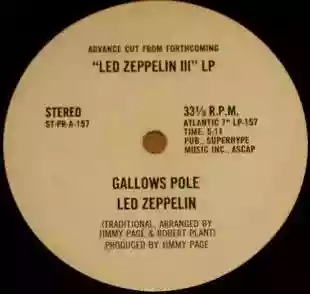
Among these electroacoustic magnificences, "Gallows Pole" does not suffer in comparison, which the group decided to immortalize on their third career album. Page had picked it from an American record, but the song's origin is lost in the past centuries and the mists of Anglo-Saxon lands... a traditional tune telling the story of a guy pleading with his executioner to spare him by bribing him with gifts, gold, silver, and more, brought by his relatives. The affair, at least in this Zeppelin version, ends badly because, despite the gifts, the unfortunate still gets a noose around his neck.
The three musicians of the group organize a continuous crescendo throughout the five-minute duration of the piece, accelerating considerably (from about 82 to 107 beats per minute) and adding instruments as it progresses. Page starts alone, with a very effected twelve-string guitar upon which Plant's stunning voice lays its first invocations; by the time of the first chorus and the first screams of the singer, the rhythm takes a definite leap forward, and a beautiful mandolin enters to double and enrich the vocal melody. Additionally, a second acoustic guitar, this time a six-string, thickens the groove on the opposite channel of the twelve-string.
A few bars later, Jones's bass arrives, as usual, dark, warm, and full-bodied, for a second verse already beautiful, frenetic, and urgent. We're already in a folk atmosphere heavily leaning towards rock, but a few more bars are enough, and John Bonham's powerful attack arrives, with an unparalleled and unsustainable fullness and physicality. Accompanied by a frenzied banjo (Page) that seems to tighten the noose, taking air, time, and life from the music and the protagonist of the lyrics.
Plant is now at a fever pitch, but the rhythm accelerates again. He doesn't stop fighting against the hangman wanting to execute him or against the sublime clatter of Bonzo, the bombastic thump of the bass, and the masculine clattering of the acoustic instruments. To which is added, in full bloom, a psychedelic electric guitar improvisation and a strange little choir "Eeeeappah," or something similar, by Page and Bonham, inserted on one last available track of the mixer (those were eight-track times...). The running train keeps pressing on like this for a good minute before a merciful fade-out starts, with the divine chaos receding progressively, not before showcasing a terrifying, definitive yell from Plant.
What a blast! Hard rock with the mandolin and banjo, but with someone like Bonham in the engine room and the power of the young Plant, it could be done. Kudos to them.
Loading comments slowly
Summary by Bot
The review praises Led Zeppelin's Gallows Pole as a stellar example of their heavy folk style, combining traditional folk roots with powerful hard rock energy. It highlights the evolving musical layers, tempo acceleration, and dynamic performances by Page, Jones, Bonham, and Plant. The song is celebrated for its intense buildup and emotional delivery, standing alongside other iconic Zeppelin works.Tracklist Lyrics
Led Zeppelin
Led Zeppelin were an English rock band formed in 1968 by Jimmy Page with Robert Plant, John Paul Jones and John Bonham. They became one of the most influential rock groups of the late 1960s and 1970s; the band disbanded after John Bonham's death in 1980.109 Reviews
