
 •
Rating:
•
Rating:
THE REVIEW
Introduction:
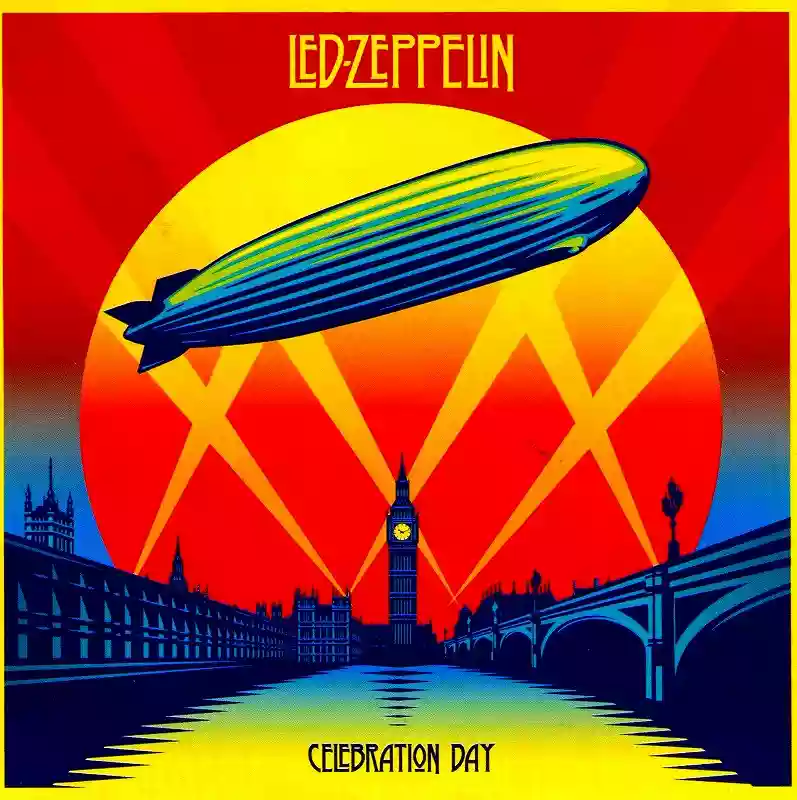
It couldn't have been done better. The three glorious surviving old-timers and the mature son of the late drum leader of the Dirigible prepared well and performed as best as possible in this una tantum reentry held over ten years ago at London's O2 Arena. This, taking into account the deteriorated vocal cords of the then 59-year-old Plant, Page's moderate arthritis at almost 64, the human unreachability of father John for the still explosive Jason Bonham who at that time had crossed 41, and… that's it, because in the case of the nearly 62-year-old Jones of that period, no ailment or decadence can be highlighted.
Context:
Ameth Erthegun, the boss of the Atlantic record label who instantly believed in them in 1968 and made their fortune, had passed away the previous year: dedicating a tribute concert to him was, therefore, a good, excellent reason for such a challenging and significant reunion. In the past, the band had made a couple of (patchy) exceptions to the break they had wisely imposed on themselves after the unfortunate death of Bonham, and always in favor of exceptional events (the American megaconcert of Live Aid in 1985, the fortieth anniversary of the Atlantic label in 1988), but on this occasion, the noble desire to celebrate an important and esteemed person was adequately accompanied by conviction, sound, power, concentration, organization, a state of form suitable for the immense quality of the repertoire to be proposed again.
Strengths and weaknesses:
The Led Zeppelin sound that emanates from the powerful amplification system is the same, unchanged over time, superb: deep bass, pounding drums, guitar neither too clean nor too distorted, far from precise at the risk of being lifeless, but not uncertain. Page's guitar is… too right: this musician has always had the perfect style, sound, and soul for the music he intended to create in his fruitful youthful years. Endowed with good but not transcendental technique, with agility within the professional norm, what made him immensely peculiar is that mix of priceless sense of the piece and its arrangement dynamics. He is truly a guitarist-producer, self-producing as he plays, managing to be spontaneous while having everything under control: a born talent.
In excellent form then, this over-sixty Page, back to being slim and therefore at his ideal weight, even though no longer with the agility of youth that allowed him contortionist moves on stage obviously, after several years spent overweight (see the end-of-millennium concerts with the Black Crowes for reference). Without too many frills, he maneuvers his Gibsons, Gretsch for slide technique, Danelectro for the odd tuning needed for "Kashmir," playing everything there is to play, maybe a shred less pyrotechnic than before but always penetrating and effective.
John Paul Jones, as already mentioned, has not lost an ounce of musical exquisiteness with age. Like all great players, he has aged far better, and less, than the leading figures enjoying his services: zero show, a thousand substance; his bass lines and keyboards are impeccable and foundational.
Jason Bonham is a great hard rock drummer, although there are many others as good as him. Tested here in the concert of a lifetime in his mythical father's shoes, lost at the age of only twelve, he manages as best as possible, slapping his kit as if there were no tomorrow (and indeed there won't be, as this kermesse is a una tantum), having meticulously prepared what must be played, i.e., his father's exact parts, which he knows and plays since childhood. In the end, he makes a great figure and the audience gives him a big hand too, well-toned after more than two hours of major maneuvers at the Dirigible's heavy artillery.
The evident weak point of the record is the already mentioned frazzled, depowered, falsetto-lacking voice of Plant. Indispensable to the cause, namely the focal issue that such production should still be credited to Led Zeppelin, the old lion expertly navigates through the challenging vocal parts he had conceived in his youth, often resorting to lower keys, at times removing himself quickly from a high note instead of pushing it all the way, occasionally forcing the band to lower a song's original key, sometimes having the enraptured audience sing… in short, managing to save the day with his irreplaceable contribution. But it's a fact that he can no longer sing his decades-old repertoire.
We are at the end of our tether, or rather at the point of the café ammazza, he like so many other great rock screamers of the past, like Daltrey, Gillan… but clearly, better this half-service Plant than any other frontman at full strength and vocal extension. It is certain, indeed, that among the many peculiarities of the Dirigible, the style and vocal timbre are among the most important and fundamental, and the forced absence of father Bonham already digs an enormous hole, an abyss… Hence, at least in his case, the original vocalist's presence, equally indispensable, is preserved. Unfortunately, his vocal cords can no longer astonishingly push songs from the repertoire upward and forward. Still, at least they characterize them, making them instantly plausible, credible, enjoyable, Zeppelin-like. The youthful breath may be gone, but the distinctive style remains, always priceless.
Highlights of the album:
On the heady blows of the still young and vigorous family drummer, also an alcoholic like his father but… redeemed for his own good and health, a savory slice of the celebrated Zeppelin repertoire (sixteen songs, drawn from the just under a hundred of their career) is unfolded for one last live pass for the joy of the twenty-thousand attendees, and then for all of us listening to this double album.
The choice of "Good Times Bad Times" as the prologue comes as an immediate surprise. The first song of the first album, sure, so a sort of historical homage… The fact is that it was very soon abandoned by the group in live setlists, just after the release of the second album, which expanded and wonderfully elevated the repertoire with spectacular and alluring episodes. The rendition of this Zeppelin page at the O2 Arena is… correct: it's the first track, and the four musicians need to acclimate and warm up; the episode certainly is not among the night's most successful, but its emblematic and unexpected retrieval makes it symbolically important.
A quite similar narrative for the second track "Ramble On," for my money, among the career's brightest gems despite a constant, inexplicable sidelining in the band's concert history. That long, articulated bass line, that lingering and quiet clattering of guitars in the verses' full range, then turning up the volume to slam with power chords in the choruses (with the bass still magnificently pulling the cart with unparalleled punch and creativity), are, in my view, one of the absolute peaks of our band in terms of dynamics, personality, frothy supremacy. A pleasure to grasp this belated, conclusive live homage to this pearl, inevitably welcome and exhilarating to the max.
"In My Time of Dying" is lethal. Plant navigates it well, being part of the less shouty second career phase, and he performs it with his usual flair while the spotlights focus mainly on Page's dragged-out, dusty slide guitar performance on a magnificent white Gretsch White Falcon. The trio's performance in the extended, sparkling instrumental phase is invaluable: led by the very attentive and precise Bonham wrestling with many odd bars written in the score, the trio unearths the entire sequence of piercing and tremendously energetic riffs, which stretch this number to its usual near-twelve-minute duration, all well-deserved.
"Nobody’s Fault But Mine" is another challenging number but superbly suitable for live performance, with all its stop&gos marked by a more-than-ever protagonist drum. Here, Jimmy's art of bending time to his will and testing himself and his bandmates on a hard rock execution that needs to remain smooth, spirited, and determined amidst a thousand rhythmic oddities, is at its peak. The four old-timers do not falter and, well-prepared and warm, fire off these nearly seven minutes of this convoluted heavy blues without hesitation.
"Kashmir" is a war machine, probably the night's highlight. At a certain point, the implacable drum thuds, the enchanting staccato clattering of the Danelectro, the inflated synthesizer fanfares, the oriental and serpentine vocal melody create an impression of unmatched prestige, inexorability, and arrogance. It’s rock at its best: thunderous and insinuating, unsettling and satisfying.
The rest:
"Black Dog" suffers a bit in comparison to the original on the fourth studio album, lacking Plant's piercing and sharp voices, the chromatic richness of the studio arrangement.
"For Your Life" is a minor episode of "Presence" and the Zeppelin catalog, and remains so here. A debatable choice, as "Nobody’s…" already represents their sixth album, among others.
"Trampled Underfoot" is excellent, nothing to say. Page's performance is commendable, considering how all that funky hard clattering is quite… exhausting at his age.
"No Quarter" is… interminable, as well as admirable. It’s John Paul Jones' moment, as well as the celebration of the Zepps' dark side, the Fender Rhodes electric piano sound (here reproduced by a synthesizer), Page’s skillful swing on the electric guitar this time set to less abrasive and potent sounds.
"Since I've Been Loving You" is THE blues par excellence. There is nothing better in the world in the field of slow and atmospheric blues. However, the supreme performance on Led Zeppelin III is unapproachable, not only because of Plant’s means, who gets away with it remaining quite buttoned-up even in the otherwise dramatic and haunted last verse but also due to John's cannon shots that no other drum and cymbal hitter can replicate, including his son Jason.
"Dazed and Confused" is too right… maintained as is for the occasion at thirteen minutes, the ideal length. It's no longer the time to "stretch" it to over twenty-six, as happened in 1973 with the album "The Song Remains the Same," nor to forty as it happened on the most inspired and self-indulgent nights. Page doesn't overuse the violin bow, the central instrumental and choral part is still lush and captivating.
"Stairway to Heaven" is that, what can be said. Here, too, the studio-built version in 1970 is in the Empyrean, unreachable with its different guitars, the fabulous and exquisite footwork of John Bonham, the young Plant's voice strength. Not even in the golden years did the Zepps manage to improve it live, after all.
In the immediately following "The Song Remains the Same," Page slings over the mythical double-neck Gibson and unfolds the twelve-string tour de force that characterizes the song. When it's Plant's turn to sing, the feeling of inadequacy remains: this number should've stayed instrumental, the opening fanfare to the fifth album… Page shouldn’t have let his singer win! It's the least successful moment of the night.
"Misty Mountain Hop" is quite extensive compared to the original which opened the second side of the epoch-making Zoso, Untitled… or whatever the hell they called their fourth album. Beautiful, but I would have preferred another selection from the prolific list of the quartet’s masterpieces.
Here… the era rock’n’roll inserts further extending the historic "Whole Lotta Love" have never been my favorite. I think the band considered them to "stretch the broth" when the repertoire was still limited, but then never stopped including them. In my opinion, it was a mistake: "Whole…" is an unmatched shard of psychedelic hard rock, four minutes launched into the cosmos without taking a breath, without prisoners, with the most instinctive and inane text of all time, but who cares. In this occasion, the rendition of the song still lasts the usual many, too many minutes (nine), and, in my view, the middle variations dilute that dangerous, testosteronic, urgent, aggressive aura of this unparalleled rock beauty marked 1969. Amen.
"Rock’n’Roll" is the second and final encore after "…Lotta Love," and that's just right, certain songs are meant to open or close, not to be in the middle. Here Page is great and hops between the many guitar parts crafted and recorded in the studio original, ensuring plenty of instrumental fullness and “punch.” A nice goodbye… and if they had wanted to go on that night, people wouldn't have moved an inch even at the tenth encore, oh well.
Final Judgment:
Almost 120 minutes of Zeppelin music, for the last time captured in concert. It must, by necessity, be placed among the best live legacies of the British supergroup, certainly the best in terms of sound and recording (we're in 2008, and technology has advanced compared to the group’s seventies season). On the other hand, it cannot rival "cousins" like "How the West Was Won" (2003 album, recordings dating from 1972) and "BBC Sessions" (1997, recordings from 1969 to 1975), mainly because there the young Plant pumped like a siren, without restraints, liberating (and squandering, in a few years) the vocal cords beyond every limit. And then John Bonham was in the engine room, the rhythm machine every rock bassist and guitarist dream of being accompanied by.
Top marks, of course. There's also the film, the DVD, whatever you want to enjoy the event.
I was compelled to write these things by the only review on the subject already present on the site, exceedingly foolish, disrespectful, and ignorant.
Loading comments slowly
Summary by Bot
This review praises Led Zeppelin's Celebration Day live album as a powerful, well-prepared reunion concert. Despite vocal limitations from Robert Plant and the absence of John Bonham, the surviving members deliver a strong performance with excellent musicianship and sound quality. Key songs like "Kashmir" and "In My Time of Dying" stand out. The album holds an important place in the band's live legacy, even if it cannot fully match earlier concerts.Tracklist Lyrics
04 Nobody's Fault But Mine (00:00)
10 In My Time of Dying (11:10)
12 Nobody’s Fault but Mine (06:43)
14 The Song Remains the Same (00:00)
15 In My Time of Dying (00:00)
21 The Song Remains the Same (05:46)
22 Good Times Bad Times (00:00)
26 Since I’ve Been Loving You (07:52)
30 Good Times Bad Times (03:11)
31 Since I've Been Loving You (00:00)
Led Zeppelin
Led Zeppelin were an English rock band formed in 1968 by Jimmy Page with Robert Plant, John Paul Jones and John Bonham. They became one of the most influential rock groups of the late 1960s and 1970s; the band disbanded after John Bonham's death in 1980.109 Reviews
Other reviews
By jonny testicolo
This record is beautiful, a practically perfect concert without any hitch.
Robert Plant confirms himself a true vocal ace, reproducing all the songs in the same exact original keys and with a vocal tone that in maturity has even improved.
