 •
Rating:
•
Rating: THE REVIEW
No other musical entity has managed over the years to capture the attention of two worlds as distant and, in some ways, opposite, as dark and metal. As proof of this cross-success, just consider how often one encounters (whether at a Cure concert or a Mayhem concert, it doesn't matter, and that's the beauty of it!) the black T-shirts of Lacrimosa, stamped with Stelio Diamantopoulos's famous clown face and the band's logo, that very "Lacrimosa," arranged in an arc, emerging from the clown's hands as if it were magic, a conjuring trick, or simply a stage trick. And just like an illusionist, Tilo Wolff, a German author who later relocated to Switzerland, has managed to craft a significant artistic experience, which has proven capable of winning over large swathes of the public, enchanting anyone sensitive to the allure of the decadent and sensual atmospheres which he has championed over the years, in various forms, like few others in recent history.
Melancholy, theatricality, romance: these seem to be the pillars of Tilo Wolff's art, a visionary talent and tortured soul, whose androgynous figure makes him the most worthy heir of the mythical Bowie of the early seventies. And like the White Duke, Tilo Wolff's journey is one of continuous evolution: born as a one-man band, the Lacrimosa project debuted in the music market with albums like "Angst" and "Einsamkeit," frescoes of unusual anguish and desolation, which stylistically are strongly rooted in the electronic suggestions of a dark/industrial sound. These works will form the base upon which to graft ever-new elements, and with the help of various musicians, and even a choir and an orchestra, the grandiosity obsessions of the Frankfurt artist will lead to the symphonic metal that will characterize the band's artistic maturity phase.
"Inferno", which in my opinion stands as the band's unsurpassed masterpiece, not only marks the definitive embrace of the metallic universe, hinted at by the good "Satura." "Inferno" also, and above all, celebrates the entry of Anne Nurmi, the female alter ego of Wolff, into the formation. It is indeed during the "Satura" tour that Tilo Wolff, while attending a live performance of the Finnish band "Two Witches" (supporting Lacrimosa themselves), is utterly struck by the compelling charisma of their singer-keyboardist. His efforts to involve the girl in his project will be rewarded, and thus, by virtue of a deep artistic affinity, the collaboration finally takes place, the prelude EP "Schakal" is released, and Lacrimosa effectively becomes a duo.
With "Inferno" the lineup further expands to Jan Yrlund, Jan P. Genkel, and AC (former drummer of the Teutonic power metallers Running Wild!!!), who, despite only taking up session roles and not participating in the writing of the music, will have a significant impact on the direction taken by the band: in 1995, the year of the album's release, Lacrimosa is no longer a dark band, but plays metal in every respect, complete with heavy guitars, a bastard bass, and pounding drums, riding the wave of success of bands like My Dying Bride and Paradise Lost. But Tilo Wolff's decadent and visionary soul remains unique and unmistakable, and the link to a distant past is tangible and clearly evident, demonstrating a strong personality and a well-defined poetic vision: the circus atmospheres, the theatricality, the distinct melodic sensitivity, the dismal visions, here enriched by Nurmi's beautiful voice (somewhere between Jarboe and Siouxsie) and the symphonic layers she crafts, make this "Inferno" a matchless jewel of elegance and poignant melancholy.
Long compositions follow one another, more or less steady at medium tempos, all with the aim of painting a world of solitude, lost love, and pain, but without ever overwhelming the listener, since the excessive heaviness linked to the themes and moods of the album is alleviated by an extraordinary imaginative composition, the care and sophistication of the arrangements, and the skill of the musicians involved. The sound of the new Lacrimosa is no longer the sparse and essential one that characterized the early works: the band’s current sound is imposing and elegant like a Gothic cathedral, oppressive at times, but also majestic and full of evocative atmospheres. Among powerful guitar riffs, grand orchestrations, and poignant piano scores, not forgetting a stroke of cello here and there that always sets the atmosphere, the standout is, of course, Tilo Wolff's characteristic voice, acidic and graceless, at times grotesque, supported by his harsh German, which one may not even like, but which over time has become, whether one likes it or not, a distinctive feature of the band, without which we couldn't imagine Lacrimosa's music today. But Anne Nurmi's orchestrations will also become a strength of the band, while, vocally, the charismatic singer will limit herself to refining Tilo's ossianic laments, still carving out a leading role in the beautiful "No Blind Eyes Can See".
As for the individual tracks, saying they are simply beautiful is an understatement. The brilliance of the songwriting, the always complex structure architecture (at least compared to the genre's standards), the number of technical solutions, and the interpretative intensity make each track a little masterpiece, and although they are part of a single emotional flow, each composition effectively shines with its own light, and it's no coincidence that almost all the tracks contained here will become band classics: "Kabinett der Sinne", "Versiegelt Glanzumstromt", "Schakal" (perhaps the best track written by Lacrimosa), and "Vermachtnis der Sonne" will remain in the live performance setlist for a long time. The symphonic intro that preludes the work will become the famous "Lacrimosa theme" destined to open the concerts, while the captivating "Copycat" (between post-punk, dark, and power metal!) is the Lacrimosa classic of classics, always called to close live shows and to constantly feature in the dance nights of any self-respecting gothic club.
The adventure of Tilo Wolff and Anne Nurmi will continue in the wake of what was achieved in this "Inferno", which will become the new standard for the future, with works increasingly refined and better packaged: "Stille", "Elodia", "Fassade", impeccably formal works, will gradually exasperate the symphonic component, until in "Echos" the electro-dark sounds of the early days will be revisited in light of the experiential baggage meanwhile accumulated (of the latest "Lichtgestalt," which I never had the pleasure of listening to, I can’t tell you anything, and to be honest I have no clear idea if the band has disbanded or not, since it's been a while since I last heard anything about them).
Tilo Wolff, increasingly a classical composer, will become a sort of Renato Zero of the Dead and his music, increasingly a victim of his overwhelming egocentrism, will suffer from redundancy, mannerism, and excessive self-complacency. While the quality level remains more than good, it is in this "Inferno", in my opinion, that, even with its imperfections and improvable aspects (which will indeed be improved by the excellent successors), the duo seems to reach the perfect balance, offering us their best fruits.
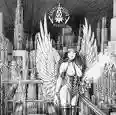
P.S. all those wondering where Stelio Diamantopoulos's clown has gone (the cover is gallantly dedicated to the dark angel representing the new-entry Anne Nurmi) can rest assured: just observe the extension of the cover in the inner booklet and we find him sprawled on the ledge of a skyscraper playing his violin unflinchingly...
Loading comments slowly
Summary by Bot
Lacrimosa's album Inferno marks a pivotal moment, blending symphonic metal with dark, theatrical, and melancholic tones. The addition of Anne Nurmi enriches the band's sound, creating an elegant and majestic musical experience. Each track stands out as a masterpiece, showcasing sophisticated arrangements and emotional intensity. The album is praised as Lacrimosa's peak work, defining their artistic identity and setting high standards for their future releases.Tracklist Lyrics Videos
Lacrimosa
Lacrimosa is a Swiss-based gothic/darkwave act founded in 1990 by German musician Tilo Wolff. Mid-1990s, Finnish artist Anne Nurmi joined, cementing a duo that blends darkwave and gothic rock with classical, orchestral, and later metal elements.06 Reviews
