
 •
Rating:
•
Rating:
THE REVIEW
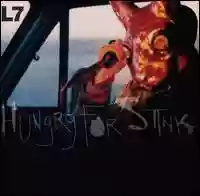
When I hear about L7, I instantly think of "Bricks Are Heavy," unanimously regarded as the best album ever by the Los Angeles quartet. "Pretend We're Dead" is a heavy burden, and matching the success of the album from which it is drawn is no simple task. Therefore, "Hungry For Stink", the direct successor to "Bricks Are Heavy," will always and unjustly remain in the background, classifying as L7's most underrated work.
While staying faithfully anchored to the band's heavy sound, "Hungry For Stink" offers new sounds and new musical grips, forging an original style compared to their foxcore colleagues (and slightly departing from the Plasmatics/Runaways model). The (arduous) task of opening the album is entrusted to "Andres": it kicks off immediately with a grim and powerful riff, introducing the deep and almost masculine vocals of Donita Sparks. The girls do not lose sight of the punk/metal mold that has always distinguished them. Nevertheless, "Andres" ranks among the peaks of their production and is worthy of the masterpiece "Bricks Are Heavy".
"Baggage" is the second track, a grunge that repeatedly winks at metal, mainly in the guitar riffs. The vocal style is among the most visceral adopted in foxcore (alongside Courtney Love's early work with Hole and the more capable Kat Bjelland).
In "Can I Run", we return to the atmosphere of "Bricks Are Heavy," and more precisely to that of the classic "Pretend We're Dead," to which it is similar for its irresistible melodies and certain guitar attitudes. L7 fused a definitive personal sound, hardly imitable by the riot grrrls who would follow them.
"The Bomb" is the angriest, thus referring to the band's first self-titled album, also for some vocal and guitar tensions. On a superficial listen, it might seem punk, but it's not fast enough, so it can be better defined as a fine grunge/metal for certain melodic aspects. In short, a decidedly tense piece that quite involves for the tribal rhythms of the drums. One of the few boring points of the album is represented by "Questioning My Sanity", which seems to me an outtake from the aforementioned debut. However, Sparks and Gardner's guitar work is infinitely more mature than the style of "L7" and is executed masterfully.
Interesting experimentalism is noted in the punk of "Riding With A Movie Star", as evidenced by the use of keyboards and the "Egyptian" guitar solo, without losing sight of the grunge component. The piece is decidedly cosmopolitan, especially due to the use of African percussion and the general atmosphere that vaguely recalls "Walk Like An Egyptian" by the Bangles (devoid, naturally, of a certain heavy attitude).
"Stuck Here Again" is a track with a blues-like feel, softer tones compared to the rest of the album, and reveals itself to be a particularly relaxed (so to speak) and different moment on the sonic level. The lyrics, however, feature seemingly nonsensical wordplays (I'm good at feeling bad/ I'm even better at feeling worse), conveying a sense of loneliness-boredom-pain.
The best episode of the album in my opinion is "Fuel My Fire", composed by Donita Sparks with the collaboration of the Cosmic Psychos, a rock group active since the Eighties that greatly influenced Seattle grunge artists, especially Mudhoney and Pearl Jam. If it weren't sung by a woman, "Fuel My Fire" could actually be easily mistaken for any Mudhoney track (with all due respect to Mark Arm and his associates!), perhaps the only flaw is indeed that it feels familiar.
Rhythm and lead guitar intertwine perfectly in "Freak Magnet", creating unforgettable riffs and solos. Sparks' vocal fury is uncontainable, Scaruffi compares it to that of Hope Nicholls of Fetchin Bones, an ante-litteram riot grrrl with a stratospheric voice; I feel this comparison is very fitting. "She Has Eyes" and "Shirley" flow pleasantly: the former, like all of Jennifer Finch's compositions, is the most pop moment, owing to the soft and never harsh singing, unlike the outbursts of Donita Sparks and Suzi Gardner, yet it remains above average; the latter is a powerful hard rock in pure L7 style, with vocals as sharp as blades and essential, hammering drums.
An additional proof of the effective value of "Hungry For Stink" is "Talk Box", a real journey through noise and psychedelia, all guided by Sparks' dreamlike voice and a tortured solo. More than one critic found the influence of Grace Slick, a statement I do not fully agree with. The track remains, however, a magnificently melancholic and latently angry conclusion.
I would be tempted to give this album five stars, but "Bricks Are Heavy" continues to pulse in my head: it's hard to forget.
Loading comments slowly
Summary by Bot
Hungry for Stink, L7's follow-up to their acclaimed Bricks Are Heavy, is an underrated gem combining heavy grunge and punk elements with fresh experimentation. Tracks like "Andres" and "Fuel My Fire" highlight Donita Sparks' powerful vocals and mature guitar work. While it doesn't eclipse its predecessor, the album carves a distinct, personal sound in the 90s rock scene. Its varied styles range from bluesy moments to psychedelic noise, making it a compelling listen for fans of intense, authentic rock.Tracklist Lyrics Videos
L7
L7 are an American rock band formed in Los Angeles in 1985 by Donita Sparks and Suzi Gardner, joined by Jennifer Finch and Demetra “Dee” Plakas. They fuse grunge, punk, and hard rock, scoring a breakthrough with 1992’s Bricks Are Heavy and the anthem Pretend We’re Dead. After a 2001 hiatus they reunited in 2014 and released Scatter the Rats in 2019. The group is also known for activism, including Rock for Choice.06 Reviews
