
• Rating:
THE REVIEW
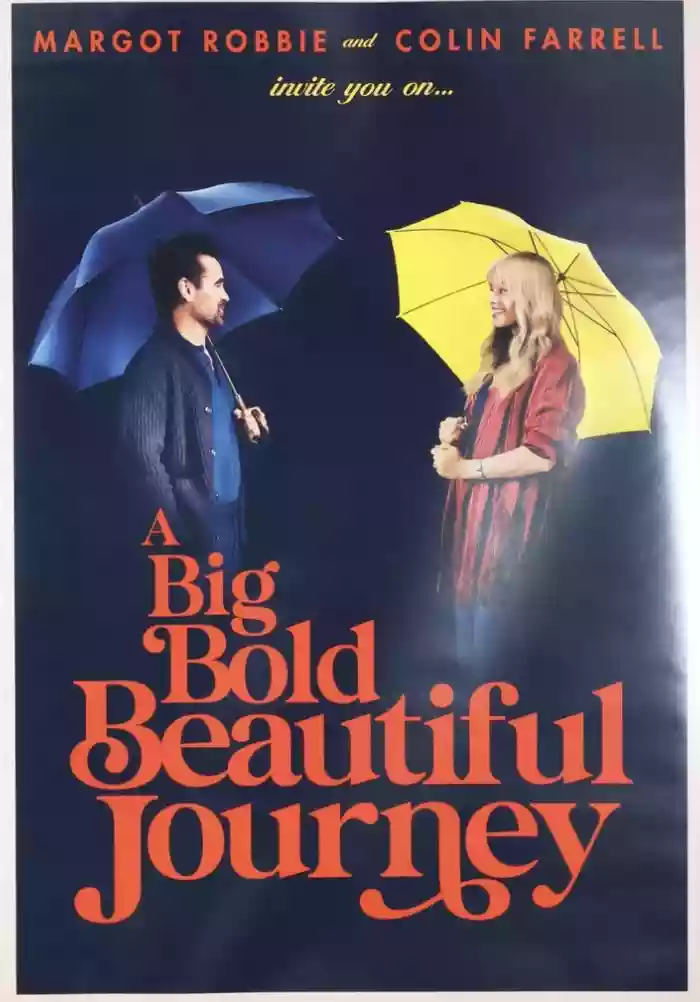
Sarah and David—two people clearly not made for each other—are awkwardly pushed together by a pair of insufferable car-rental “magic” employees. Does it sound silly? Because it is.
A Big Bold Beautiful Journey is the kind of contemporary film that explains, better than any industry report, why audiences are quietly abandoning cinemas. On paper, it looks almost daring: a heterosexual love story (already treated like a niche genre), wrapped in a vaguely surreal, sci-fi premise, and fronted by two attractive, capable A-listers (Colin Farrell and Margot Robbie). A calculated attempt to lure a middle-aged audience. The result? A misfire on every level.
There are three main problems here—two obvious, one more insidious:
- The smug dialogue
- The fake resolution device
- The ambiguous female character
The opening scene is already a warning. Phoebe Waller-Bridge machine-guns absurd lines about how to open a door—yes, really—delivered at breakneck speed, soaked in unnecessary profanity. It doesn’t read as edgy or clever. It’s pure performance of intelligence: frantic, self-satisfied, and faintly ridiculous. If anyone was still in the cinema after that, they were either very patient or already asleep. The problem persists throughout. Dialogue has been replaced by positioning, because the characters aren’t people—they’re templates. Sarah is the “fiercely independent woman.” David is the man who wants marriage and children. They don’t evolve; they simply occupy their assigned ideological slots and are expected to “connect” because the script insists they must.
The central narrative device—revisiting the past through magical doors to understand why they’re single—is equally hollow. The episodes, whether remembered or not, reveal very little. Nothing significant is discovered, nothing meaningfully reframed. The exercise feels redundant from the outset. Sometimes people are single for simple reasons: they’re difficult, abrasive, or fundamentally incompatible with others. No sci-fi contraption required.
The third issue is more subtle, and more telling. The modern female character must be strong, independent, and above all invulnerable. But when flaws are permitted, they are almost invariably sexual, repackaged as empowerment. Looks like the contemporary woman in fiction can be depicted only as the female counterpart of a womaniser. Sarah casually admits to cheating, while simultaneously desiring the safety of a relationship, because the film mistakes incoherence for complexity and hopes no one will notice.
But above all, the film tries hard to sell a love story that has no emotional or psychological foundation. What remains is a collection of scenes masquerading as narrative.
Add to this an aggressively murky visual style—where entire scenes seem to take place in near-darkness—and you’re left with a curious paradox: occasional flashes of striking photography trapped inside a hollow, irritating film.
At that point, one might as well skip the cinema altogether and leaf through a book of landscape photography. At least there, the emptiness would be intentional.
---------------------
Available on Prime
Loading comments slowly
Summary by Bot
The review delivers a scathing critique of A Big Bold Beautiful Journey, calling it hollow and misguided. The reviewer targets its artificial dialogue, uninspired story, and template characters. Visual style is noted but seen as wasted in a film with no real emotional core. The attempted romance is dismissed as unconvincing, and the narrative structure feels contrived. Ultimately, the review argues the film fails on every level.
Kogonada
Kogonada is a South Korean-born American filmmaker and video essayist known for the feature films Columbus (2017) and After Yang (2021), and for directing on the Apple TV+ series Pachinko.01 Reviews
