
 •
Rating:
•
Rating:
THE REVIEW
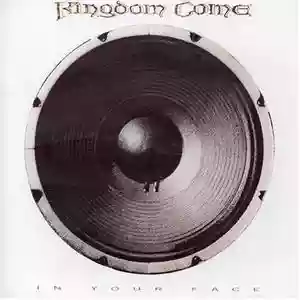
After a scandalously derivative first album (with "Get It On," the leading track, a true assemblage of the riff of "Black Dog" with the exotic progression of "Kashmir"), the Los Angeles-based Kingdom Come adjusted their aim a bit for this second work from 1989, placing the Zeppelin subtly in the background and producing a hard rock still very much in the shadow of the Zeppelin, but at least without directly copying specific instrumental and vocal passages from the invaluable repertoire of Page and company.
Needless to say, this album turned out to be a half-flop, whereas the first one sold very well, projecting them into the big league and arousing envy and justifiable anger from many colleagues. Biblical punishment, therefore, for this quintet that started strong and immediately stalled. A pity, because "In Your Face" is a firm and valid album, Zeppelinesque but no more than many others, with good songwriting, powerful and tube-driven sounds, irresistibly vintage. The rhythm section travels like a hammer, the two guitars maneuver in a simple and effective manner, the leader Lenny Wolf 'plants' somewhat, but ultimately manages to impose a very dramatic and Wagnerian style (he is German). The album begins with the urgent and killer riff of "Do You Like It", upon which drums and bass immediately pounce, giving no respite, until the end. A nice debut, but even better is the following "Who Do You Love", inaugurated by a colossal guitar strum on a fourth chord, upon which an enormous riff and then Lenny’s very high voice are grafted. A mellotron-like keyboard makes everything extremely dramatic, there is a scent of "Kashmir" but with class, variations, intelligence.
The sounds are truly cyclopean and booming (poor Bonzo would surely have said "Hey, let me play it!") for a formally perfect hard rock, certainly not invented by them but what a joy even today to blast it in the ears at a harmful volume. It withstands the test of time well because it’s 100% seventies, greatly produced, noisy but clean, with perfectly fitting sounds. "The Wind" enjoys a fine intro, with a lethal bass loop on the 'four' kick, and then develops in a more collected and lyrical way. Another notable track is "Highway 61", which follows the always spectacular acoustic preamble/electric explosion scheme: a delightful dobro starts, Lenny plays a verse on it and then lets out a skin-crawling scream, as the apocalypse breaks out, big guitars far and wide, galloping rhythms, piercing screams, all very convincing until the calm and the epilogue, once again left to just the dobro. And so it was.
Good old Lenny Wolf has long returned to Germany, he keeps the Kingdom Come project alive with musicians from his country, he deserves credit for a good compositional vein, an Austrian stubbornness, and a voice that Robert Plant had already worn out long ago at his age. Importance and historical role of Kingdom Come? Zero point zero, but if you're looking for a rock blues album (more rock than blues) with guts, without too many frills, with solos well-served to the economy of the tracks, short and sharp, with a voice that cracks, with thunderous drums, with a bass as big as a wardrobe, and if finally, the smell of the Zeppelin doesn't compromise your proper rock enjoyment of all the rest, but rather intensifies it, this stuff goes down smoothly.
Loading comments slowly
Summary by Bot
Kingdom Come's second album, 'In Your Face,' offers a strong hard rock experience heavily influenced by Led Zeppelin but with less direct copying than their debut. Despite being a commercial disappointment, the album highlights solid songwriting, dramatic vocals by Lenny Wolf, and powerful instrumentation. Tracks like 'Do You Like It' and 'Who Do You Love' showcase the band's ability to fuse classic rock elements with their own style. The album stands the test of time with its vintage yet polished sound.Tracklist Lyrics
Kingdom Come
Kingdom Come is a German hard rock band formed in Los Angeles in 1987 by Hamburg-born singer, guitarist, and producer Lenny Wolf. The band’s 1988 debut drew heavy Led Zeppelin comparisons and commercial success, followed by evolving lineups and a long career based from Germany, with later albums incorporating darker, industrial-tinged textures.07 Reviews
