
 •
Rating:
•
Rating:
THE REVIEW
Let me preface by saying that I discovered “the joke that kills” not a long time ago, so I'm new to Jaz Coleman and Geordie Walker.
The listening of their perhaps most famous hit, however, penetrated me at a time when I needed to be carried away by intense emotions and to momentarily distance myself from the problems of everyday reality.
I was unaware that “Love Like Blood” was rightly defined almost as the manifesto of new wave music and of the entire eighties decade, also due to the socio-political matrix that emerges from the lyrics and stands out even more from the stunning videoclip produced. Obviously, with my ears still full of the captivating melody of the aforementioned song, I went in constant search of the works of our protagonists and was truly breathless listening to the angry and decadent eponymous debut, or the mid-80s triad consisting of “Night Time”, “Brighter Than A Thousand Suns” and “Outside The Gate”, absolutely engaging albums above all, perhaps, thanks to the group’s decision, in line with the wave sounds of that time, for a greater incorporation of melody in the musical structures and the consequent significant loss of the acidic and apocalyptic beats of their earlier works.
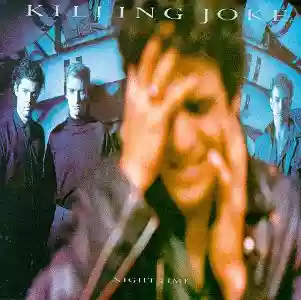
Of the “Eighties”, perhaps, their best episode is precisely the work that contains “Love Like Blood” and, indeed, “Eighties”, another very famous hit, whose guitar riff progression, according to many, was not too subtly usurped by Nirvana’s “Come As You Are”, namely “Night Time”. It would be, however, a grave mistake to absorb the entire album in its two most famous songs, because this “Night Time” is a work that cannot be divided or analyzed piece by piece distinctly. It must be treated and adored as a great work, like when one is dazzled in front of a Renaissance painting or a Gothic cathedral.
This is what “Night Time” is for me, a breach in the darkness (“Darkness Before Dawn”), an hypnotic catharsis (“Kings and Queens”), a scream of liberation (“Tabazan”), an inexorable sensory involvement (“Europe”), a mental stimulus (“Multitudes”). After all, from a genius like Jaz Coleman, nothing but brilliant offspring could come, and his notable influence and that of his creation on myriads of current bands is one of the most evident and irrefutable testimonies.
What else could be expected from someone who literally says:
“I don’t use the phone, I don’t watch television, I still write letters. I don’t belong to this twentieth century, in a certain way. Or maybe it is the century that still has to catch up with me… .”
Well, I would say that the second statement is certainly the most truthful.
Loading comments slowly
Summary by Bot
The reviewer, new to Killing Joke, was deeply moved by 'Love Like Blood' and explored their discography, praising 'Night Time' as an essential and immersive 80s album. The record is celebrated for its blend of melody with intense, socio-political themes, and timeless influence. It’s described as a comprehensive work of art demanding full appreciation beyond its famous hits. Jaz Coleman's unique vision and the band’s impact on future generations are highlighted as key strengths.Tracklist Lyrics Videos
Killing Joke
Killing Joke were an English band formed in London, known for blending post-punk with electronic, tribal rhythms and a harsh, industrial-leaning attack, fronted by vocalist Jaz Coleman and guitarist Geordie Walker.24 Reviews
Other reviews
By RAW
"Night Time is the album of the big leap for Killing Joke: a fundamental band in the rock, post-punk scene from the eighties onwards."
"It is certainly the most accessible (and always original) work of their entire career as well as their greatest commercial success."
By Algeone
Their records from forty years ago still sound contemporary and charming today, convincing us that their motto (Semper Imitatum Numquam Idem) was adopted without presumption.
'Night Time ... was the one that summed it up and made it accessible to a larger audience.'
