
 •
Rating:
•
Rating:
THE REVIEW
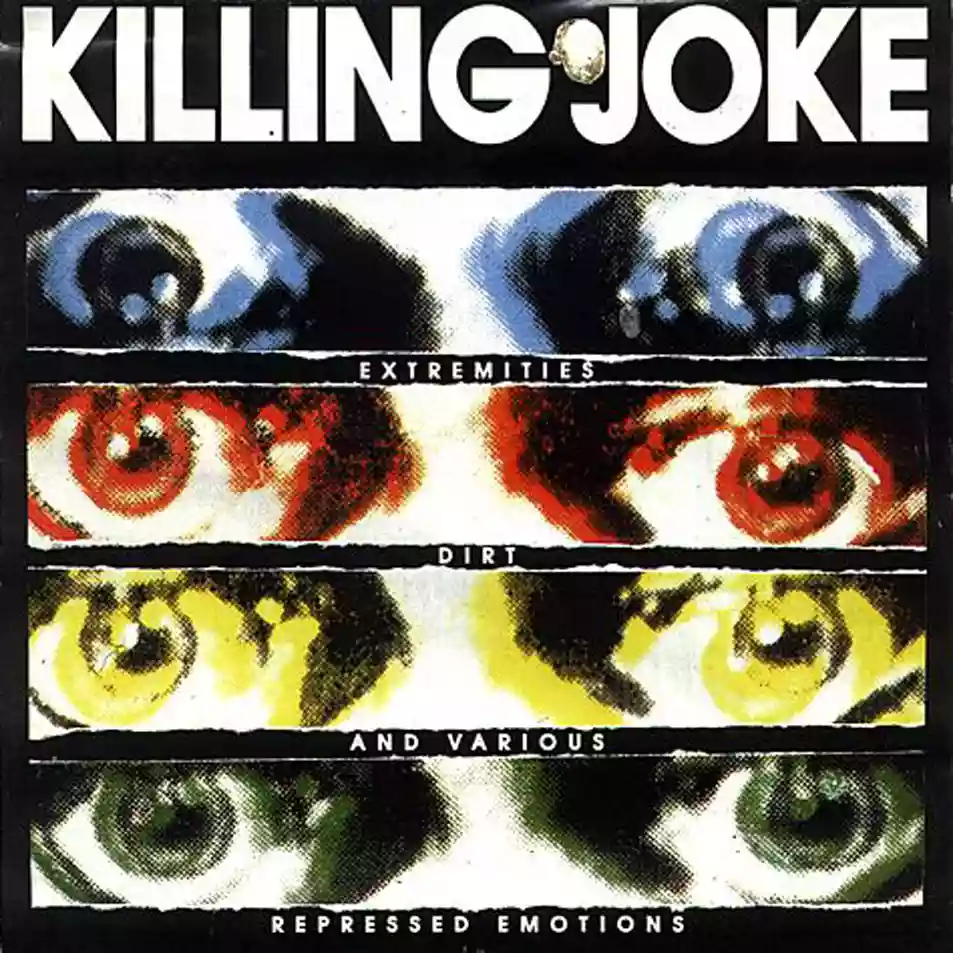
On what Killing Joke has been, on their historical importance, on the peaks reached in the '80s, I think there isn’t much to say and redo, at least on these pages, so I won’t bore you with clichés but will get straight to the point, namely to analyze in detail the production of this extraordinary group during the '90s: a sparse production, summarized in only three albums, often overlooked and forgotten. After "Outside The Gate," the band seemed on the verge of collapse, that album was practically a solo project by Jaz Coleman branded Killing Joke by the record company's will; rumors of a split become increasingly insistent, but no: as if to honor their chosen name, the KJ return to the fray after just two years with this significantly titled album "Extremities, Dirt And Various Other Repressed Emotions."
I’m not exactly sure what happened within the English lineup between 1988 and 1990, but a new spark struck: "Outside The Gate," besides the caustic irony typical of KJ, also incorporated reflective atmospheres; it was a varied, accessible album, rich in influences and very suggestive, with EDAVORE everything changes completely: this album is a monolith, ten songs (plus a short instrumental) that settle on an average length of 5/6 minutes, saturated, heavy, predominantly industrial atmospheres. The tension is palpable, the lyrics critical and corrosive, more than ever prophetic: Jaz Coleman very directly and unequivocally denounces all the aberrations of post-Cold War society and anticulture: the cult of the money god, capitalist oppression that strangles the planet in a sneaky and masked neo-colonialist regime, mass lobotomy from advertising bombings, pollution, alienation of a depersonalized society embodied in the slogan produce-consume-die, anti-values like greed, selfishness, and ambition.
"Extremities..." is an album that exalts to the fullest the shamanic and preachy charisma of Jaz Coleman, a stentorian, gloomy, evocative voice, an industrial Jim Morrison; he is the catalyst of Killing Joke, the one who can exploit to the maximum, in all its enormous potential, the sound texture created by Geordie Walker’s acidic guitar and Paul Raven’s ever-pulsing, sumptuous, and relentless bass, with an excellent dose of synthesizers further coloring the atmospheres. It is thanks to these elements that the album "rocks," hits right from the start, enters instantly into circulation despite its length and the complexity of the compositions, indeed, it’s precisely in the more dilated episodes that these Killing Joke express their best, above all, the formidable invective of "Age Of Greed", the epic and almost oppressive pathos of "Intravenous", and the dark and sick scenarios of "Inside The Termite Mound", extraordinary rides, of almost Wagnerian sound power and evocative in their apocalyptic allure. The tempo slows with a disorienting work like "Solitude", from which the oriental atmospheres of the next chapter, "Pandemonium", begin to become transparent, converging into the anguished and strident hypnosis of "North Of The Border", episodes that well represent the bewilderment and depression of the individual prisoner of a society devoid of prospects, values, and feelings.
However, some simpler episodes are not lacking, "Extremities" and the single "Money Is Not Our God", anthems branded by a Paul Raven in this context, to say the least, superlative, and the insinuating "The Beautiful Dead", with psychedelic reflections; songs that all bands in the industrial and alternative metal scene will know to perfection, so much imitated, never achieved, as their motto states. Yes, because Killing Joke is unique, there is really little to do about it, and "Extremities, Dirt And Various Other Repressed Emotions" is a further demonstration of coherence, inspiration, outright refusal of any commercial logic: an album of denunciation, intense, strong, vibrant, direct, exciting which, after the last apocalyptic barrage, "Struggle", closes with Jaz's liberating laughter, aware of having hit the mark, once again.
Loading comments slowly
Summary by Bot
This review delves into Killing Joke's 1990 album 'Extremities, Dirt And Various Repressed Emotions,' highlighting its heavy industrial sound and strong social critique. It praises Jaz Coleman's vocal charisma and the band's musical prowess, emphasizing the album's coherence and impactful themes. The work is seen as a powerful continuation of Killing Joke's legacy, distinctively non-commercial and prophetic. Particular tracks such as 'Age Of Greed' and 'Intravenous' are noted for their emotional weight and complexity.Tracklist Lyrics Videos
Killing Joke
Killing Joke were an English band formed in London, known for blending post-punk with electronic, tribal rhythms and a harsh, industrial-leaning attack, fronted by vocalist Jaz Coleman and guitarist Geordie Walker.24 Reviews
Other reviews
By Algeone
'A work of frightening intensity, endowed with evocative powers that few have managed to reformulate later on.'
'The struggle is hard, the struggle is long, the struggle is beautiful.'
