
• Versione 2 Rating:
THE REVIEW
Such a complex and tragic chapter of modern history as the Troubles in Northern Ireland deserves a brief introduction. The conflict involved three principal actors: Republican paramilitary groups (primarily the IRA and the less well-known Irish National Liberation Army), Loyalist (local Northern Irish) paramilitaries, and the British security forces.
According to data from the CAIN Archive, Republican paramilitary groups were by far the deadliest actors in the conflict, both in absolute terms and relative to their size. They were responsible for approximately 59% of all deaths, compared with 30% attributed to Loyalist paramilitaries and 10% to the British security forces.
These figures make it difficult to reduce the Republican cause to a simple struggle between victims and oppressors. The IRA remains one of the most notorious terrorist organisations in Western Europe, responsible not only for attacks against military and political targets but also for the killing of alleged informers and traitors, a subject explored in the bestselling book Say Nothing: A True Story of Murder and Memory in Northern Ireland.
Knowing both Irish and British citizens, I have learned that the conflict still inspires fierce loyalties and equally fierce resentments. Even today, many participants and observers remain convinced that history is entirely on their side. When Sinn Féin leader Gerry Adams supported the peace process and IRA ceasefire, many in Britain still viewed him primarily through the prism of terrorism, while others saw him as a key figure in ending decades of violence.
Fortunately, I don’t have to choose a side. A filmmaker, however, often does.
Ken Loach has never hidden where his sympathies lie, and there is nothing inherently wrong with that. Everyone knows which side he usually takes, and in many of his films his commitment gives his work passion and conviction. In a situation as complex and tragic as the Troubles, however, his approach feels considerably less persuasive.
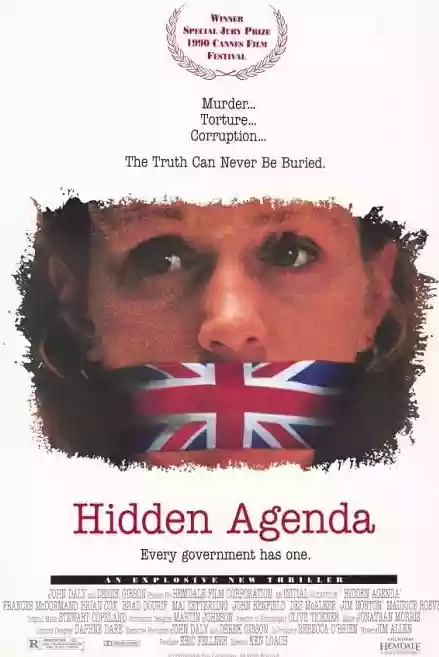
The story follows Paul Sullivan, an American civil-rights lawyer who becomes entangled in the affairs of Captain Harris, a former British intelligence operative whose actions set in motion a chain of events leading to tragedy and political scandal. I would have preferred the true circumstances of Sullivan's death to emerge gradually through the investigation rather than being revealed to the audience from the outset, but suspense has never been Loach's primary concern or strongest suit.
British investigator Peter Kerrigan arrives to examine the case and soon becomes involved with Ingrid, Sullivan's grieving girlfriend. Together they uncover the pieces of an increasingly improbable conspiracy that ultimately leads to a rather unsatisfying conclusion.
The film suffers from two major problems.
The first is Loach's trademark documentary-style “realism”. Presenting events without visual flourishes is a perfectly valid artistic choice, and nobody watches a Ken Loach film expecting dazzling cinematography. Yet this style can also be deceptive, creating an impression of neutrality that is not really there. Loach is not presenting facts impartially; he is presenting them through his highly selective ideological lens.
The second problem is even more glaring. Harris, a man fully aware that he is being watched, arranges a largely pointless meeting at dawn in the middle of nowhere despite knowing that both he and Sullivan are under surveillance. The scenario is so implausible that it undermines the entire narrative. If I wanted to be particularly uncharitable, I would add that the second, fatal meeting feels nearly as contrived.
The film was a clear vehicle for Loach's hostility towards 1980s Thatcherism, but it attracted controversy also for its alleged pro-IRA stance, and it is easy to understand why. Loach's approach strips away much of the messy, multi-sided reality of the Troubles. The actions of both Republican and Loyalist paramilitaries are largely presented as reactions to state oppression rather than as the actions of organisations capable of committing atrocities in their own right.
As a political statement, Hidden Agenda is clear enough. As an examination of one of the most complicated conflicts in modern British history, it feels selective, simplistic, and ultimately unconvincing.
So why watch it? Because good political films are not necessarily those that persuade us, but those that compel us to think, argue, and examine our own assumptions.
------------------------------------------
Available on Prime
Loading comments slowly
Summary by Bot
The review analyzes Ken Loach's film Hidden Agenda, focusing on its portrayal of the Northern Ireland Troubles. It highlights problems with the film's realism and ideological bias. Narrative contrivances and selectivity are criticized. The film's political messaging is clear but its examination of history is lacking. Ultimately, the film's strength lies in provoking thought, not persuasion.
Ken Loach
Ken Loach is a British film director renowned for social realist dramas about working-class lives and political conflicts. He won the Cannes Palme d’Or twice (The Wind That Shakes the Barley, 2006; I, Daniel Blake, 2016) and frequently collaborates with screenwriter Paul Laverty.10 Reviews
