
 •
Versione 1
Rating:
•
Versione 1
Rating: THE REVIEW
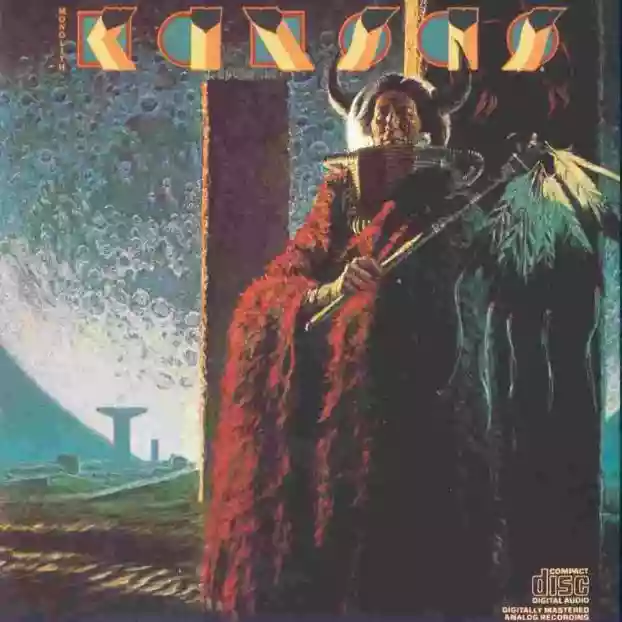
The proud silhouette of a Native American chief, adorned with the emblems of power and covered in animal fur, stands next to a squared monolith, apparently a totem but which, upon examining the back cover, is revealed to be one of the dilapidated pillars supporting the surviving vestiges of an ancient highway interchange, a site chosen by that man and his tribe to plant their teepees... This symbolic revenge of the Native American, surviving in an apocalyptic future over his conquerors and massacres, is the exciting welcoming graphic of the 1979 album by the glorious band from Topeka, Kansas.
If Zeppelin (or Purple, or whoever you prefer) opened the hard rock gates, if Black Sabbath (or others) coined metal, if King Crimson (perhaps the Moody Blues) generated progressive, it must be stated that Kansas (along with Rush, if you like) planted substantial seeds for progressive metal. Because they were the first to combine the typical progressive taste for suites, time changes, and various pomposity with the parallel metal taste for constantly noisy guitars and high-pitched vocals.
Those who don't love this band at all consider it derivative: they're (almost) right, as it took the insights of Genesis, Yes, Gentle Giant, and company, but also added its own touch, burdening and dramatizing the music as much as possible; sometimes at the risk of falling into bad taste, but at other times signing great pages of pompous, exaggerated, lush American rock.
Three primary resources were used to achieve the peculiar Kansas sound and write their own page in rock history: first, the stentorian and pathos-laden voice of keyboardist Steve Walsh; then the constant addition of the amplified violin, an instrument with inherent dramatic and decadent characteristics, entrusted to long-haired Robby Steinhardt; finally, the work of the two guitars, among which the very bright one of leader Kerry Livgren, platinum (then... today a distinguished and balding man) composer, arranger, and additional keyboardist, a great musician capable of a personal guitar timbre, very compressed and round, a real whip crack.
For a reason not plausible to me, this record is rarely among the first mentioned about Kansas. Yet I am personally very attached to some of its episodes, especially the opener "On The Other Side" greatly sung by Walsh after Livgren equally great solos with the lead guitar, in a stunning intro. In the instrumental interlude, the band goes obbligato on a 13/8 time, in the 'Dream Theater' way (understood, at the time of the record, the New Yorkers were still in school age and maybe busy buying Kansas records!), then returning to the beautiful vocal melody, supported by the twelve-string electric arpeggio, and concluding with Livgren's guitar return for the outro.
Another favorite of mine is the closing track "Reasons To Be", the folk ballad seen from the Kansas perspective, i.e., semi-acoustic yes, but with the most possible emphasis and tones. In between, six other abundant compositions among which it's easy to distinguish those essentially due to Livgren's pen, more linear, ingenious and catchy, or to Walsh's, with more intricate and variable results, sometimes cumbersome, other times surprising.
Loading comments slowly
Summary by Bot
Kansas' 1979 album Monolith is highlighted as a crucial work blending progressive rock with metal elements. The review praises the band's unique sound, particularly the vocals of Steve Walsh, Robby Steinhardt's violin, and Kerry Livgren's guitar work. Standout tracks like "On The Other Side" and "Reasons To Be" showcase their intricate musicianship and dramatic style. Despite being underrated, Monolith represents a significant chapter in Kansas' legacy and progressive rock history.Tracklist Lyrics Videos
Kansas
Kansas is an American rock band formed in Topeka, Kansas, in 1970 (originally as White Clover), known for a blend of progressive rock and hard rock with a prominent violin. Their best-known songs include “Carry On Wayward Son” and “Dust in the Wind,” and their 1970s albums Leftoverture and Point of Know Return are widely regarded as classics.14 Reviews
