
 •
Rating:
•
Rating:
THE REVIEW
According to dictionaries, the term "classic" refers to something that constitutes "an exemplary model," or, in reference to the formalizations of a theory or style, its "systematization," even in opposition to more modern directions.
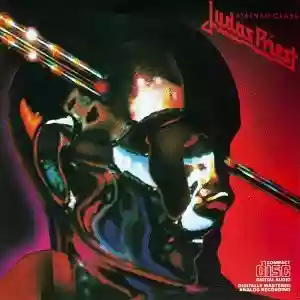
I believe it's the adjective that best fits the fourth official album of Judas Priest, whose songs for the first time defined the characteristics of heavy metal, already sketched out in the previous works of the Birmingham quintet, such as Sad Wings of Destiny and Sin After Sin: it is in this album that the insights of the previous works find their perfect formal synthesis and the compositional elegance that would characterize the group for the rest of their career, and on a purely aesthetic and iconographic level, the salient features of heavy metal are codified. Just look at the cover reproduced alongside: indecipherable, alien in its modernity, and at the same time tied to tradition by the three-quarter pose assumed by the head of the subject represented, as in the best sculptures from ancient Greece.
The importance of Stained Class for the career of Priest isn't conceivable on a strictly musical level, considering how the album gained a sulfurous fame from the mid-'80s, being at the center of the suicide of two American fans of the group, due to the alleged subliminal messages contained within the album's tracks. It's worth mentioning that the court involved in the controversy, in which the band members themselves were charged with incitement to suicide, concluded with the acquittal of Priest, who were nevertheless marked by that human and legal ordeal. However, it doesn't change the fact that online, even on Italian sites, legends about SC and the content of its tracks continue to flourish, characterized by mostly speculative logics best left untouched.
Both in content and form, Stained Class crystallizes the metal language that would later be revisited by a myriad of English and American bands straddling the '70s and '80s: sharp guitars with solo exchanges, a square yet not particularly inventive rhythm section, always at the service of the riffs produced by the two axemen, and above all, the sharp silhouette of Rob Halford's voice, sometimes declamatory, sometimes more violent. Compared to the coeval Killing Machine, a few months later, SC severely cuts ties with the hard blues of origins, accelerates rhythms, and simplifies arrangements, significantly compacting the tracks. The lyrics, with references to the Middle Ages, alien presences, and extrasensory experiences, color the music with a doomed aura, without superstructures or messages to convey, in the spirit of a self-referential language devoid of cultural references that are the very limit of the Priest's musical proposition (similar to Black Sabbath and unlike Blue Öyster Cult).
Coming to the content of the individual tracks, the album opens with the classic Exciter, with arrangements stripped to the bone and Halford's voice reaching unheard-of heights, giving a sense of claustrophobia and anger (it's no coincidence that one of the most influential bands of the early '80s took their name from this track); it is followed by the equally stunning White Heat, Red Hot, with a broken and hammering chorus that increases the listener's heartbeat, with almost disturbing effects. The third track, Better By You, Better Than Me—a cover of Spooky Tooth—shifts to perhaps a more ordinary rock, but catchy and pressing, which contrasts well with the preceding tracks, thanks to a Halford in great shape. The title track, with more refined rhythmic solutions, especially in the harmonic progression leading to the chorus, is one of the album's most successful pieces, both lyrically and in terms of emotional impact and sound hardness. The trio represented by Invader, Saints in Hell, and Savage should be considered as a unit, as they are pieces with a similar pace, extremely tense in the verses and explosive in the choruses, in a perfect blend of executive grit and melody that appears as the group's fundamental legacy to the emerging NWOBHM. The subsequent Beyond the Realms of Death, written by drummer Les Binks, is the emotional heart of the album, steering towards a dark sound reminiscent of the Sabbath lesson and similar to some pieces of Sad Wings of Destiny, albeit characterized by a greater rhythmic cohesion and effective sound synthesis: beyond the purely musical aspects, it is a piece that communicates to the listener a sense of genuine discomfort and unease. The concluding Heroes End, with a beautiful rhythm, best summarizes the group's style in the early part of '78, combining the devilish tones of the singer with the clanking riffs from Downing and Tipton's guitars, well-assisted by Ian Hill's bass.
An album to have, without being surprised if by the end of the listening, you are overwhelmed by a certain anxiety… but it's only heavy metal.
Loading comments slowly
Summary by Bot
Stained Class is Judas Priest's defining heavy metal album that perfected their sound and influenced countless bands. Featuring aggressive riffs and signature vocals by Rob Halford, it mixes raw power with melodic sophistication. Despite a dark controversy in the 1980s, the album remains a cornerstone of heavy metal history. Standout tracks like 'Exciter' and 'Beyond the Realms of Death' showcase the album's intensity and emotional depth.
Judas Priest
Formed in Birmingham in 1969, Judas Priest are among the pioneers of heavy metal, known for twin-guitar attack and Rob Halford's high vocals. Their career spans classic studio albums and acclaimed live records.49 Reviews
Other reviews
By Cronos
"An album to have because it has marked the history of Heavy Metal."
"The album is a strong pillar of Priest’s discography and includes some great masterpieces loved by fans."
