
 •
Rating:
•
Rating:
THE REVIEW
Sometimes, on certain occasions, one must remain inert like statues and watch the unfolding of eras, minutes, and hours that fill the surrounding void in the world. At certain moments, however, the continuous and constant evolution of the human cycle of everyday life leads to a radical change in both societies and customs, related to traditions adapted to the needs and peculiarities of human aspirations. There are stories that should be passed down to future generations, stories that should be taught and told to today's children and those of the future, with the sole purpose of transmitting passion, love, sacrifice, and potential spiritual growth. Children, to appreciate the joy of living, need dreams, hopes, a goal to ensure that their role in this world, which lies in victimhood and madness, can find such a value as to coincide with the substantial fullness of residing in the universe in all its entirety.
There was a Polish man named Yahiel De-Nur who was imprisoned in the Nazi extermination camp of Auschwitz, stripped of his freedom while all his family members were killed. The journey of this man is wrapped in fear and unease; when he decided to write his famous novel "The House of Dolls," he chose to sign his writings with the name common to all detainees Ka- Tzetnik (whose initials refer to Konzentration Zenter"Concentration Camp") who, like him, saw their lives slip away like leaves in the wind, like rose petals resting in the womb of that war-ravaged land that gradually devoured all of Europe. The picture of his novel is a manifestation of sanguinary cults; it is a representation of a perverse and twisted society, the human conscience becoming the emblem of distinct hypocrisy and ignorance. The protagonists of the novel are monsters revolving around utter meanness, perverse butchers cultivating power at the expense of their fellow beings; Yahiel's society is a sclerotic community due to a lack of freedom. The story narrates about a girl who worked in a factory, then taken away following a night raid, she was first taken to a labor camp and then to a prostitution camp, where the most beautiful girls had the "privilege" of becoming instruments of pleasure for the German soldiers, they were violated, raped, and reduced to slavery, treated as if they were a damn object that could be used as a source of lust, to satisfy the most arcane and perverse fantasies of the soldiers who served in those Nazi extermination camps.
In 1977 four English guys from Salford, Bernard Sumner, Stephen Morris, Peter Hook, and Ian Curtis decided to form a band whose name would be a tribute to Yahiel's novel. With the Hitlerian symbols, Ian Curtis's Joy Division played a much more shadowy game than Gainsbourg's. The very name of the group is the translation of Freudenabteilung, the brothels set up in the female concentration camps to entertain the perpetrators. A year after their inception, the English quartet recorded their first EP at Pennine Sound Studios.
"An Ideal for Living" came to light in June 1978, being thus the symbol of freedom, four delicate tracks that through the charisma and interpretation of the great Curtis intend to lead the listener to escape those infamous suburbs, hidden in the darkest and most clandestine recesses of that generation that wants to flee, wants to escape from that shadowy society, under the glances obsessed by the sinister wrath of Nazism. But perhaps they fear the consequences, perhaps they remain traumatized. But it is here that "An Ideal For Living" is born, a testimonial that presents itself as a sort of hope for future generations. Curtis knew this well, he understood the anguish and solitude that those people had to endure in those damn camps, his voice is a cry against power, against those men drawn to materialism that makes them so frivolous, so atrocious.
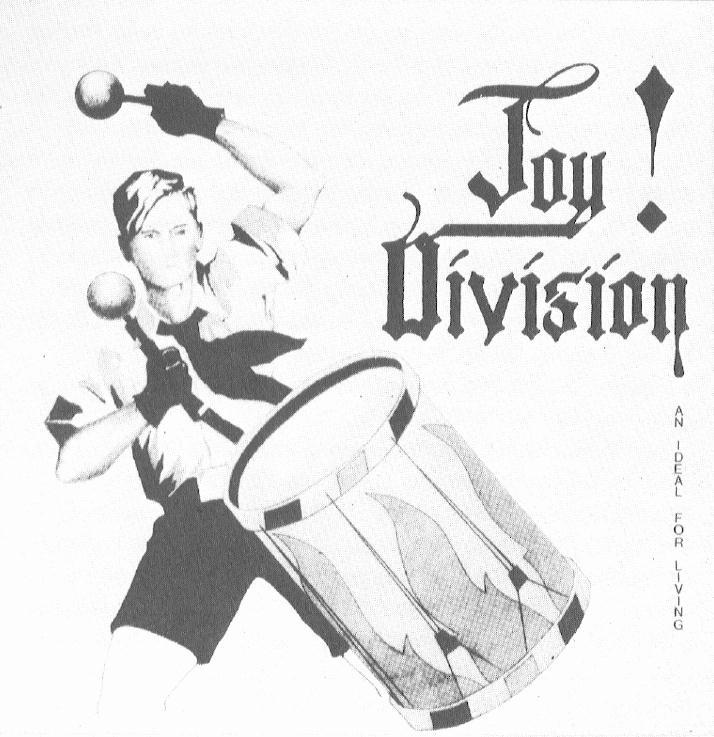
This EP was produced in a limited edition of 1,000 copies, featuring the black-and-white figure of a member of the Hitler Youth playing a drum with the words JOY DIVISION printed in Gothic type. Four tracks shaped by a soul forged by a free spirit, stripped of its shyness and fear. It begins with "Warsaw", initially this name was chosen by Curtis as the band's name, with a text of dark hues, words with an almost cryptic flavor. Already at the song's incipit, Curtis pronounces a series of numbers 350-125... GO!!!! This sequence of numbers probably indicates a serial code of some Nazi soldier. The sound and lyrics continue drastically, accompanied by Curtis's voice as if it were a sort of manifestation absorbed in music. We then find ourselves in the wonderful "No Love Lost" a song inspired by Yahiel's book citing precisely a passage from the novel....
"Through the wire screen, the eyes of those standing outside looked in at her as into the cage of some rare creature in a zoo. In the hand of one of the assistants she saw the same instrument which they had that morning inserted deep into her body. She shuddered instinctively. No life at all in the house of dolls.
No love lost. No love lost"
There are no words to describe the content; this song represents the clear proof of Joy Division's art, the combination between the most delicate soul of the English quartet and their scenic approach through Curtis's digressions and movements (the true Leader of the band). "Leaders of Men" consists instead of a sort of representation of the role of the leader, one who must solve the problems raised in the abyss of a poverty symbol of the civilization of that period. A melody supported by an orchestra of mighty guitars and with Ian's monumental interpretation. The task of closing what is possibly one of the EPs that remains today among the most influential records in the history of modern music, capable of educating future generations of the post-punk and new wave movement, is entrusted to "Failures". Through its 3 minutes of music and lyrics full of passion and melancholy, it gathers the art and commitment of this band, which will be the fundamental pillar of the records that will follow.....
"So long sitting here,
Didn't hear the warning.
Waiting for the tape to run.
We've been moving around in different situations,
Knowing that the time would come.
Just to see you torn apart,
Witness to your empty heart.
I need it.....need it....need it"
Loading comments slowly
Summary by Bot
This review explores Joy Division's debut EP 'An Ideal For Living,' emphasizing its deep historical inspiration and powerful lyrical themes rooted in trauma and societal issues. Ian Curtis's vocal delivery and the band's raw sound mark the record as an influential post-punk milestone. The EP's connection to grim historical realities distinguishes it as a meaningful artistic statement. 'An Ideal For Living' remains a key influence on future generations in post-punk and new wave.
Joy Division
Joy Division were an English post-punk band formed in the late 1970s (Ian Curtis, Bernard Sumner, Peter Hook, Stephen Morris). They released two studio albums, Unknown Pleasures (1979) and Closer (1980). After the suicide of lead singer Ian Curtis in May 1980 the remaining members later formed New Order.43 Reviews
Other reviews
By Mr.Moustache
The cover alone, depicting a teenager explicitly dressed in Hitler Youth attire, intent on striking the membrane of his own unawareness, expresses what the record tries to impose in a totalizing manner.
‘Failures’... embeds in your limbs the certainty that there is no going back once the journey has begun: no future.
