
 •
Rating:
•
Rating:
THE REVIEW
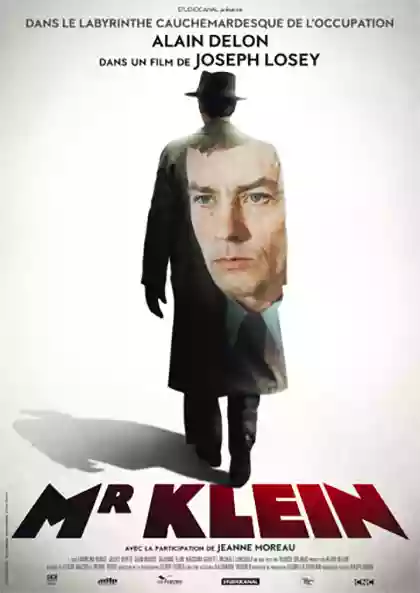
As I wrote in the review of "Tre piani," it's illusory to think you can lock yourself in your own home and remain impervious to everything that happens outside, in the world. Sooner or later, what you expelled through the door will come back through the window, and there will be no escape. To have confirmation of this, last night I re-watched, after rummaging through my DVD collection, a very significant title on the subject, "Mr. Klein," directed by Joseph Losey in 1976.
Both the film and the director have been unjustly relegated to oblivion for too long. Yet Losey, in his long career that ended in 1984, gave us sharp works on the hypocrisies and injustices of modern society. "Mr. Klein" fits into this philosophical and political discourse carried out consistently by the American director who, when McCarthy's anti-communist line was raging in the USA in the 50s, opted to move to Great Britain.
The story's protagonist is Robert Klein (played by Alain Delon), who, in Nazi-occupied Paris in 1942 with the collaborationist Vichy regime's approval, thinks of everything except the ongoing war. On the contrary, he collects and resells at a higher price art pieces that wealthy Jews sell in the illusion of saving themselves from a predictably tragic end. He is, therefore, a vile and wealthy speculator (or "shark," as people of his rank were called).
Everything seems to be going well for him until one day he finds a copy of a clandestine pamphlet signed by a Jewish organization in his mailbox. Thinking he is doing the right and clarifying thing, he goes to the police station to report the unfortunate mistake since he belongs to an Alsatian bourgeois family of pure Aryan race. But by doing so, precisely due to a classic heterogenesis of ends, he initiates a series of troubles that will cost him dearly. Indeed, another Klein, who is indeed Jewish, exists and is obviously wanted by the police, but manages to mislead the investigations and is suspected of being part of the resistance. This double, whom we will not see in action, will inevitably complicate the existence of the Aryan Klein, despite his ability to prove that he has nothing to do with the Jewish namesake. Needless to say, due to a series of unfortunate circumstances, both will end up in the sadly famous Velodrome d'hiver roundup in Paris in July 1942, destined for Auschwitz.
A decidedly tragic ending for a film rich in merits. Meanwhile, the director reminds us not only of one of the defining moments in the Holocaust suffered by Jews during World War II. Above all, he shows us what it truly means to live in a Kafkaesque situation. The individual, no matter how well socially positioned, remains nonetheless defenseless in the face of any Power (deliberately capitalized) that ends up annihilating him. He can vehemently proclaim his innocence, but what stands before him is merely a dull, self-referential bureaucracy, the executive arm of Power, that proceeds swiftly without stopping. There are several examples, and in the past, we've read of people who had to present certificates of existence in life to bureaucrats who, data in hand, asserted that the living and breathing citizen before them was deceased. Paradoxical yet unfortunately true.
Additionally, it's worth noting that the protagonists in the film are indeed the two Kleins, except the second is a character whose absence makes him looming, and this condition adds suspense to the plot. The entire work has a relentless rhythm, and it becomes increasingly clear that there will be no escape for Klein. His fate is, therefore, sealed, and although he is a speculator, the viewer ends up experiencing a growing sense of anguish and claustrophobia in the face of the protagonist's misfortune. Certainly, Klein doesn't evoke empathy, but we definitely see how unpredictable life can be, leading us to find, right around the corner, a gigantic, unavoidable trap.
Finally, there is also to note Alain Delon's intense performance. I know he has acted, in his long career, for great directors like Visconti, Antonioni, Zurlini, besides appearing in more commercial films. However, here he simply surpasses himself and presents us with a character not only greedy and unscrupulous but also humanly powerless when, despite all the attempts made to save himself, he must succumb to a cynical and deceitful fate. Once again demonstrating that it's illusory to remain unscathed when the world around us is burning.
Loading comments slowly
Summary by Bot
Joseph Losey's 1976 film Mr. Klein is a profound exploration of identity and power in Nazi-occupied Paris. The film depicts the tragic fate of Robert Klein, a speculator caught in a Kafkaesque bureaucratic nightmare. Alain Delon's intense performance adds depth to this political and philosophical drama. The movie remains a powerful reminder of Holocaust horrors and the helplessness of individuals against oppressive systems.
Joseph Losey
Joseph Losey (1909–1984) was an American film director who worked frequently in the UK after being blacklisted in the United States during the McCarthy era. He directed films such as The Servant, The Go-Between and Mr. Klein.01 Reviews
