 •
Rating:
•
Rating:
THE REVIEW
Uh-oh! We've been informed that this review also appears (in whole or in part) on wikipedia.org
"I shot a man in Reno, just to watch him die"
J. Cash
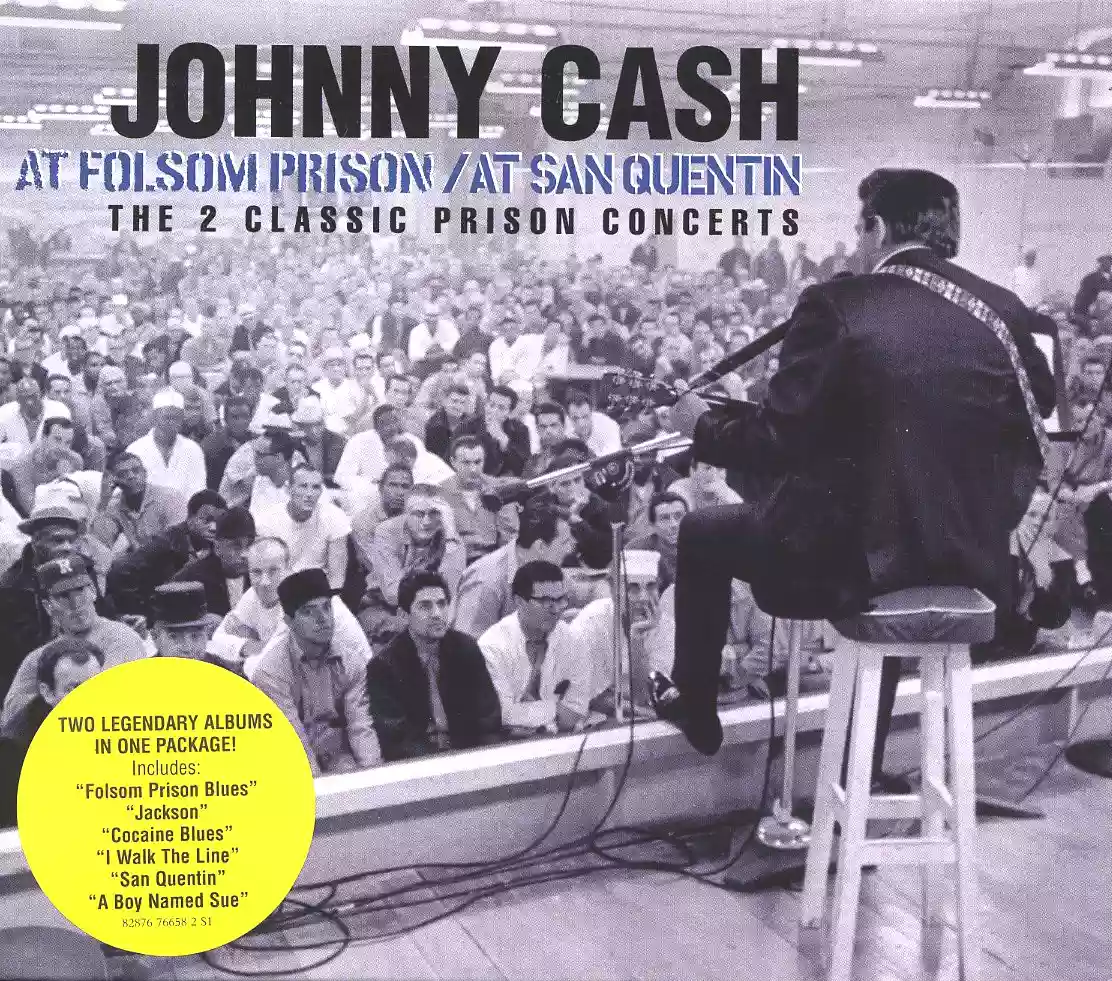
All the irreverence and tenacity of the bard of America's most misfit and hostile are in this double collection just released by an ex-convict who lived through the things he would sing about. Johnny Cash, in fact, was the first to decide to perform concerts in prisons and to record them as well.
38 years ago (!!) Johnny went to sing in two of the most dangerous prisons in the United States, one of which had once hosted him for petty crimes.
From this experience emerged two of the most surprising live albums ever made, especially considering the year 1968 and the ensuing "social revolution" in full swing.
Harsh, direct, and sharp verses that give a clear idea of the Cash character, known as the "man in black" for his inclination towards pessimism and his always dark and impenetrable look. Johnny is a man who feels persecuted, full of remorse, fighting with demons, and it seems that in this battle, the demons win most of the time. Cash never talks about violence lightly. He must always live with the remorse for what he's done and can never shake it off. A factor and perspective that he shares with the other prisoners gathered here to exalt Cash because they feel he is "one of them."
The versatility in interpreting ballads, gospel, blues, country, and rockabilly and the incisiveness of his compositions inspired by daily life and work make Johnny Cash a real bridge between tradition, modern country, and commercial rock, and thus a real symbol who could stir the troubled conscience of the average American with his songs.
On January 13, 1968, in front of an audience of two thousand inmates, naturally supervised by armed guards not exactly thrilled about this concert, Cash delivered a stunning performance, one of the best of his career, which was immortalized with "At Folsom Prison", now remastered with several additional tracks. It is striking, for example, to hear the roar of the convict audience when, after the customary introductions, our man kicks off the show with "Folsom Prison Blues".
At the end of the show, he performs a song composed by Glen Sherley, an inmate at Folsom, "Greystone Chapel". Johnny didn't go alone but brought along his entire entourage: producer Bob Johnston, his young wife June Carter, brothers Luther & Carl Perkins on guitars, Marshall Grant on bass, and W.S. Holland on drums. Alongside them should not be forgotten the Statler Brothers and the Carter Family, who provided the vocal bases.
All in all, an impressive group for a charity concert at a maximum security prison!
A year later Johnny tried again. And it was another success immortalized in the 2nd record "At San Quentin": an even more notoriously tough prison known as the hardest in California and among the toughest in all the States.
Here, too, three songs became historic, such as "San Quentin" composed for the occasion, "Wanted Man" which obviously garnered a tremendous success among the 2000 spectators (much to the embarrassment of the guards busy calming spirits). The third was "A Boy Named Sue", one of the first songs that addressed the topic of homosexuality without beating around the bush.
In short, a double album considered by many as his twin-masterpiece, in a box set rich with news and curiosities for a bold and "solitary" work: much like the life and legend surrounding this shy yet genuine character, who passed away after many adventures in 2003 at the age of 71, whose exploits are narrated in the film "Walk The Line" currently showing in cinemas.
Loading comments slowly
Summary by Bot
This review celebrates Johnny Cash’s groundbreaking double live album recorded in Folsom and San Quentin prisons. It highlights Cash’s unique connection with inmates, his versatile musical style, and the socially charged environment in which these performances took place. The albums remain landmarks in music history and powerful expressions of empathy and rebellion.Tracklist Lyrics Videos
02 At San Quentin (00:00)
04 Dirty Old Egg-Sucking Dog (01:17)
05 Flushed From The Bathroom Of Your Heart (02:39)
09 Green, Green Grass Of Home (02:57)
11 Dark As The Dungeon (03:05)
13 Cocaine Blues (03:02)
14 25 Minutes To Go (03:31)
16 The Long Black Veil (03:56)
19 Wanted Man (04:02)
21 Wreck Of The Old '97 (03:23)
28 (There'll Be) Peace In The Valley (02:37)
Johnny Cash
Johnny Cash (1932–2003) was an American singer-songwriter known as the “Man in Black,” celebrated for a deep baritone voice, stark storytelling, and songs about prisoners, outsiders, faith, and redemption. His late-career American Recordings with producer Rick Rubin sparked a major resurgence and introduced him to new audiences through sparse arrangements and transformative covers.20 Reviews
