
 •
Rating:
•
Rating:
THE REVIEW
You’ve reached that age, that age where you feel not just strong, but invincible—and above all, special. You are at the height of your youth and everything feels way too tight. While you’re scraping by, you realize that you can’t settle for so much normality and mediocrity. And so your thoughts turn towards a new beginning, where everything is easier and where there’s room for everyone’s aspirations. Money, fame, success—for a life that truly deserves to be lived. There are those who drop everything and go to Australia, those who move to the other side of the country because they don’t want to go halfway around the world, those who leave a secure job to do what they truly love.
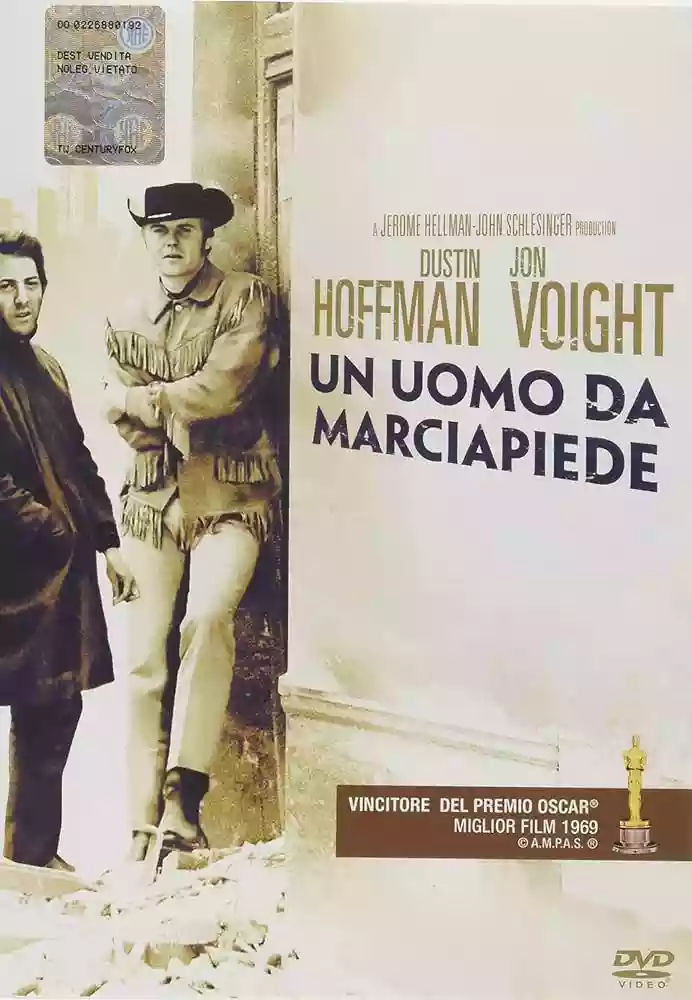
Joe is a fake cowboy. He’s a stupid romantic who still hasn’t figured out how the world works. He believes himself to be a real stud, and that’s what he wants to do with his life. He decides to take a bus from Texas to New York City. He feels so sure of himself that he’s certain the city women will line up to take him to bed and shower him with money. They’ll go crazy for his hat, his boots, and his fake cowboy look and real man attitude.
“Excuse me, ma’am, can you tell me where the Statue of Liberty is?”
Just kidding, ma’am, I’m your Statue of Liberty, and you can fuck me to the bone for the modest sum of $20.
Joe gets punched around for three quarters of the movie but, as I’ve already said, he’s a stupid romantic. Romantics are sad and melancholic, but the stupid ones are also optimistic and always try to get back up. The more you beat them, rob them, humiliate them, the more determined they get, and at the first meager success, they revive those pointless hopes from the beginning. John Voight is able to embody well this character full of passion and energy who is, in many ways, still a child.
The central figure isn’t Joe, because the one who will make our fake cowboy grow up is “Sozzo.” A filthy and rotten Italian-American perfectly played by Dustin Hoffman at the height of his craft. This greasy, petty, and devious figure is dying, drowning in his own phlegm and foul sweat that seeps through the screen, nauseates us, and wraps around us. He clings desperately to Joe, first robbing him easily and then exploiting him. Together, their chances of surviving the winter increase and perhaps, making one last ride to salvation. To the south.
A film like this can’t end well, and rightly so. On that last bus ride, Joe comes to his senses and realizes that “Sozzo” was once like him. He was a disillusioned man who hit the ground face-first, grown hard from hitting reality, and realized too late that those incredible strokes of luck that change your life are called that for a reason.
Because they never happen.
A frantic use of zooms by director John Schlesinger (well-deserved Oscar for Best Director in 1970) perfectly conveys the chaos of the Metropolis—capital M—of the United States. Especially in the scenes of sex, violence, fear, and pain that overwhelmingly characterize this film. The camera is unstable, almost as if it were drunk and staggering, and this reflects the dissolution of Joe’s American dream. The color turns on and off as if it were a switch, unnaturally and hallucinatory. The light in the cinematography is harsh and dry, as we dive into the misery and grime that sticks to us.
I believe this film is a real gem, the Siamese twin of the much more famous and acclaimed “Easy Rider”.
Loading comments slowly
Summary by Bot
The reviewer praises 'Midnight Cowboy' as a groundbreaking and emotional film. John Schlesinger's direction is celebrated for its bold realism. The performances of Dustin Hoffman and Jon Voight are highlighted as deeply moving. The movie's portrayal of urban struggle and unlikely friendship receives high acclaim. Rated a perfect 5 out of 5.
John Schlesinger
John Schlesinger (1926–2003) was a British film director known for Midnight Cowboy, Sunday Bloody Sunday, and Marathon Man.05 Reviews
Other reviews
By DanteCruciani
"Midnight Cowboy remains one of the finest films of those years alongside Easy Rider and The Graduate."
"Dustin Hoffman's performance is one of his best ever; Rico represents life, both cruel and capable of evoking forced, hysterical smiles."
