
 •
Rating:
•
Rating:
THE REVIEW
Sam, should I put on a record? Do you feel like listening to something in particular? Her answers to these questions are always yes and you choose. And I, being a bit of a jerk, pretend to forget that there are things my sweet wife really can’t stand. So, last night, during the 11’35’’ of Boogie Chillen n. 2 (from Hooker ‘N Heat), I was right in the middle of the bridge built from the solid and sturdy material of simple, dry chords, repeated until they generated the hypnotic and rhythmic groove so characteristic of John Lee Hooker, when I was abruptly brought out of my trance by a peremptory “ora basta!”
Okay, okay, the repetition of those musical phrases, dark and dynamic, where the rhythmic impact of the chords overtakes the articulation of any melody, can be anxiety-inducing for those who aren't big on the genre. But yesterday I really wanted to listen to John Lee—he and Bo Diddley, for me, are among the truest representatives of the African American roots of music. They’re part of the same great musical family tree, with Hooker planting the seed and Diddley, with his “Bo Diddley beat,” tending those roots until something revolutionary sprouted. Speaking of Hooker, for example, his fingerpicking foreshadows the style that, a few years later, would be made popular by Chuck Berry, closing the magical and devilish triangle of three fifties geniuses. Without them, well, bye-bye to the (unrepeatable) music of the ‘60s and ‘70s.
Luckily—not just for my wife—there was that one time John Lee let himself be reined in by a group of session musicians who would go down in history as the “Funk Brothers”: a crew of Detroit musicians who played on most Motown recordings from 1959 up to the company’s move to Los Angeles in 1972. Go check out who played on “My Girl,” “I Heard It Through the Grapevine,” “Baby Love,” “Papa Was a Rollin' Stone,” “Ain't No Mountain High Enough,” … always and only them!
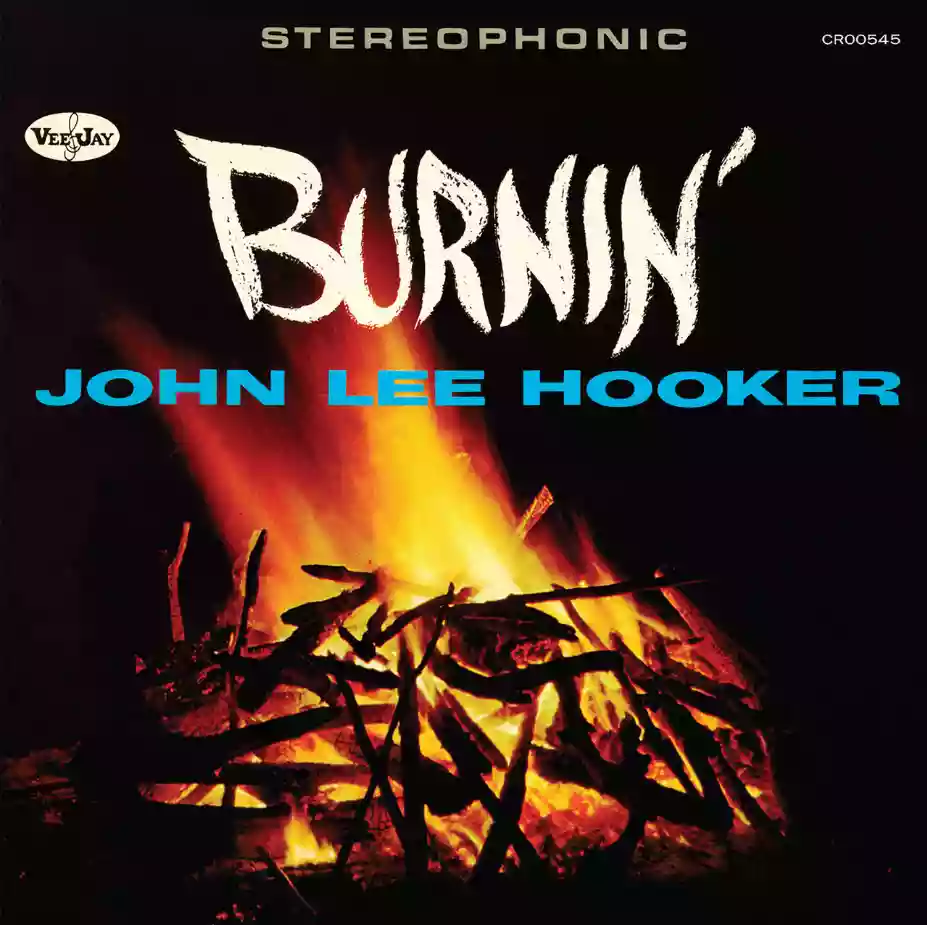
The result of those reins is that legendary masterpiece “Burnin’” from 1962, opening with a track whose title alone says it all: “Boom boom”—Boogie Man’s greatest hit, born because, like me, he could never make it to work on time! After landing himself a spot at the Apex Bar in Detroit in the early '40s, he developed the habit of showing up well past the scheduled time, and the bartender would regularly point her index finger like a gun, aim at John Lee and chastise him: “Boom boom, you’re late again!” But Hooker had his own sense of time. Besides always being late, he rarely stuck to a steady tempo or played a song the same way twice, making it tough for backup musicians to follow him. From this perspective, “Burnin’” is a small miracle because the Funk Brothers manage to contain Hooker with a rich and layered sound—plenty of piano and horns on most tracks, and above all, with the “bite” of the rhythm section, courtesy of drummer Benny Benjamin and bassist James Jamerson. Their involvement was producer Calvin Carter’s happy intuition, making “Burnin’” John Lee Hooker’s very first truly “electric” record in every sense.
The musicians’ mastery goes a long way in keeping these tracks tight and coherent, with Larry Veeder’s smooth and velvety handling of the guitar riff in “Boom boom”; with the saxophones of Hank Cosby and Andrew “Mike" Terry” enriching the four minutes of slow and repetitive blues on “Process”; the whole band ever more at ease riding the solid groove of Jamerson and Benjamin in the steady boogie of “Lost A Good Girl”; the energy poured into “A New Leaf,” which moves along like a kind of hoochie-coochie-man in the advanced stages of senile dementia; with the swing of the horns and a ragtime piano accompanying the searing guitar licks of the front-man in “Blues Before Sunrise,” made even better by Larry Veeder’s excellent guitar solo. A touch of minimalism gives “Let’s Make It” and its slow tempo a disorienting vibe, with the Funk Brothers perhaps struggling to find the right pace, as in “I Got A Letter.” In “Thelma,” then, the band decides the best way to handle Hooker’s meager rhythms is to ignore him and his escapades and just stubbornly repeat the formula, over and over, with a much better result—even if the best side of the LP is undoubtedly side A.
Although I doubt the Funk Brothers had much fun with someone like John Lee Hooker, and Hooker himself preferred playing uncompromising blues (“When I was younger, I played more hard blues by myself. I could play more guitar and do more on my own. I didn’t have a band getting in the way. I could do what I wanted when I wanted to do it”), the whole band holds up and helps make this album recording—done entirely in a single day, October 26, 1961—something unique. But beware, for better or for worse, Boogie Man keeps total and absolute control of everything, using the session men to get the sound he wants. So Burnin’ was and remains, in the end, Hooker’s show—a thoroughbred, not tamed but energized by his own band. His guitar rides the groove of each song, splitting the difference between rhythm and soloing. In the faster tracks he rants and yells to persuade the other musicians, and in the slower ones he moans and complains, with his talking blues.
It was the records and artists of the golden age of electric blues—like “Burnin’” and John Lee Hooker himself—that dazzled the English kids who would later form bands like the Rolling Stones and the Yardbirds, and a few years down the line, Cream and Led Zeppelin. If at the time of its release “Burnin’” seemed an anomaly, caught between blues and R&B, today it stands as a gloriously turbulent collection, stepping outside of history to live in the eternal present of music, for ever and ever, amen.
P.S. Sam enjoyed it, I’ll get the record.
Loading comments slowly
Summary by Bot
This review highlights John Lee Hooker's 'Burnin'' as a quintessential blues album. The reviewer commends its raw energy and authentic style. Praise is given to Hooker's influence and the album's timeless appeal. The review emphasizes the quality of guitar work and passionate vocals. 'Burnin'' is celebrated as essential listening for blues enthusiasts.Tracklist
John Lee Hooker
John Lee Hooker (1917–2001) was an American blues singer-guitarist, a pillar of post-war Detroit blues and electric boogie. Known for hypnotic one-chord vamps, a talking-blues delivery, and signature songs like Boogie Chillen’ and Boom Boom, he influenced generations from Chicago clubs to British rock.09 Reviews
