
 •
Rating:
•
Rating:
THE REVIEW
Once upon a time, there was the Enlightenment. The enlightened Enlightenment. It had ideas breathing greatness, reason as a universal tool, man as the measure of all things, and the very real possibility that the intellect applied to the world could produce justice, equity, and then progress—still at a paleolithic stage but already well charted. Kant was writing treatises on human dignity. Rousseau imagined social contracts. Diderot compiled encyclopedias, convinced that distributed knowledge would free humanity from its chains. It was a beautiful moment in the history of Western thought, full of that trust in the future. The kind of trust you can only have before you’ve actually seen what happens when the future, inexorably, finally arrives for real.
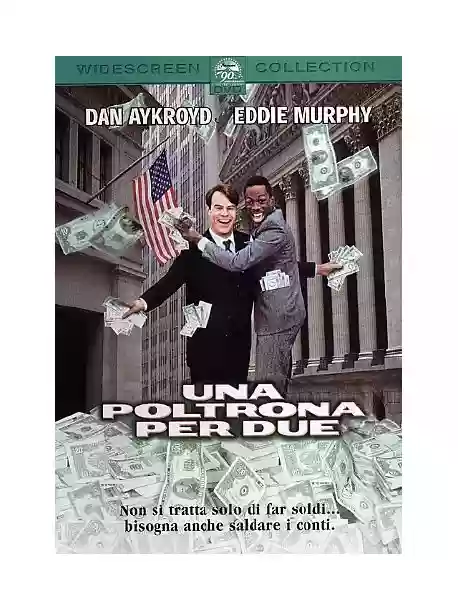
Ah, among many other things then came John Landis. And with him, in 1983, Trading Places.
The film opens in Philadelphia—surely not a random city, cradle of American democracy, the place where the Declaration of Independence was signed. That extraordinary document that proclaimed the equality of all men. It is said to have been written with the same pen and by the same hands that its signatories used to run slave plantations, thus inaugurating that typically Western tradition of combining sublime principles with abyssal contradictions. Without this ever disturbing anyone in particular—heaven forbid. Philadelphia, then. City of brotherhood. City of liberty. City where brothers Mortimer and Randolph Duke sit atop a brokerage firm, managing others’ destinies with the serene nonchalance of those who have never had to worry too much about where their bread comes from.
The Dukes are Enlightenment thinkers in the fullest sense of the word—they believe in reason, they believe in empirical observation, they believe in the controlled experiment. As often happens, the object of their experiment—social, of course—is a human being. Louis Winthorpe III, successful broker, engaged to a well-connected woman, member of the right club, diner at the right restaurants, bearer of all the social capital Philadelphia knows how to lavish on its favored sons—is picked as a guinea pig as casually as one might select a lab rat, which is already in itself a highly effective epistemological statement. In parallel, Billy Ray Valentine, a street hustler, a poor Black man from Philadelphia as per the film’s implicit classification, is extracted from his natural habitat—the sidewalk—and inserted into the artificial environment of financial success. The question the Dukes pose is simple, elegant, and Enlightenment in its formulation.
Is it character that determines social position, or is it social position that determines character?
Probably the Dukes hadn’t read much Rousseau, or not very attentively—Rousseau had already answered. The French writer had penned marvelous pages about how society corrupts naturally good man, about how institutions shape the individual much more than the individual shapes institutions. But Rousseau didn’t trade commodities, at most he might have played dice or baccarat, and this difference proved historically decisive.
The experiment proceeds with admirable scientific rigor. Winthorpe is deprived of everything—job, home, fiancée, reputation—with the precision of a surgeon removing organs one by one to see which is vital. Valentine, on the other hand, is given everything—money, accelerated education, proper attire, the right social context—and is observed as he adapts at a speed that should make us all reflect deeply on the nature of merit, on what we call talent, and on how much of that "talent" is simply opportunity finding a body to inhabit. In this, the film is ruthless, even though it makes us laugh, even though it is a comedy, and it shows with crystal clarity that Winthorpe, without money, quickly becomes a desperate, angry, base man, while Valentine, with money, quickly becomes a competent, intelligent, even elegant man. Man, the film suggests with the lightness of a Christmas comedy, is almost entirely a construction of circumstance. Character is, for the most part, a matter of your bank balance.
This is the Enlightenment thesis of the film, and up to here we could still be in the eighteenth century.
But then comes the commodities market, and everything changes—those dizzying fluctuations that only a few know how to catch.
The climax of Trading Places takes place on the New York commodities exchange, in the scene with the frozen orange juice—and here the movie ceases to be a comedy and becomes, unwittingly or perhaps very deliberately, the most unconsciously lucid manifesto American cinema has ever produced about the real workings of financial capitalism. Winthorpe and Valentine, now allies, obtain insider information on the orange harvest—information the Dukes had obtained illegally and which our heroes now appropriate with a counterattack of equal moral elegance. Armed with this asymmetric knowledge, they buy and sell orange juice futures with a precision that bankrupts the Dukes in a matter of minutes, while they themselves become obscenely rich.
The film’s Enlightenment moral—that merit exists, that justice is possible, that the wicked are punished—is realized entirely through the exact same speculative mechanisms the villains used. There’s no reform of the system. No structural criticism. There’s only a change of hands—the money goes from the bad guys to the good guys through precisely the same tools the Dukes employed.
Voltaire would have laughed. And then he would have wept. And then he would have written a pamphlet.
Diderot would have said that knowledge liberates man—in the strictly literal sense, he’d have been right, because it’s exactly knowledge, that note about the orange crop, that frees Winthorpe and Valentine. But here, knowledge is not used to enlighten the world. It’s used to beat the Dukes at their own game. It’s used to win, not to change the rules. The Encyclopédie reduced to insider trading.
And yet—and it’s here that the movie becomes irresistible, its innocence becoming its depth—all of this is presented as a happy ending. As justice done. As the deserved conclusion to a story in which the good guys win, the bad guys lose, Christmas comes, and everyone heads off to the Caribbean. The 1983 audience laughed and applauded, and they were absolutely right to, because the film is an extraordinary comedy and Eddie Murphy at that time was perhaps the funniest human being on the planet. But beneath the comedy, etched with the unconscious precision of great popular films, this enormous, silent truth remained: the Enlightenment wasn’t defeated by capitalism. It was simply absorbed. Digested. Converted into fuel for a system that took from reason the method and left the goal behind, took from equality the word and left the substance behind, took from liberty the sound and left the meaning behind.
In 2026, commodity futures markets still exist. Asymmetric knowledge is still the main engine of wealth accumulation. And every once in a while, someone wins, like Winthorpe and Valentine, by playing the system better than the system itself—and this victory is celebrated as confirmation that the system works, that social mobility exists, that anyone with enough intelligence and enough luck can sit in that armchair.
There are two of them, those armchairs. There’s always room for two.
The problem is how many of us there are.
Loading comments slowly
Summary by Bot
This review highlights the enduring appeal and comedic brilliance of John Landis' 'Trading Places.' The film's clever premise, stellar performances, and sharp humor continue to capture audiences. Praises are given to Eddie Murphy and Dan Aykroyd for their iconic roles. The review underlines the movie’s status as a must-watch classic in the comedy genre. Overall, it’s a warm recommendation for both first-time viewers and nostalgic fans.
John Landis
American film director, screenwriter, and actor known for anarchic comedies and horror-comedies. Broke out with National Lampoon’s Animal House (1978), followed by The Blues Brothers (1980) and An American Werewolf in London (1981)—whose makeup effects won the inaugural Academy Award for Best Makeup. Continued with Trading Places (1983) and other studio hits.05 Reviews
Other reviews
By Trofeo
Trading Places on Christmas Eve: the perfect blend of nostalgia and holiday magic.
After twenty-five years, Trading Places remains a highlight of my Christmases from childhood through adulthood.
