
 •
Rating:
•
Rating:
THE REVIEW
When a film is made just right, it feels like watching a ballet, a symphony, or a parade, like the parade of actors who skillfully and masterfully move through this concrete jungle.
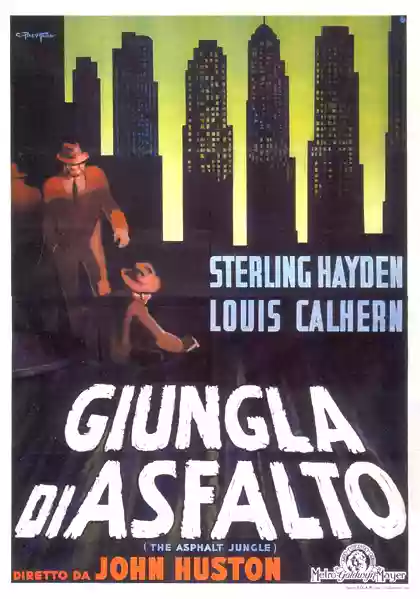
The Asphalt Jungle (1950), based on the novel by William R. Burnett, is a masterpiece of American noir, even a prototype, in the sense that everyone who attempts this genre later will have to reckon with it.
Directed by John Huston.
Erwin Riedenschneider (Sam Jaffe) is DOC. He's around sixty, just out of prison, and for a long time during his incarceration, he's planned the heist of a lifetime. Safe, precious stones, lots of money. To successfully pull off the job, he needs three elements: a safe-cracking expert, a driver, a thug... an hooligan, basically someone who can throw punches.
Dix Handley (Sterling Hayden) is a small-time criminal with a horse-racing habit, but he's tough, loyal, and determined like few others. He's the one who throws punches.
Louis Ciavelli (Anthony Caruso) is the safe-cracker and Gus Minissi (James Whitmore) is the driver.
To successfully pull off the job, DOC needs money and he asks Cobby (Marc Lawrence), a cowardly gambler, who in turn, thinks it’s a good idea to involve his boss, Alonzo D. Emmerich (Louis Cahern) who, in turn, has a very young and very cute and flirtatious mistress, and we know mistresses are costly. The actress who plays the role of Angela Phinlay is making her film debut and although it's a minor role, she leaves a mark. Her name is Marilyn Monroe.
Then there's the steadfast commissioner, the corrupt lieutenant, the cabbie who knows, the private investigator, Dix's girl, Emmerich's (cheated) wife... there's also a cat eating on the bar counter.
When a film is made just right, you can tell from the opening credits, from the music by Miklós Rózsa, one of the greatest composers of Hollywood cinema between the early '40s and the '80s. A solemn, dark, and threatening music that promises nothing good, even the title tells you that you'll find yourself in an asphalt jungle...
We are faced with what is called an "ironclad screenplay", a work practically devoid of errors, structured in three acts: introduction/heist/epilogue.
Compact and homogeneous like grandma's zabaglione, it doesn’t waste a single minute of the 112 total to calmly show you the characters, their characterization, the theory of the heist, the practice, and what will ensue.
There isn't a real protagonist but you'll end up rooting for DOC and DIX, the only two in a way "clean" or rather "correct". Perhaps because they're more "human", perhaps because they have a dream, a project that is nothing transcendental but would take them out of this filthy, corrupt, and above all, asphalt jungle.
Loading comments slowly
Summary by Bot
John Huston's The Asphalt Jungle (1950) is celebrated as a cornerstone of American noir cinema and a benchmark for heist films. The review highlights its masterful direction, a tightly woven screenplay, and memorable characters that feel strikingly human. The soundtrack by Miklós Rózsa adds a dark, ominous tone fitting the 'asphalt jungle' setting. Marilyn Monroe's minor but impactful film debut is also noted. Overall, the film is praised as a flawless, timeless classic.
John Huston
John Huston (1906–1987) was an American film director, screenwriter, and actor. He launched modern film noir with The Maltese Falcon (1941), shaped the heist template with The Asphalt Jungle (1950), and won Academy Awards for directing and writing The Treasure of the Sierra Madre (1948). His career spanned five decades across genres from Westerns to literary adaptations.06 Reviews
Other reviews
By Hellring
"The Asphalt Jungle" is one of the undisputed manifestos of classic American cinema.
Crime is just a sinister form of the struggle for life.
