
 •
Rating:
•
Rating:
THE REVIEW
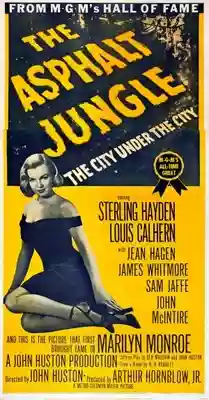
People often wonder about the usefulness of discussing masterpieces, those works that have made cinematic history, but the same goes for music and everything else. Bringing up milestones may seem almost like an insult to them, but it's not if the film in question is "The Asphalt Jungle", a movie that perhaps never received the recognition, especially critically, that it deserved.
It's 1950, and John Huston already has seven feature films under his belt, the first of which, "The Maltese Falcon," is considered one of the earliest examples of classic noir, one of those titles that codified the noir atmosphere in the following years. It's no coincidence that "The Maltese Falcon" (1941), Frank Tuttle's "This Gun for Hire" (1942), and Billy Wilder's "Double Indemnity" (1944) are often regarded as the "trinity" that launched classic American noir, a genre destined to flourish in the following decade. In addition to an already established directing career, Huston made his debut as a screenwriter for MGM and later moved to Universal, entering the world of cinema and, above all, solidifying the foundations of what would become his future cinema, a very strong bond between image and screenplay. Even in his eighth directorial effort, Huston collaborated with Ben Maddow to craft a plot inspired by the eponymous novel by William Burnett. The result is an ironclad screenplay that doesn't stifle Huston, who is capable of maintaining the tension of the story, especially through a direction that we would today call "old style," but which is the film's strongest point. Every single shot, from the numerous close-ups to the scattered long takes, makes "The Asphalt Jungle" one of the undisputed manifestos of classic American cinema. In Huston's style, there is the imprint of the great masters, from Ford to Howard Hawks, from Wyler to Raoul Walsh of the "second period." Yet, the story brought to the screen is one of the most clichéd and déjà vu: a criminal just out of prison (Sam Jaffe) seeks men to carry out a heist in a jewelry store. His "companions," from the moody Dick (Sterling Hayden) to lawyer Emmerich (Louis Calhern), are persuaded by the meticulousness with which Dr. Erwin has organized everything. But in these actions, things never go as planned for the robbers, and from that moment on, a series of cascading "incidents" unfold that only worsen the situation further.
Typically noir nighttime atmosphere, with the presence of the uncontrollable "femme fatale," that Marilyn Monroe who was beginning to gain attention in the cinematic world, even if in this film she doesn't have a leading role. Noir that also becomes a crime drama, both in the search for the robbery's culprits and in the "banning" of a police force that is already corrupt and complicit with the criminal underworld of the big cities. Two "brother" genres that Huston fuses together to mold an action and escape story typical of classic cinema, but at the same time, it has the greatness of not dwelling on the dichotomy so dear to American cinema: that almost visceral need to identify the "good" and the "bad" in every situation. In Huston's film, it's difficult to determine who can be defined one way or the other, but there are definitely not many "good guys" to be seen.
"The Asphalt Jungle" is a central title in 1950s American cinematography and probably one of John Huston's artistic peaks. A very tough film for its time, blending crime and moral vision, viewing that asphalt jungle as a metaphor for the broader struggle for survival. In the end, even lawyer Emmerich, a man of law willing to get his hands dirty in the illicit, knows very well that "crime is just a sinister form of the struggle for life." Because in Huston's film, the poetics is one of pessimism, of gloomy tones, and claustrophobic photography (splendid and curated by Oscar-winner Harold Rosson). A film that exudes pathos in every single frame and where emerges the epic of America attempting to finally implement the transition from the "wilderness" typical of the nineteenth century and the western, to the "civilization" and progress represented by the great metropolises. The men, in every way, are defeated, annihilated. It's the great cinema of a master like John Huston.
Loading comments slowly
Summary by Bot
John Huston's 1950 film 'The Asphalt Jungle' is an essential classic of American noir and crime drama, featuring masterful direction and a taut screenplay. The movie blends a gritty crime story with moral ambiguity and atmospheric cinematography. Though the plot is familiar, Huston's execution and deep thematic poetics elevate this work to a cinematic milestone. The film marks a peak in Huston’s career and reflects the social struggles of its time.
John Huston
John Huston (1906–1987) was an American film director, screenwriter, and actor. He launched modern film noir with The Maltese Falcon (1941), shaped the heist template with The Asphalt Jungle (1950), and won Academy Awards for directing and writing The Treasure of the Sierra Madre (1948). His career spanned five decades across genres from Westerns to literary adaptations.06 Reviews
Other reviews
By Poldojackson
When a film is made just right, it feels like watching a ballet, a symphony, or a parade.
We are faced with what is called an 'ironclad screenplay', a work practically devoid of errors.
