
 •
Versione 2
Rating:
•
Versione 2
Rating:
THE REVIEW
Joe Jackson, absolute genius of pop rock, in the early part of his career is a torrent of creativity and from 1979 to 1989 he releases 10 albums (including two soundtracks) and almost all of them are high-level albums, including a stunning masterpiece like “Night and Day” from 1982 and a grand instrumental album titled “Will Power” (1987), an album criticized by many critics, but which instead (in my personal opinion) touches on brilliance.
“Big World” is situated shortly after the first half of the first decade of his career, indeed it’s 1986 and Joe Jackson has already done several world tours, year after year, from 1978 to 1984, almost without stopping, tours that were exhausting for him both physically and mentally, but it’s especially the last tour, the one for “Body and Soul” (album from 1984) that leaves Joe close to a nervous breakdown and with little desire to return to touring and perhaps even to making music.
It’s only the beginning of a psychological and physical stress that, in 1991, will lead the English musician to seriously consider retiring from the scene.
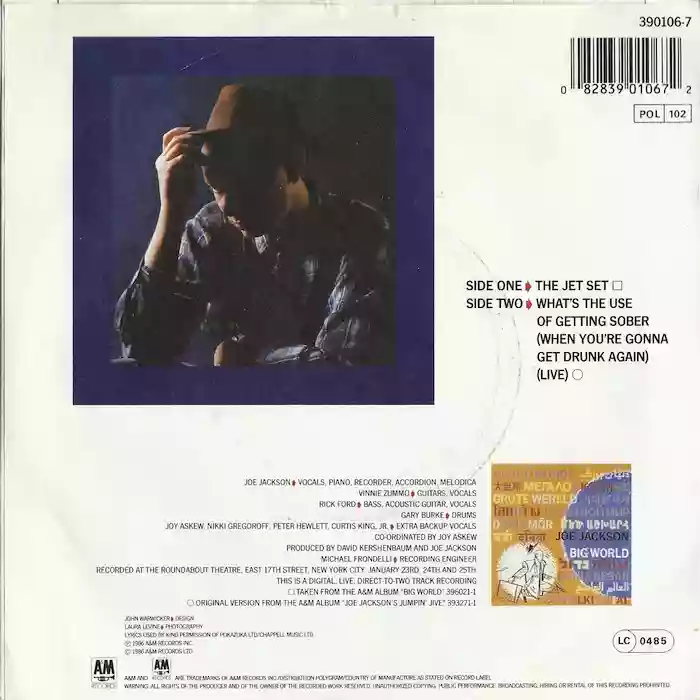
Now however we are in the mid-80s and Jackson (although stressed by the show-business world built on singles to be ranked on charts) is still quite young and tries not to be imprisoned by that star-devouring machine which is the music entertainment world. His way of responding to the music market is to offer his music in an unusual way; indeed for the first 4 albums (from 1979 to 1982) Joe Jackson had produced quite standard music videos to support the singles, from 1983 to 1988 he will carry on his personal battle against the world of music videos, indeed he’ll produce only two videos from the album “Body and Soul” (an album that was also recorded “live”, albeit in studio), but the videos will be taken from performances during the tour following the release of the album. For his next work (the “Big World” that I’m discussing in this review) his rebellion will be even greater. In a world where more and more “stars” seem often created at a table, with artificial studio recordings, Joe decides to record new songs live, without any post-recording touch-ups. What’s heard in “Big World” are indeed live recordings of new tracks performed in a theater in New York, in front of a selected audience of spectators, who were asked not to applaud until the complete execution of the track. To support the album, videos were then created (naturally “live”) that captured Joe and his band while they were recording live (with an audience present) their new songs.
Joe Jackson (musically speaking) from 1979 to 1984 had already ventured through almost every genre across the globe, from classical to rock, from punk to jazz, and more, and this “Big World” further broadens his sound exploration.
The response from the public is always excellent. The album ranks at number 34 on the US sales chart and at number 41 in England. In the Netherlands, it reaches up to 2nd position and 21st position in Germany.
“Big World” in the end is a good work and (as you may have understood) very courageous, even though it reflects the period of mental stress Jackson was under during much of the 80s. Indeed some tracks are very beautiful, see the initial and energetic pop-rock of “Wild West” or the angry and very original “Right and Wrong”, but also excellent tracks like the rock of “Precious Time” and “Tonight and Forever” and the concluding “Man in the Street”, or the great melody of the slow and enveloping “Shanghai Sky”, other tracks are slightly less successful, even though they still hold considerable musical value, I’m talking about songs like “Fifty Dollar Love Affair” (with its sudden vocal outbursts), “Forty Years” (slow and hypnotic), “Hometown” (a very rhythmic pop track) and “Survival” (a rather captivating Afro-Cuban rock).
But not everything is successful (the album is probably too long, 3 sides, for a total of over 60 minutes of music). “We Can’t Live Together” is appreciable but too slow and lacking bite, “Tango Atlantico” is nice but not exceptional, the same can be said for the rock of “The Jet Set” and jazz-rock of “Soul Kiss”. Most of the album is anyway of a rather high level, even if it’s not masterpiece material.
So not a perfect album, but still a work of quality and absolutely worth listening to over and over (and maybe many times).
Loading comments slowly
Summary by Bot
Joe Jackson's 'Big World' (1986) showcases his rebellion against music industry norms with live recordings of fresh songs, capturing raw performance energy. The album blends various genres, reflecting Jackson's broad musical explorations and mid-80s creative stress. While not perfect or a masterpiece, it includes remarkable tracks like 'Wild West' and 'Right and Wrong' and remains a worthwhile listen. Chart success was solid internationally, confirming public appreciation.Tracklist Videos
01 Wild West (04:36)
02 Right and Wrong (04:34)
03 (It's a) Big World (04:43)
04 Precious Time (03:23)
05 Tonight and Forever (02:35)
07 Fifty Dollar Love Affair (03:39)
08 We Can't Live Together (05:25)
09 Forty Years (04:30)
10 Survival (02:19)
12 The Jet Set (03:50)
14 Home Town (03:12)
15 Man in the Street (05:04)
Joe Jackson
Joe Jackson is an English singer-songwriter, pianist and composer known for moving across styles from late-1970s new wave/post-punk into pop-rock shaped by jazz and Latin influences, as well as later classical-leaning projects. His 1982 album "Night & Day" is widely regarded as a signature work and commercial peak.15 Reviews
Other reviews
By dsalva
It moved me like the first time and I wanted to share it!!
A very special album, for an absolutely unique artist.
