
 •
Rating:
•
Rating:
THE REVIEW
As a kid, I used to make sandwiches at the Verde Luna nightclub.
And the Verde Luna nightclub offered cosmic mushrooming on Fridays, or, as the bouncer Cazzurlo used to say, music for cavrones.
Cazzurlo was the one who gave that very apt nickname to Carla (bartender and space babe). The nickname was Conta.
Conta...what does it count?...counts sleeping with the boss.
And indeed, Carla, since she dedicated herself to that admirable activity, had assumed an arrogance that was noteworthy…
On Saturdays, the Verde Luna nightclub offered moderate mushrooming for heretical cavrones…
And on Sundays? Sundays were Reggae…
The concept was “we make so much money with the mushrooming that if nobody comes on Sunday, it doesn't matter.”
And indeed, no one really came, and to prove it, just look at the number of sandwiches: two hundred on Friday, one hundred and twenty on Saturday, twenty (on a good day) on Sunday…
And so, for most of the time, I would just wander around the place, dancing a bit, drinking, but mostly listening.
And, damn, what music…
I especially liked that track that starts with a guy yelling in Jamaican patwa “Forward and payaaka, manhangle and den go saaka” (which should mean something like “go steal someone else’s girl, hold her tight and then screw her”)
That track literally drove me crazy.
Today I know that, performed by a certain Scotty, it is a cover of a famous rock steady song.
To Scotty, Mr. Laganà, in his book “Cento dischi ideali per capire il reggae,” dedicates just a small footnote and defines the song as “swaying.”
And, to tell the truth, sway it does...but it does it very well…rather, as well as it possibly could.
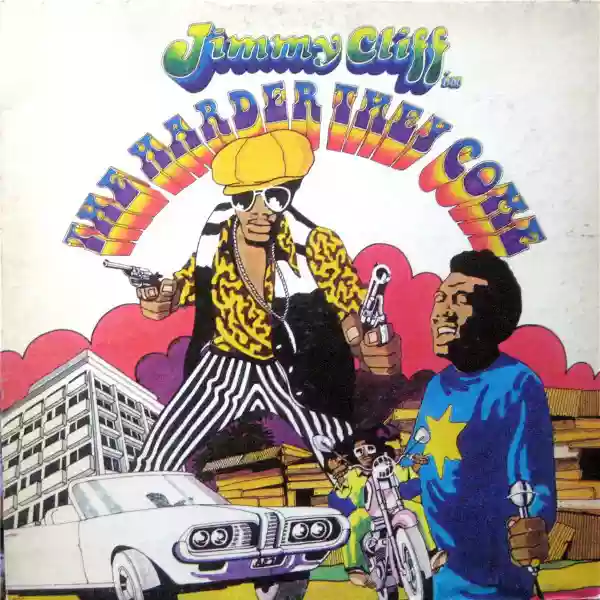
The song is called “Draw your brakes” and it is track two of “The harder they come.”
__________________________________________________________
Let's be honest, that story of Haile Selassie being seen as a god on earth is a bit laughable.
It’s that someone, namely the black dreamer Marcus Garvey, took seriously an obscure prophecy about the coronation of a black king who “would expel colonialism, uproot evil, and prepare the African continent for the return of its people.”
And shortly after, what does Ras Tafari do? He actually becomes emperor of Ethiopia under the name Haile Selassie.
Of course, if we were to list all the oddities of various religions, we would never finish. However, let's admit, this one is really big.
Unless, of course, you don’t live in Jamaica, maybe in a ghetto, maybe with the police breathing down your neck since, as always, you get by as best as you can.
Ah gentlemen, I can guarantee you that from that perspective everything changes.
Then again, maybe someone could tell me that in “The harder they come” Rastafarianism is not yet central as it will be from Marley onwards. And they’d be right, too.
However, there is a however.
And that however is a song titled “Rivers of Babylon”...
______________________________________________
“Rivers of Babylon” is one of the most important songs in Jamaican history.
And, above all, it is a very sweet religious hymn with fiery words which, though floating on a lazy and sly rhythm, evoke the (very harsh) Psalm 137 of the Bible.
In that psalm, those speaking and swearing vengeance are the Jews deported to Babylon. And with that psalm, the identification of the singer is total. It's not hard to understand why.
So, at this point, I think it's useful to remember a little thing I discovered recently, and the little thing (source Saint Eddy Cilia) is this: in the summer of sixty-six, Haile Selassie made a state visit to Jamaica.
At the airport, he was greeted by one hundred thousand people, and those one hundred thousand people sang a song for hours, guess which one...
There was a problem, though: Haile Selassie was completely unaware of being a god on earth, so upon seeing (and hearing) all those people singing, he was frightened and refused to get off the plane...
“Rivers of Babylon,” performed by the Melodians, a fabulous rocksteady vocal trio, is track three of “The harder they come.”
Scotty, the Melodians? And Jimmy Cliff?
____________________________________________________
Well, exactly, I don't think it's right that “The harder they come” is attributed solely to Jimmy Cliff.
Ok, Jimmy, highly esteemed by people like Dylan and Paul Simon, was, at that time, the reggae singer par excellence. And, ok two, he was also the main actor in the film of which the record is a brilliant soundtrack.
But, well, he sings four songs out of ten. And it's not like the others are nobody...
Just for example, besides the Melodians, there are the legendary Maytals, who, with the single “Do the reggay,” were the first to use the magic word (which, I imagine you realize, is not “Do,” nor “The”)
And there is Desmond Dekker who at the end of the sixties placed a rocksteady single (“Israelites”) at number one in the Albion lands.
And “Israelites,” present in the deluxe edition of “Harder,” is another epochal song.
A sort of incongruous Caribbean spiritual and hopping (with choruses and such), it starts with words that, given the music, you wouldn't expect: “Get up in the morning, slaving for bread.” Approximately “I wake up in the morning to go and be a slave.”
The beauty of these songs is that, compared to a very fresh and naive music, there are often powerful words.
So Maytals, Desmond Dekker, Melodians...
But Jimmy is the name-bearer.
____________________________________________________
Reggae, aside from some mythical relationships (like Africa or the soul coming from the States), is the child of rocksteady and the grandchild of ska.
And the story of the transition from ska to rocksteady, at least as Saint Eddy Cilia tells it, is quite amusing.
Here, that transition happened due to the boiling summer of sixty-six. It seems that in that year, the heat in Jamaica was such that dancing to the fast ska rhythms became impossible.
So, simply, the pace was slowed down...
However, Jimmy Cliff tells the same story differently.
“Jamaican music is directly tied to the spirit of the people because it comes from the people's consciousness. At the time of independence, that music was built on fast rhythms because everyone felt on the move: it was called ska. Then people settled down, began to question the meaning of independence, music became slower, more relaxed, and took the name rocksteady.”
Then, as things further changed with reggae (the pace even more slowed, of course, but also some other “trifle” I have already mentioned), our Jimmy adds:
“Finally, the people realized that independence did not mean everything. They began looking for their African roots: reggae was born.
_____________________________________________________________-
“The harder they come” thus captures a moment of transition, namely the shift between rocksteady and reggae, which actually happened a few years before the album's release.
Furthermore, it announces to the world, well before King Marley's arrival, the beauty of Jamaican music. And it does so by presenting a group of formidable artists and a sound, both sun and dust, still delightfully roots.
With still a little foot (perhaps even one and a half) in those genres that all together gave life to the splendid child, born anyway well aware, of backgrounds, legacies and whatnot.
Sun and dust we said...
And that dust has the scent of the sixties and the absolute freshness of the origin of something...
And a sweet hypnosis, a swaying sound...
And the usual mix of spirituality and naturalness (not to say sensuality) of many of the music, let's say, non-European...
______________________________________________________-
Then well, we must talk about Jimmy, I didn't mean to snub him. Besides, the four songs present are fantastic and, perhaps, his best ever.
What to say, for example, of a title track that comes out of the relaxed mood of the record and pumps magnificently with a fantastic R&B flair particularly suitable for a text halfway between the angry folk singer and the spaghetti western hero?
Yes, what to say?
I don’t know; maybe it’s enough to mention that Mr. Bob Dylan occasionally performed it live, recognizing, I suppose, its extraordinary ability to say the essential as well as possible, as well as its very close kinship with the beloved folk singers and blues men of the past?
And “You can get it if you really want”? Well, let’s say it's one of those songs that, whenever you listen to it, makes your day. And since plenty of lousy days happen...
____________________________________________________________________-
And the movie? Well, I haven't seen the movie...
What a pity, seeing as, from what they say, it would have the merit of having shown, for the first time, the real Jamaica, avoiding the postcard images for bored tourists.
B movie inspired by blaxploitation and spaghetti westerns, it tells the story of a young man who, after arriving in the city from the countryside, unsuccessfully tries his hand at a singing career to end up dealing Ganja on the streets of Kingston.
Jimmy Cliff, as we mentioned, is its main actor, as well as part co-writer. No wonder: after all, he too came from the countryside and had dealt Ganja on the streets of Kingston...
However, he certainly hadn't become, as happens to the protagonist of the movie, the island's number one threat, as well as an idol for those rude boys who will drag him to the top of the charts, in defiance of the bad record producers.
The outlaw musician, in short. One who could speak like Jimmy in the title track of the record:
They speak of a pie in the sky
that awaits me when I am dead.
As soon as you are born they throw you down
twenty feet under the ground.
As sure as the sun will shine
I will take what’s mine.
The harder they come
the harder they fall
one and all.
The oppressors try to keep me down
try to drive me underground
and they think they've won the fight
I say forgive them Lord
for they know not what they do,
As sure as the sun will shine
I will take what’s mine.
The harder they come
the harder they fall
one and all.
They set them up in a trying
to drive you to any extent
I'd rather be a free man in my grave
than living as a puppet
or as a slave
As sure as the sun will shine
I will take what’s mine.
The harder they come
the harder they fall
one and all.
___________________________________________________________---
Ah, for “Pressure drop” by the Maytals and 007 (Shanty town) by Desmond Dekker, ask the Clash...
Aloha...
Loading comments slowly
Summary by Bot
This review dives deep into Jimmy Cliff's 'The Harder They Come' soundtrack, highlighting its pivotal role in reggae's evolution. It praises the diverse artists featured, the spiritual and cultural themes, and the blend of rocksteady and ska influences. The review also reflects on the social backdrop and the lasting impact of standout tracks like 'Rivers of Babylon' and 'You Can Get It If You Really Want.' A heartfelt homage to a classic album that shaped Jamaican music history.Tracklist Lyrics
Jimmy Cliff
Jimmy Cliff is a Jamaican singer, songwriter, multi-instrumentalist and actor who helped bring reggae to international audiences. Star of the 1972 film The Harder They Come, he’s known for classics like Many Rivers to Cross and You Can Get It If You Really Want. He was inducted into the Rock & Roll Hall of Fame in 2010 and holds Jamaica’s Order of Merit.01 Reviews
