 •
Rating:
•
Rating:
THE REVIEW
It is interesting what Plutarch writes in his masterpiece par excellence, the Parallel Lives, when he deals with the valiant and resolute Athenian fighter Alcibiades; toward a passage which laziness and idleness now prevent me from reviewing and rewriting here, which nonetheless deals with his early childhood, it is said that during his studies, he categorically refused to learn the art of the flute, instead gladly accepting to play all other instruments of the time. This fact was not at all unfounded; in fact, he intelligently claimed that the flute did not allow for the use of the word, unlike the lyre, his favored instrument. With a hint of mockery, he said somewhat: "Let’s leave the flute to the Thebans, who cannot speak!"
It is a rather pleasant anecdote, which, however, poses a curious dilemma to which I have nonetheless already paired a sure consequence for some time: what would the good old Greek strategist say after listening to the one and only inimitable Pied Piper performing in some piece that more than others proves his extraordinary skill like "Bourée", "Too Old To Rock'n'Roll Too Young To Die" or "Locomotive Breath"? He would take it all back and, with conspicuous embarrassment, would immediately apologize and rush to compliment him, the great Jan. Because he, with his little flute, sowed and still sows far more discourse than he might have even if he had begun to shout for a lifetime, I mean in Music, the music that counts.
And how better to celebrate the greatness of Jan Anderson to those poor and petty men who have not yet tasted that melodic and divine sound? Clearly, by sketching a brief review of the most famous and beautiful album of the Jethro Tull after the perfect A Passion Play, Aqualung.
This album is distinctly divided into two parts, which, I dare to add, are headed at the beginning of each by the most significant tracks, "Aqualung" and "My God". The instruments are few and of classical tradition, the genre is divided between rock, hard rock, and that very pleasant and particular British folk, predominant.
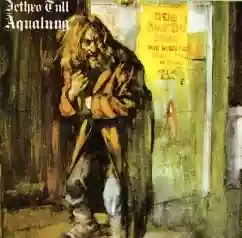
It starts with "Aqualung", the most famous and engaging song by the Tull; everyone knows the story: accompanied by an exciting riff, it talks about an old, filthy, dirty tramp who nonetheless inspires deep tenderness. He is the same beggar who appears in that very original cover design that seems to have the same features as the great Jan; however, I have read that it does not wish to allude to his possible past of poverty and that resemblance is intentional but does not hold any sort of hidden meaning.
It then moves on to "Cross-eyed Mary", Mary the cross-eyed, a prostitute who does nothing but beguile rich men to steal their money and donate it to the poorer ones, thus acting as a perfect female counterpart to the legendary Robin-Hood; succeeding this are the sweet and refined "Cheap Day Return", "Mother Goose" and "Wond’ring Aloud", the romantic of the group, which in themselves do not possess strong impact rhythms but are indispensable for the album’s proper balance; in the second song, the same Aqualung speaks of his melancholic past. The first part closes with the lively "Up To Me", preceded by loud laughter, which narrates with a strong tinge of melancholic irony the sad life of the poorest strata of English society; in general, these songs talk about: the various aspects and the many dark shades of the lives of the poor and the marginalized.
The second part begins with the other "captain" song, namely "My God". It starts with quiet verses but composed of strong words, as if in the midst of repressed anger, and then it explodes into a merciless but rational scream meticulously channeled throughout all its wrath in an irresistible chorus, which chills the blood; the reason for such fury is found in the anti-clerical (yet not anti-Christian) nature of the Pied Piper. This is followed by the ironic and catchy "Hymn 43", and the beautiful "Slipstream" which revolves around the theme of Death. This track is a sister to "Cheap Day Return" due to its calmness and brevity.
"Locomotive Breath", the next song, is inimitable for its beauty, as is irresistibly charming the sweet "Wind Up", which softly but angrily strikes against bourgeois hypocrisies, which hints at those who have not succeeded in life, and who once again shout against the despotic and unjust church.
The album will be followed by some bonus tracks ("Lick Your Fingers Clean", "Wind Up (Quad Version)", "Songs For Jeffrey", "Fat Man" and the beautiful "Bourée") plus an interview with Jan Anderson.
In general, it is a moving and profound album that requires a great number of listens to be appreciated in all its grandeur even though many skillful and peculiar choruses immediately catch the ear; "Aqualung" will especially appeal to those who particularly love the Medieval era because undoubtedly one can particularly sense in the last songs the medieval English charm, the theme of the wanderer and the minstrel, the warm atmosphere of taverns and inns.
Although obviously, the musical genre can’t be more different, I would feel like comparing it to other gems like Aion and The Serpent’s Egg, by Dead Can Dance, given the relevance of the context, the Middle Ages indeed.
Just as the ethereal Lisa Gerrard whispers her masterpieces with incredible charm, so the great Jan plays his flute with incredible skill, both aware of awakening distant eras, remote times, and diverse cultures in the wonder of their listeners.
Loading comments slowly
Summary by Bot
This review praises Jethro Tull's album Aqualung for its masterful blend of rock, hard rock, and British folk. It highlights the album's two-part structure, legendary tracks like 'Aqualung' and 'Locomotive Breath,' and its deep social and anti-clerical themes. The reviewer appreciates Ian Anderson's flute mastery, comparing his impact to iconic artists and medieval musical influences. Overall, Aqualung is celebrated as a profound and timeless classic demanding repeated listens.
Jethro Tull
Jethro Tull are an English rock band formed in 1967 and long led by Ian Anderson. They are known for blending progressive and folk rock around Anderson's prominent flute and for landmark early-1970s albums such as Aqualung and Thick as a Brick.84 Reviews
Other reviews
By Stràfiko Piezzecore
One of these is Aqualung, the 1971 album by Jethro Tull. It’s the story of a tramp – Aqualung, indeed – seen as a product of a self-generated and destructive humanity.
An album that – for crying out loud! – cannot be missing from the shelves of a person with honest intellectual capabilities.
By Trespass84
The most brilliant high point in the long history of this group is probably the 1971 album, “Aqualung”.
"My God" ... Certainly a masterpiece made such by its structure ... just listen to it!!!
By STIPE
"The famous supreme guitar solo by Martin Barre leaves you breathless. One of the best solos of all time!"
"The album has represented a milestone in the history of rock, certifying the legend 'of the man who played the flute on one leg.'"
By pier_paolo_farina
An album whose half is dedicated to harsh criticism of those churches intent on hoodwinking the pious souls.
His flute so supreme and coquettish adorning both My God and Cross Eyed Mary, two pieces that fall perfectly so beautiful and charming.
