
 •
Versione 1
Rating:
•
Versione 1
Rating:
THE REVIEW
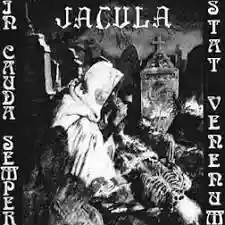
In Cauda Semper Stat Venenum by Jacula is a remarkable case of historical forgery. The album is dated 1969 but the sounds are, upon close examination, artificial and probably date back to the '80s. The late Antonio Bartoccetti, on the other hand, was always a deceiver. His projects have always been shrouded in an aura of mystery, and it hasn’t always been easy to understand what was behind them. It was said that Jacula’s albums were intended for monasteries (I would like to know if it’s true, anyway I wrote a story on the topic). When I reviewed the book “Magister Dixit” he wrote me directly saying I should “dwell more on the subject of demonic possessions”. In fact, according to him, he was in contact with a girl who had undergone an exorcism. In reality, "Tardo Pede In Magiam Versus" (this one is authentic) was sold together with the Jacula magazine, the porn-horror comic. Some claim, even regarding “Tardo Pede In Magiam Versus”, that the quality of the music was mediocre. I disagree with these assertions: at the time the album was very original: there was no drums and the sound was characterized by a beautiful church organ and beautiful gothic atmospheres. The situation changes instead with this "In Cauda Semper Stat Venenum": the Tony Iommi-style guitar sounds are fake and everything smells of deceit. Despite this, I read online reviews that praise it as a masterpiece of sick and sepulchral sound. Couldn’t be more wrong. But it doesn't end here: the lyrics are Italian translations (as attested by some enthusiast) adapted from excerpts taken directly from “In The Court Of The Crimson King” by King Crimson and “Pawn Hearts” by Van Der Graaf Generator, which are later than 1969! It’s hard to believe that Peter Hammill and Pete Sinfield wrote the lyrics for In The Court and Pawn Hearts by translating Jacula's lyrics into English. There are cases of this kind but here we would be beyond ridiculous. The album is, in every respect, a remarkable case of backdating.
Here’s a small example:
Jacula, 1969
Solo, sei solo
gli spiriti in coro chiamano,
mi abitano nella notte,
la sola vita che sento è la presenza del divino
Van Der Graaf, 1971
Alone, alone the ghosts all call,
pinpoint me in the light,
The only life I feel at all is the presence of the night.
Jacula, 1969
So che non c’è tempo,
so che non c’è nessuna rima,
veri segni trovatemi
Van Der Graaf, 1971
I know that there’s no time,
I know that there’s no rhyme,
false signs find me.
Loading comments slowly
Summary by Bot
The review exposes Jacula's 'In Cauda Semper Stat Venenum' as a deliberate forgery backdated to 1969 but likely produced in the 1980s. It criticizes fake guitar sounds and plagiarized lyrics taken from King Crimson and Van Der Graaf Generator. The album's mysterious aura and Bartoccetti's deceptive nature are discussed, emphasizing that this release lacks the originality and authenticity of earlier Jacula works.
Jacula
Jacula is an Italian occult/progressive rock group led by Antonio Bartoccetti, known for organ-driven, drumless atmospheres, esoteric themes, and links to the related project Antonius Rex. Classic albums include Tardo Pede in Magiam Versus (1972) and the debated In Cauda Semper Stat Venenum, with a 2011 revival titled Pre Viam.06 Reviews
Other reviews
By mayhem
Bartoccetti manages to invent a sick, decadent, and dark sound, absolutely ahead of anyone else.
Despite the heaviness of some passages, it can rightly be called a masterpiece of dark, or dark-gothic if you will (...we’re in 1969!).
