
 •
Rating:
•
Rating:
THE REVIEW
These days, enormous colorful Berlusca-sized posters summarizing upcoming musical events are plastered on walls. Since they are collective, with eight or ten faces and dates, you might see side-by-side two faces that alone give an idea of the abyss between the two characters: one is the codfish-like (unsalted) face of Max Pezzali, the other has the same sad smile and the same bob haircut (now grayed) that Jackson Browne had 30 years ago.
Since this site is about music and not psychiatry, it's the latter I'd like to talk about. I confess I know nothing about his recent works, so I take advantage of the thirtieth anniversary and go back to "Late For the Sky," for many his masterpiece but also a highly debated work. It must be said that in the mid-70s, many critics, still drunk on the post-'68 euphoria, would trash any album and art form that strayed even slightly from the pure exaltation of the "revolution" (exactly which one is unclear). In Italy, De Gregori and Guccini experienced this, despite not being dangerous blackshirts, as we know.
In the USA, it was particularly poor Jackson Browne who got labeled as a "voice of retreat," just because he preferred existential topics over political ones... as if feelings and personal stories didn't ultimately translate into political actions!
This kind of stamp, a "scarlet letter" (you are "the one about retreat," shame on you!), overshadowed the substance, the value of this Californian singer-songwriter, which was not just the ability to write cultured and refined lyrics, but also a great melodic inventiveness, necessary to best express that state of mind between serene and resigned, that "sad smile" that prevails in his songs. For this purpose, he could rely on solid musical bases given by the so-called "West Coast sound," that type of music said to evoke in the collective imagination the sensation of expansive and desert spaces, with endless highways where adventurous journeys are made, naturally hitchhiking. Beyond these American film clichés, essentially this translates into calm ballads, with clear acoustic guitars in the foreground, somewhat like country music but without its banality and monotony. Occasionally, there's a tentative foray into rock, but gentle, discreet, never over the top.
Even in this, which is his most "personal" album, Jackson Browne gives ample space to his calm melancholy, to the splendid slow songs, to the sweet intertwining of guitars and keyboards. It's hard to find a standout song, but "Fountain Of Sorrow," with its gait foreshadowing the crystalline blues-rock of Dire Straits, "For a Dancer," with its poignant fiddle, which evokes deep Cohen-like sadness, the same "Late For the Sky," with its classical piano, and the majestic slow finale "Before the Deluge" are a step above the excellent average quality of the entire album. Thus, I've already mentioned half the album, so it's quicker to say that the quality only slightly dips in the only two vaguely rock songs: "The Road And The Sky" and "Walking Slow."
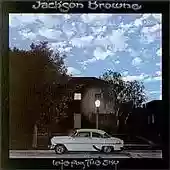
One can't close without a mention of the splendid cover, with Magritte-like play of light, an additional touch of class for a splendid album, very relaxing yet never boring.
Loading comments slowly
Summary by Bot
This review revisits Jackson Browne's 1974 album Late For The Sky, regarded as his masterpiece and a key West Coast sound example. It highlights the album’s melancholic, introspective lyrics and refined melodies, praising standout tracks like "Fountain Of Sorrow" and "Before the Deluge." The review also discusses the album’s underrated reception during its time, due to its focus on personal rather than political themes. The evocative cover art adds an extra touch of class to this timeless, heartfelt record.Tracklist Lyrics Videos
Jackson Browne
American singer-songwriter and musician, born in Germany and raised in Los Angeles. Emerging from the Greenwich Village/LA scenes, he debuted on Asylum Records in 1972. Known for literate, introspective songs and the West Coast sound, with landmark albums through the 1970s and enduring live and acoustic work.07 Reviews
Other reviews
By alby66
"Late for the Sky is a journey through suffering, aimed at catharsis, not self-destruction."
"Never in any other album has Jackson represented himself with so much honesty and sensitivity."
