
 •
Rating:
•
Rating:
THE REVIEW
Undoubtedly the most interesting talent of the Cream lineup, an innovator in his instrument's role, a personal and competent singer, and a precious composer, Jack Bruce released his first solo work in 1969.
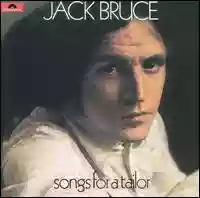
"Songs For A Tailor": songs for a tailor. The feminine is necessary, as the album was dedicated by Bruce to a stylist friend, Jeannie Franklin, who passed away that year after a car accident while she was with the Fairport Convention.
The difference between this work and the previous albums with the Cream is the surprising richness of the compositions. This album is strongly and deliberately an album of songs, with complex harmonies and substantial arrangements. Bruce leaves behind the constraints of the most super supergroup ever seen in rock history, one of the few that actually produced good music (at times) and not just an excuse to attract enthusiasts to a formula that often thrives more on appearance than substance.
Although less in the spotlight than his fellow band members (Clapton was the God of six strings and Baker the king of drummers at that time), the Scottish bassist surpassed them by far in talent. Nobody before had given the electric bass such an authoritative voice, far beyond its role as the link between rhythm and harmony. Without Bruce, it's uncertain the path the four-stringed instrument would have taken, but thanks to a top-level musical background, including conservatory training as a cellist and as a double bass player in the jazz world, he showed oblivious listeners what could be achieved with a Gibson eb3, a FullTone pedal, without being failed guitarists forced to play such a little "protagonist" instrument.
Regarding his role as a composer, if you overlook the eternal hit "Sunshine Of Your Love", there are many masterpieces Bruce created during his time with Cream, in collaboration with the loyal lyricist Pete Brown. "White Room", "Politician", "I Feel Free" and the overlooked but splendid "Deserted Cities Of The Heart" are just some of the many titles from the Glasgow musician. "Songs For A Tailor" adds more, perhaps even more delightful ones.
The classic "Theme For An Imaginary Western" is the most well-known track of the collection: a Bachian ballad, with atmospheres similar to "A Whiter Shade Of Pale" but more complex, both harmonically and rhythmically. But from the beginning, you realize that this album presents a strong characterization of musical writing. "Never Tell Your Mother She's Out Of Tune" and "Ministry Of Bag" are rich blues, accompanied by a great horn section, including Harry Beckett and Dick Heckstall-Smith; yet, it’s the more intimate and imaginative moments that are most captivating: "Ticket To The Waterfalls" is a rock rumba with an introduction, where Bruce’s baroque bass craftsmanship is deeply highlighted. Similar to "Theme For An Imaginary Western" is the wonderful, paradoxical "Weir Of Hermiston", inspired by an unfinished novel by Stevenson, lush, melancholic, with a solemn piano accompaniment that transforms into a brief, unexpected twist. "He The Richmond" is a boogie-funk reminiscent of Van Morrison's "Moondance", but with more sarcasm in Bruce's singing, seasoned with classic descending scale countermelodies of the "Burned" bass. "Boston Ball Game" is African blues arranged for a small orchestra, akin to certain scents of contemporary South African jazz (Lewis Moholo, Chris McGregor). "To Isengard" is the only acoustic moment on the record, contemplating "The Lord of the Rings" and "The Clearout", which closes the collection, is the song closest to Cream and their expressions.
A special place deserves the splendid "Rope Ladder To The Moon", performed with some members of Nucleus (Chris Spedding, John Marshall); a mysterious and eerie song, also famous in the version done by Colosseum in their live performance; there it became a Dionysian orgy of virtuosity for Chris Farlowe's voice, Dave Greenslade, and Jon Hiseman (immense drummer, present in almost all the tracks of "Song For A Tailor); here marked by a murky cello background and Marshall's essential drumming. An "relentless" song.
Following this masterpiece, Bruce created "Things We Like", a rock jazz jam with John McLaughlin, of modest interest, and "Harmony Row", the true second solo album after "Songs For A Tailor", beautiful but not at the same level. Meanwhile, important collaborations, with the edition of Tony Williams' "Lifetime", alongside the great organist Larry Young, and Carla Bley's "Escalator Over The Hill", a historic '70s jazz "melodrama".
In conclusion, despite the ups and downs, Bruce remains the most interesting musician of the Cream triad, even if the least known: far beyond Clapton's mediocre and stylistically rich instrumentation and Baker's heavy drumming, often brilliant but equally prolix and dull. If his role as the most important rock bassist is indisputable, his talent as a composer and singer is equally significant. "Songs For A Tailor": an album to rediscover, recently reissued with bonus tracks, for the sixty years of the choleric genius and boozer from Glasgow.
Loading comments slowly
Summary by Bot
Jack Bruce's 1969 solo album 'Songs For A Tailor' reveals his extraordinary talent beyond Cream. The album features intricate compositions, rich arrangements, and innovative bass work that redefine the instrument’s role in rock. Dedicated to a lost friend, it blends blues, jazz, and rock with memorable tracks like 'Theme For An Imaginary Western'. This work highlights Bruce's strengths as a composer, vocalist, and pioneering bassist.Tracklist Lyrics Videos
Jack Bruce
Jack Bruce (born 1943, Glasgow – died 2014) was a Scottish bassist, singer and composer. A co-founder of Cream with Eric Clapton and Ginger Baker, he became one of rock’s most influential electric-bass voices and pursued an adventurous solo career spanning rock, blues and jazz fusion.02 Reviews
