
• Versione 1 Rating:
THE REVIEW
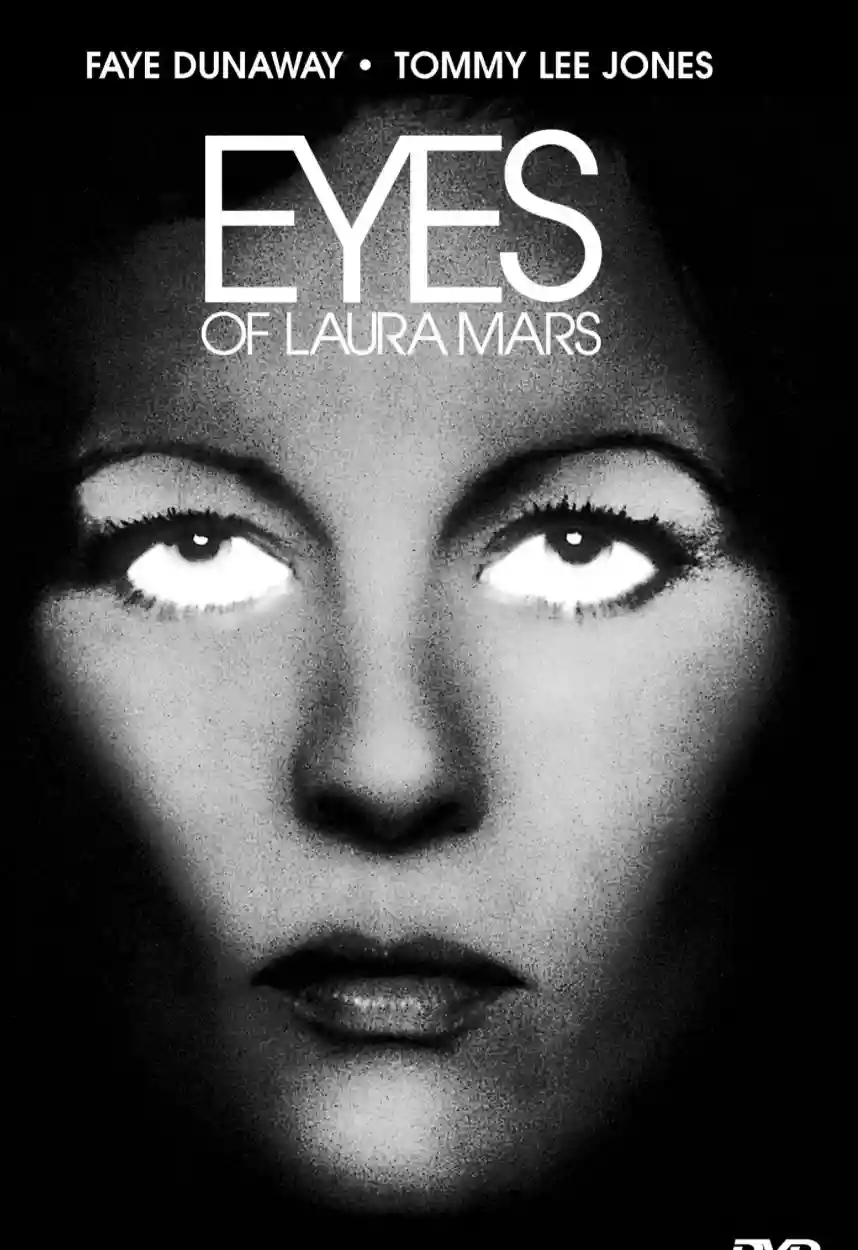
Eyes of Laura Mars (1978) is one of those films that, on paper, promises far more than it could ever hope to deliver, and then spends two hours politely confirming your worst suspicions.
A controversial fashion photographer who sees murders as they happen. A decadent New York poised between grit and reinvention. Glossy interiors already drifting toward the beige minimalism of the future, while everyone else is still happily trapped in baroque 70s excess. Add a clique of insufferably chic fashion creatures, a few dutifully rough policemen, and a very young Tommy Lee Jones with long hair that suggests a brief but sincere lapse in judgment, and the ingredients seem almost irresistible.
Unfortunately, something goes wrong - and not subtly.
The central problem may well be Faye Dunaway as Laura Mars. Striking, maybe, but never quite convincing as the creative force behind the disturbing, violent photographs (courtesy, in reality, of Helmut Newton). Rather than dangerous or transgressive, her Laura feels oddly decorative, as if she had wandered onto the set, been told she was a genius, and decided not to argue. When hysteria is required, she delivers it generously, but generosity is not always the same as control.
Then there is the small matter of her “visions,” which arrive, recur, and eventually resolve in a way that suggests explanation was considered but ultimately deemed unnecessary. They function less as a narrative device than as a stylistic accessory, like a particularly impractical handbag.
As for the mystery, some claim - usually with suspicious confidence - that the culprit is easy to guess. This is doubtful, and in any case beside the point. The killer operates with such cheerful arbitrariness that deduction becomes less a matter of logic and more a form of gambling. The film itself seems only mildly interested in who did it, provided someone is available for a last-minute unlikely plot twist.
What remains, however, is the atmosphere, and here the film almost redeems itself. As a time capsule, it is undeniably compelling: the heavy makeup, the aggressive glamour, the peculiar marriage of fashion and violence that now feels both naïve and faintly deranged. It captures a moment when excess had not yet been house-trained, and when bad taste still had the courage of its convictions.
With a script by John Carpenter, one might expect a stronger spine; instead, the film feels like a collection of good ideas left unsupervised. Directed by Irvin Kershner, later entrusted with The Empire Strikes Back, which suggests someone, somewhere, saw something worth encouraging, it remains an oddly prestigious misfire.
Stylish, incoherent, and ultimately hollow: like a glossy photograph where everyone looks fabulous, and no one quite knows why they’re there.
Loading comments slowly
Summary by Bot
The review critiques Eyes of Laura Mars as a stylish but ultimately unsatisfying thriller. While praising its compelling atmosphere and 70s decadence, it finds fault with casting, character depth, and narrative logic. The visuals impress, but the film lacks narrative cohesion or convincing performances. The script, despite John Carpenter's involvement, doesn't fully deliver. In the end, it's seen as an evocative but hollow cinematic experience.
Irvin Kershner
Irvin Kershner (1923–2010) was an American film director best known for Star Wars: The Empire Strikes Back (1980), Eyes of Laura Mars (1978), Never Say Never Again (1983), and RoboCop 2 (1990).03 Reviews
