 •
Rating:
•
Rating:
THE REVIEW
In the prosperous constellation of diadems of the Iron Maiden Universe, for the enthusiast, it is ever so difficult to isolate a star, so rich is their musical heritage. Icon of the NWOBHM, with very few stumbles, constantly blooming with creativity each decade, enriching album after album, tour after tour their choreographic/musical repertoire, the band has successfully established itself at the pinnacle of every heavy-laden celestial sphere.
And so, in such a dazzling scenario, choosing one album over another is anything but a vain choice; the musical identity articulated in the sequence of compositions has progressively modulated the Iron Maiden's SELF through silent maturation marked by the developments of their creativity.
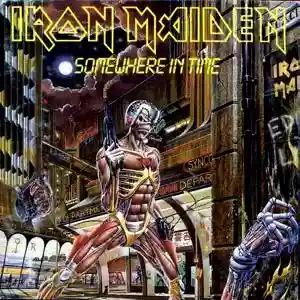
One of the most important moments in this lustrous cursus honorum took place in the second half of the '80s; it was the Annus Domini 1986 and the tumultuous audiences that had crowned the glories of that milestone named Live After Death, were eager for the new life Eddie would assume after the Egyptian opulence of Powerslave. A new age, stemming from an ultra-millennial historical traversal, thus arrived like a whirlwind in record stores on September 29, 1986; from the refined archaisms of Egyptian spirits to the disintegrating multifaceted media presence of an alternative future, Eddie, emulating a cyborg killer, reinterprets his previous eras with the futurist flair punctuated by the polychromaticity of crystalline compositions.
And so, who knows what astonishment may have disoriented the dawn enthusiasm of the listener when the intro of Cauth Somewhere in Time literally shattered the linear sounds of that fil rouge of the previous 5 platters; softly sudden, the appearance of never-before-seen instrumentation like guitar, bass synth hexaphonic pickups, and other avant-garde technical finds, stormed into the metal world, coloring it with the muffled tones of keyboardist infusions.
Framed this way, it might sound like pure blasphemy, yet here the smoothing breeze had the merit of being an intelligent sound expedient: a pure added value that delicately enveloped both the arrangements in general and the care of the lyrics.
The imprinting, as mentioned, shines with the complex Caught Somewhere in Time: a recurring moment where Steve Harris hardly conceals his unconscious prog vein, entangling in a thicket of colorful riffs and syncopated time changes. The result is almost a silent intuitive flash for the future creativity of Tool. Following this electronic/progressive beginning comes a dyad highlighting the perhaps never fully optimized executive/compositional virtues of Adrian Smith. The first one, Wasted Years, apparently eyeing the metal hit parade trend, actually represents a rare example of sublime linear creativity: retracing in the lyrics the titanic efforts of the just-ended World Slavery Tour, with its riffs the guitar soul of Iron Maiden captures the listener's mind into universes of parallel sublimity. The narrative then continues with Sea of Madness, the second bastion attributable to Smith's creativity; in some respects, it complements the discourse initiated with the opening track, disarticulating into an amorphous rhythmic structure. Carried by a brilliant wall of sound with a dreamy flavor, synthesized guitars sketch another marvelous example of prog concentrated within the canonical 5-minute time frame.
The duration, however, returns to expand along with the song form in the subsequent tracks: Heaven Can Wait, in certain ways, emulating in its lyrics what the Bassist had already stated with Hallowed Be thy Name, reveals itself as a track with complex yet sumptuous executive lines. Undoubtedly, it is one of the album's peaks; particularly noteworthy is Dickinson's versatile voice, a cadence of osculating wind here personalizes with rare nonchalance the complexity of rare technical metric performability.
And it is precisely the executive factor that fills the listener’s emotions with jolts with the correspondence resumed at the beginning of side B. A slow ascending phrasing introduces us to “The Loneliness of the Long-Distance Runner”; mirroring in its complexity level “Caught Somewhere in Time,” the track disentangles into a frantic rhythm drafting skillfully cadenced rhythmic progressions by McBrain's millimeter-precise drumming. Despite being substantially snubbed by a part of critics and fans, the following “Stranger in a Strange Land” deserves absolute consideration, a historical account of the unfortunate fate of a scientific expedition lost in the polar ice of which only a few survivors (among whom inspired the idea to Smith) could recount: a pure illusory journey painted with atmospheres as roaring as dreamy. Even more expressively compared to “Sea of Madness,” here the sounds convince with a stylistic refinement of rare quality, and even here as in the aforementioned track, it is the beautiful median guitar break that imposes melodically rare suggestive imagistic moments.
Following is the only moment attributable to the signature (jointly with Harris) of Dave Murray: Déjà Vu. Again, a mellifluous incipit flows into a track, though less complex than the album’s average, yet absolutely in line with the spirit pervading it. Indeed, here perhaps more than elsewhere, it is the lyrics that set the tone, embedding between the lines concepts much less abstract than a superficial listener might think (“Ever had a conversation that you realize you’ve had before, isn’t it strange? ‘Cause you know you’ve heard it before.”).
And it's always on the latent yet so recurring footsteps of that unconscious prog that the most epic majesty unlocks its own epilogue. A martial progression with a grave tone introduces the musical apologia of the most illustrious Macedonian commander. Despite the song's lyrics being nothing but a survey of historical facts about Alexander the Great, Alexander the Great reflects the grandeur of its title in its physiognomy and over its more than 8 and a half minutes duration, it carries forward a sonic prose of rare majesty. In the long instrumental phrases forming its backbone, the song's soul unleashes a chameleon pathos particularly evocative of the ancient glory of the Hero celebrated.
Such splendor represents the ideal finish for an album that, along with its successor, reaches the thresholds of perfection. A true gem set within a treasure of jewels that for many years unjustly overshadowed its splendor.
Beyond the horizons of those who insist on viewing this work as a superfluous contamination of commercial sounds, it can instead be answered that it is precisely their deliberate infusion that renders it one of the most intense pieces in the discography of one of the queens of Metal.
Loading comments slowly
Summary by Bot
This review highlights Iron Maiden's 1986 album Somewhere In Time as a pivotal release combining progressive metal with new electronic instrumentation. The album is praised for its sophisticated riffs, technical execution, and evocative storytelling. Tracks like 'Caught Somewhere in Time,' 'Wasted Years,' and 'Alexander the Great' stand out as hallmarks of the band’s evolving musical identity. The review defends the album’s blend of synths and classic metal as an intelligent, artistic choice, marking it among Iron Maiden’s finest works.Tracklist Lyrics Videos
Iron Maiden
British heavy metal band formed in 1975, led by bassist and principal songwriter Steve Harris. Famous for epic studio albums, theatrical live shows featuring vocalist Bruce Dickinson, and the mascot Eddie.180 Reviews
Other reviews
By velvetunderground
Iron is like a sea, an ocean of sounds, of shivers, and the swimmer has no choice but to dive in and swim, swim, swim...
Alexander The Great, (just to name one)... a hard rock, dark, (grotesque) a crystal-clear tunnel, horrid... (fortunately pieces like this exist in music, in history, in life)
By MetallAro
The album offers many and original experimentations, starting from the introduction of background keyboards.
I sing, or rather shout the chorus at the top of my lungs, while my parents worriedly call 911.
By juve in B
'Wasted Years' washes away any bitterness: a masterpiece written in collaboration by Adrian Smith.
'Alexander the Great' ... the best song on the album, unfortunately never played live.
By Kirk89
It’s like living in this futuristic world, and one has the sensation of not being able to get out.
Each label you see, even the most insignificant ones, makes you invent an event of history that has nothing to do with it or that has not yet occurred.
By pepozzo
The first track 'Caught Somewhere in Time' catapults us into a futuristic universe with keyboards and synthesized guitars.
'Wasted Years' is a concentrate of emotions, with choruses wonderfully sung by a Dickinson in top form.
