
 •
Rating:
•
Rating:
THE REVIEW
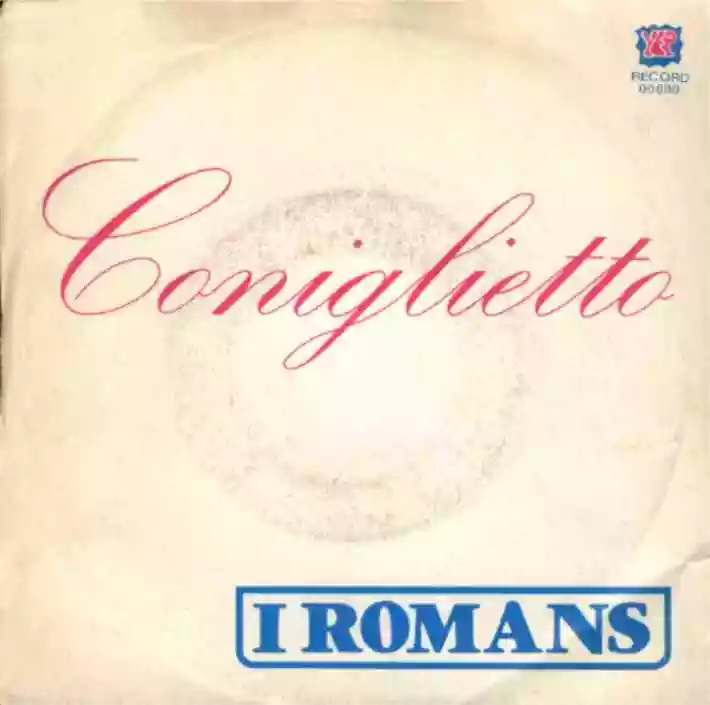
It was 1976 when from Yep Records the Romans released one of their most successful singles. Let's take it step by step. At the time, the singer Coclite refused to record `Tornerò` for the Santo California, which led to yet another dispute within the group, resulting in his subsequent departure. The new lead vocalist then became Daniele Aloisio. The changes were evident. In fact, `Coniglietto` was the first song of the 'new era' of the Romans, one of the key bands of the Italian light music movement.
Written by Claudio Natili and Ignacio Polizzy (a fundamental figure in the group's career), `Coniglietto` stands out as one of the band's most famous tracks. The style remains tied to the song form's canons, so dear to the group from the beginning, as well as to their colleagues, the Camaleonti. The beginning is marked by the choir of various members, who sing a `No Coniglietto No`, which repeats several times throughout the song, providing a vocal backdrop to the track. And then a piano marks Daniele's voice (E' stato bello averti qui per un momento amore/ Senza pensare a quelle notti buie chiuse in un cassetto vuoto/ Adesso non c'è più quella bambina con me/ Adesso non c'è più, ti ho fatto donna). The lyrics are clear so far. It's about the return of a love, the 'coniglietto' so beloved by the singer, invited by the latter not to think about the past. The change is thus revealed, due to the coniglietto, who becomes a woman. We can say that the coniglietto has become a rabbit. But let's move on.
Your scent on your skin pleases me to no end
As I mirror myself in your big eyes, you tell me softly
Love, now goodbye, I have to leave, you know
You give me a kiss and I hold you tight
Here, the protagonist's enjoyment of the rabbit's scent is highlighted. And then a farewell, a sad goodbye marked by a hug and a kiss. In short, it's clear that the rabbit is leaving, far from the man who loved it so much. A gentle piano still supports the heartbreaking lyrics. But here come the choirs again (No coniglietto no, no don't go away), with the vocalist's voice cutting through, shouting `Senza di te la mia compagna è la nostalgia`.
My fragile hope of finding a great love has become clear BECAUSE NOW I'M FALLING AGAIN. So reads the final part of the chorus. As with the greatest poets, in music and otherwise, interpretation can often lead to crossroads. We do not know for certain what Polizzy meant with this line. What was finishing again? It means they had already ended it. The artist sings in the past tense. The only thing we are sure of is that the rabbit's departure caused the castle of love in our protagonist's heart to collapse. The Caps are due to an elevation in the singing's intensity.
And here returns the piano. The singing resumes delicately (Ti vesti piano nella stanza buia quasi senza far rumore/ Il tempo passa e va, vorrei fermarlo ma tu/ Sorridi e stai chiudendo la mia porta). The rabbit struggles in the dark room as it cannot dress without making noise. And while the singer thinks about how to stop time, the rabbit closes the door, smiling. A sign of goodbye towards the beloved. And here again, the characteristic choirs of the song, invoking the coniglietto. Again the chorus, the piano fades, the guitar intervenes with a brief solo by Natili concluding a track full of nuances, never trivial and above all with a hundred hidden meanings. One wonders what happened to the rabbit. One asks where the coniglietto's destination was, and the reason why the two lovers had to part. But just as we wonder, the desire to press play again makes us forget all doubts. Enjoy listening.
Loading comments slowly
Summary by Bot
This review explores 'Coniglietto,' a 1976 single by the Italian band I Romans marking a new era after a lead singer change. The song blends emotional lyrics with rich vocal choirs and piano accompaniment. It captures themes of love, loss, and nostalgia, driven by thoughtful songwriting and performance. Despite questions about the song’s deeper meaning, its engaging melody invites repeated listening.
I Romans
I Romans are a Roman pop/light-music group formed in 1959. Early lineup included Claudio Natali, Ignazio (Ignacio) Polizzy, Diego Petrera and Alberto Cori. They scored radio hits in the 1960s and 1970s (examples: Voglia di Mare, Quanto una donna..., Coniglietto). Reviews note lineup changes, the departure of singer Coclite, Daniele Aloisio as a later lead vocalist, and that Claudio Natali remained associated with the group; Ignazio/Ignacio Polizzy is recorded as deceased.02 Reviews
