
 •
Rating:
•
Rating:
THE REVIEW
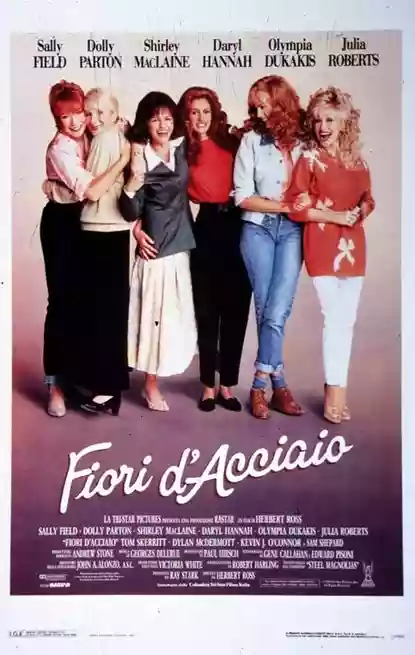
STEEL MAGNOLIAS (1989) 6/10
Herbert Ross is one of those directors whose films we’ve all seen at least once, but whose name we’ve forgotten (or, to be honest, never really learned). And yet he directed “Play It Again, Sam” (1972), “The Sunshine Boys” (1975), “The Goodbye Girl” (1977), “Footloose” (1984): not exactly obscure films, let’s say. And yet his name leaves most people indifferent (much like Hal Ashby, another great director who always remained a bit on the sidelines). Born in New York in 1927, among other things he also worked in Italy alongside Garinei and Giovannini, taking care of the set design for that theatrical masterpiece which was, in 1962, “Rinaldo in campo” (Modugno, Panelli, Delia Scala). In 1989, at the ripe old age of 62 (he would pass away in 2001), he directed “Steel Magnolias,” a film which went almost unnoticed in Italy but was a major hit in the USA—the most resounding success Ross had enjoyed since “Footloose” five years earlier.
The original title, “Steel Magnolias” (a nickname for the women of the Southern US states, where the film is set even though the depicted town is entirely fictional; in Italy, there is actually a basketball team called “Magnolia Basket Campobasso,” named after the film), is much more in tune with the spirit of the work than the insipid Italian title. Essentially, it’s a dramatic comedy in the same vein as “Terms of Endearment” (1983), that mix of laughter and tears here pivoted around a female cast, since it’s the women (fragile, strong, insecure, unbreakable) who truly drive the narrative, while the men have far less presence. The film’s main flaw is having come out at the end of the 1980s, during the era of telenovelas reigning over every television channel worldwide (“Dallas”; “Los ricos también lloran”), and its overall tone is reminiscent of that style—certainly superior to TV products, sturdier in direction (Herbert Ross masterfully “handles” a large ensemble cast that, while not quite on Altman’s level, holds its own at times), but the tears can feel a little “cheap,” some situations are a bit predictable, and the running time is frankly excessive (118 minutes). Still, as I was saying, the film was such a hit that a TV series was planned (though only a pilot episode was made), and a (rather modest) remake was released in 2012, but only on American TV (with a totally wasted high-caliber cast).
Here instead, Herbert Ross assembles in a single movie—believe it or not—Sally Field, Julia Roberts (22 years old, in her fifth film, a year before “Pretty Woman”), Olympia Dukakis, Shirley MacLaine, Daryl Hannah, Dolly Parton, Sam Shepard, and Tom Skerritt. Based on a play by Robert Harling (who also wrote the screenplay), the film does “suffer” from a certain static quality, occasionally becoming a bit too monotonous (after all, the events largely revolve around a hair salon run by Truvy Jones [Dolly Parton]), but it hardly matters. The main idea is to bring together all possible female generations on the screen (the 20-something Julia Roberts; the 40-something Sally Field; and Olympia Dukakis as a middle-aged woman), ready to back each other up, support and comfort one another despite life’s dramas (Roberts, here playing Shelby, decides—after getting married—to have a child despite having a severe form of diabetes). Drama always lurking, but also an instinctive will to live.
Ross knows that in a film like this, the strength can only come from the actresses on screen (and their respective powerhouse scenes), and he does everything to let them shine: meticulously controlled camera movements that capture every glance, grimace, or flutter of an eyelash from his (it must be said—wonderful) actresses. The men, as I mentioned before, play their roles: they’re not villains, but the film is, let’s say, not really about them. The dialogue is exceptional—another strength of the movie—even though, as the film goes on, a little fatigue does inevitably set in, in both the pace and the audience (even for the most indulgent viewer). A “women’s film” for women? No, even men will find something here to learn.
(Today On TV On La7 Cinema, 2:25pm).
Loading comments slowly
Summary by Bot
The reviewer finds 'Fiori d'acciaio' by Herbert Ross underwhelming, awarding it a low rating. Despite its classic status, the film fails to impress, suggesting it may not resonate with everyone. The review highlights unfulfilled expectations and overall disappointment. This assessment stands out in contrast to the film's reputation.
Herbert Ross
Herbert Ross (1927–2001) was an American film director and choreographer from New York City. A former Broadway choreographer, he became a major Hollywood filmmaker known for dialogue-driven comedies and dramas, frequent collaborations with Neil Simon, and dance-centered films.03 Reviews
