
 •
Rating:
•
Rating:
THE REVIEW
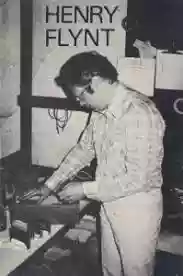
Henry Flynt is one of those characters who carries with him one of the most interesting and controversial stories of the last century.
A philosopher and avant-garde music composer, he was born in 1940 in Greensboro, North Carolina. He began his musical studies at a young age. During college, he met Tony Conrad (who would become another important avant-garde music composer, famous for collaborating with the kraut-rock/experimental group Faust), and it was precisely Conrad who was able to connect him with the famous minimalist composer La Monte Young. Flynt was immediately seen as a young talent by Young, giving him the opportunity to compose and thus appear in some events managed by La Monte Young himself. This was the spark that ignited Flynt's musical career, which he would then pursue with passion and commitment, all the while maintaining his political and philosophical activities.
A few years later, his eclectic mind and controversial activities as a philosopher began to cause him no small amount of problems, isolating him from other communities. He created the term concept-art, an expression in which “the materials are the concepts, just as the material for music is sound.” In 1961, he adhered to the small sect of those who belonged to the so-called artistic movement called "Fluxus," a term coined by George Maciunas, a Lithuanian architect naturalized American. The term Fluxus represents a project aimed at the fusion of all the arts, while still respecting their characteristics and drawing the best from each of them. It is an anti-commercial and anti-artistic artistic movement. Fluxus was also strongly influenced by John Cage's ideas on experimentation, which involved starting actions without knowing what results they might eventually yield, thus giving much more importance to the process of creation than to the final product. In Fluxus, indeterminacy dominates, and art's depersonalization should culminate in the depersonalization of the artist.
In 1966, Flynt had the amazing opportunity to play with the then-totally unknown Velvet Underground. He was literally enchanted and indoctrinated by the psychedelic and twisted viola of another John, this time the famous John Cale, (Flynt was a violinist), probably the real architect of the unparalleled innovation brought to completion by the Velvet Underground.
The seventies represented the core of Flynt's musical experience before his consecration; he had the honor of taking private lessons from his childhood idol and now acclaimed artist, La Monte Young.
In the early eighties, there was a rapprochement between Flynt and Catherine Christer Hennix, another composer, philosopher, mathematician, and poet interested in experimentation like Flynt.
Thus began the first live recording sessions, with Flynt on electric violin and Hennix on tambura (a traditional Indian musical instrument, similar to the Sitar), including an album titled You Are My Everlovin / Celestial Power, which featured only two long experimental suites with a total duration of about ninety minutes.
The music of Flynt and Hennix goes beyond any expectation; they manage to blend the icy, screeching viola of John Cale and the Velvet Underground with the more psychedelic and deranged aspects of Minimalism by La Monte Young and Terry Riley. They also fuse rural music, Blues, and Country with the traditional Indian music of Ravi Shankar.
The album, released a good six years later, is nevertheless a decade ahead of its competition, representing a truly indissoluble pillar.
Noise, drones, and psychedelia are the main elements of the Flynt/Hennix duo, which clearly anticipates an immense variety of genres that would later take hold in the nineties.
Flynt is exactly the artist who wisely knew how to experiment, starting from solid and established bases, someone who managed to innovate without deconstructing, leaving us the gift of dreamlike and majestic music, and establishing himself in the music field as an experimenter with few equals.
Loading comments slowly
Summary by Bot
This review highlights Henry Flynt as a pioneering figure in avant-garde music and philosophy. It explores his deep connections with key minimalist composers and the Fluxus movement. The album 'You Are My Everlovin / Celestial Power' is praised for its innovative fusion of experimental sounds, drawing on psychedelia, drone, and traditional music elements. The collaboration with Catherine Christer Hennix and the lasting impact of the album are emphasized. Overall, Flynt is celebrated as a visionary experimentalist.
Henry Flynt
Henry Flynt (born 1940, Greensboro, North Carolina) is an American philosopher, artist, and avant‑garde musician. He coined the term “concept art” in 1961 and was associated with Fluxus. His work bridges minimalism and drone with country/blues and Indian influences, and includes collaborations/associations with La Monte Young, Tony Conrad, and Catherine Christer Hennix.01 Reviews
