
 •
Rating:
•
Rating:
THE REVIEW
Henri-Georges Clouzot.
And two.
Sorry, I don't want to appear as obsessed, but as a cinema enthusiast, discovering Clouzot only now and deciding, after watching just three of his films, that he's one of my top 5 favorite directors of all time is quite a singular event.
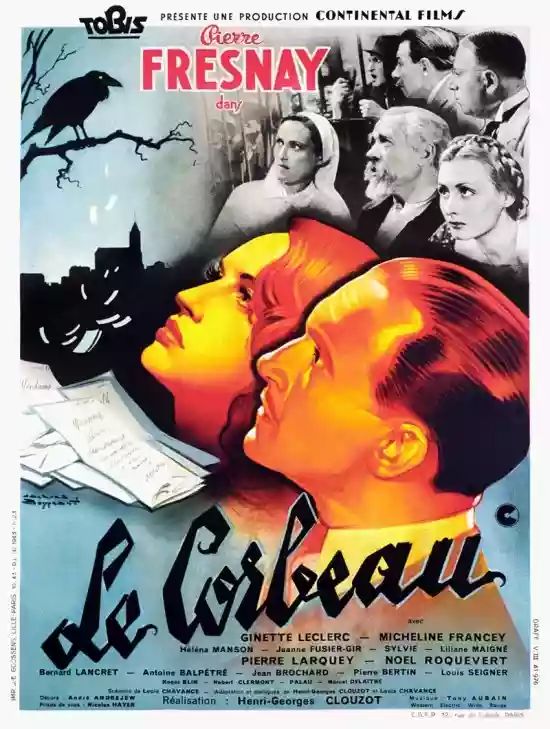
The Raven is a film from 1943.
As I briefly mentioned in the previous, sparse, review, Clouzot was harshly opposed by critics of the time precisely because of his fierce criticism of the French middle and lower-middle classes. Perhaps it's for this reason, because they've always tried to hide him from us, that I discovered him only now, and yet, I assure you, he deserves a place among the greatest of all time.
Clouzot's cinema is cynical, bold, devoid of any naive rhetoric, of ethical or consolatory judgments. The benpensantismo that in our current neo-medieval age has unfortunately come back forcefully to the forefront, is demolished and ridiculed by him with unmatched boldness and surgical precision.
In this magnificent work, even good and evil are transcended where we are clearly made to understand (and the funny thing is, these are concepts we all know deep down) that light and shadow themselves are elusive and undefined, just like the lamp that Dr. Vorzet swings in front of Dr. Germain in a scene that remains forever etched in memory.
In a small French town, the inhabitants start receiving anonymous letters signed by The Raven.
The recipients are accused and threatened by this inscrutable figure, who seems to know quite well the skeletons in each of their closets.
No one is spared, but The Raven's preferred target is Dr. Germain, accused of performing illegal abortions, as well as being the lover of Laura Vorzet, the young and beautiful wife of Dr. Vorzet, the eminent head and psychologist of the town hospital.
What initially seems like a maniac's prank takes increasingly defined and disturbing turns as the letters multiply.
An investigation is opened, a culprit must be found...
In this masterpiece, not a second of film is wasted; the movie proceeds deliberately into a sordid labyrinth where new hypotheses, new possibilities, new insinuations spring up at each crossroad.
The dialogues are memorable, the acting is superb. The soundtrack is absent (it was also absent in Diabolique but even more so here).
No one is innocent, not even the children... and yet no one is guilty, perhaps only that rascal, The Raven... But who is The Raven? And why does he do all this?
You have nothing to do but watch the film and clap your hands raw with admiration and gratitude.
Loading comments slowly
Summary by Bot
Henri-Georges Clouzot's 1943 film Le Corbeau is a bold, cynical masterpiece that challenges societal norms. The film's suspenseful plot revolves around anonymous letters terrorizing a French town, exposing moral ambiguity. Praised for its sharp dialogue, superb acting, and memorable scenes, it remains an unforgettable cinematic experience. The reviewer ranks Clouzot among their top directors after viewing only three of his films.
Henri-Georges Clouzot
Henri-Georges Clouzot (1907–1977) was a French film director and screenwriter renowned for tightly wound thrillers and noir, including The Wages of Fear and Les Diaboliques, earning him the moniker “the French Hitchcock.”03 Reviews
