
 •
Rating:
•
Rating:
THE REVIEW
The perspective of the dream.
The perspective of the dream has no angles. Presumably, it has no geometries because the only light that reveals itself in the dream is that of a dimensionless space: not points, not lines, not the Euclidean plane. There is no master, no mentor, no supernal mind guiding the sleep: the perspective of the dream is an illegitimate child content with its abandonment. The wandering nomad rests in the dream, leaves settle on the seabed, the night blazes. In the writings of Harold Budd, an ethereal craftsman of the gentle spasms of the Pavilion of Dreams, Bismillahi 'rrahman 'rrahim is the dream gutted of its intimacy, a violation of a secret that appears naked and lascivious, rebellious and immutable.
Immutable because to the ears that are allowed to see, in the open field of crossed poppies, it reveals itself as remote: it's the submerged Atlantis, the man trapped in the glacier, the decorated showcase of a shoe store seen by a war amputee. Bismillahi 'rrahman 'rrahim is the uncontrollable dream of a comatose Nutcracker ballerina.
In the deaf expression of one who waits in the dream, Harold Budd paints Two Songs and in them lays the hope of an awakening without regret. It is the perspective devoid of summers and winters: in the dream, there exists only chiaroscuro. Never white, never black, neither the dazzling light nor the treacherous darkness. The mists color the sky and it seems that Spring appears. Hemingway’s old man falls asleep and dreams of lions.
Song.
Arianna's Lament by Claudio Monteverdi in the Madrigals of Rose Angel. It is the cerulean perspective of the dream, the religious embrace with the eternal that death, invoked by Arianna, reunites. And in sleep, between bells, diaphanous piano notes, and celestial voices, the dream marries the unconscious and reveals its desire. The perspective of the dream is enchanting: it seduces and deludes the ambition to ascend. The dream is pre-death. In sleep, Ares, laying down his weapons, acquiesces on the venereal womb.
It is again the bells, the lively notes of a piano, the muffled voices that close the Pavilion: Juno leads into the impassable limit, the last unconscious gesture of the sleeper, the iron curtain separating the lover from the obsession. In the perspective of the dream, every moment is timeless, and thus cannot prevent the piece from dying in Debussy’s preludes, endlessly. The perspective of the dream enjoys only an apparent death.
I seemed to wake up to the sway of the sheaves.
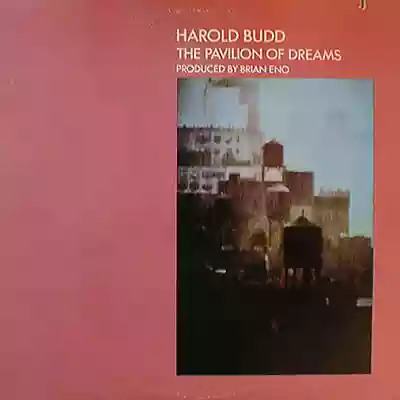
Harold Budd, "The Pavilion Of Dreams", 1978.
(For a lazy friend.)
Loading comments slowly
Summary by Bot
The review poetically describes Harold Budd’s The Pavilion of Dreams as an ethereal and timeless musical journey into the perspective of dreams. It emphasizes the album’s gentle, ambient nature and its ability to evoke a mysterious, dimensionless space beyond conventional geometry. The music seduces listeners with its chiaroscuro of light and shadow and portrays the dream as a liminal experience between life and death. Overall, the review celebrates the album as a beautiful ambient masterpiece with deep emotional resonance.Tracklist Videos
Harold Budd
Harold Budd was an American composer and pianist associated with ambient and minimalism. He collaborated with Brian Eno on Ambient 2: The Plateaux of Mirror and The Pearl, and with members of Cocteau Twins. His work emphasized silence, restrained piano, and luminous atmospheres. He died in December 2020.09 Reviews
Other reviews
By CosmicJocker
An ambient that bridges the gap between spleen and the Ideal, a chamber avant-garde that turns its gaze to the sky of our lives and shows how dreams are made of the same stuff as us.
Distant stars pulse from the freeforms of an electric piano and a sidereal harp while the secretions of a divinatory sax draw fluid constellations.
