
 •
Rating:
•
Rating:
THE REVIEW
Daevid Allen, after having energized the early Canterbury scene alongside Robert Wyatt, found himself in 1968 with his passport blocked in Paris. There, together with his poet and singer wife Gilli Smyth, he decided to gather around him a colorful community of hippies.
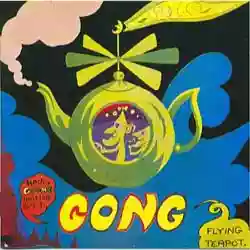
"Flying Teapot - Radio Gnome Invisible Pt. 1," from 1973, is the first of three chapters in the saga (with a not-so-clear plot, but oh well) set on the planet Gong: the Gong gnomes (the Pot Head Pixies) travel on flying teapots telepathically connected to Radio Gnome Invisible, and they arrive on Earth landing in Tibet to establish contact with a few chosen humans.
Every musician is given different names based on the character they portray in the saga: Daevid Allen is the chosen earthly being Zero The Hero (or Bert Camembert), singer Gilli Smyth is the witch-priestess Shakti Yoni, guitarist Steve Hillage is The Submarine Captain (or Stevie Hillside), saxophonist Didier Malherbe is Bloomdido Bad de Grasse, etc., while equally bizarre names are also given to the innocent musical instruments...
Um...
It seems a bit unfair to make questionable observations on lifestyles, but it’s hard to imagine how such a work could have been developed without having bid farewell forever to millions of gray cells...
Nevertheless, the music presents itself as a cultured reworking of the most innovative rock trends from the late '60s to early '70s; an amalgamation of sounds that is anything but easily definable.
We are faced with a streamlined form of progressive rock that almost aligns them with the more mutating compositions of their contemporaries Roxy Music, not so much in the sounds (which are still not very dissimilar), or in melodic taste (a bit less approachable), but in the construction of pieces that begin as carefree and bouncy little songs and end up sinking like cosmic agonies (and/or vice versa).
The main character seems to be the anarchy that dominates the sudden transitions between the silliest and circus-like nursery rhymes, the ethereal synth progressions and female chants, and the collective rock jazz gallops with a spacey and pataphysical taste.
A music more intoxicating than definitely psychedelic: the world that is imagined does not seem like an (im)possible utopia, a vision from a trip nor a revelation of the psyche, but rather a proposal of a musical comedy disguised as a concept album, in which the frequent mystic and esoteric references are counterbalanced by a wildly absurd and surreal humor, amidst nonsensical jests and cabaret-like antics.
Nevertheless, a work animated by a spirit too libertarian to be interpreted univocally.
Banana Nirvana Manana!
Loading comments slowly
Summary by Bot
Gong's 1973 album Flying Teapot inaugurates a quirky, cosmic saga featuring hippie characters and surreal storytelling. The music combines progressive rock complexity with psychedelic and spacey sounds, blending innovative arrangements with absurd humor and mysticism. The album defies simple categorization, offering a unique and intoxicating listening experience. Its anarchic transitions and theatrical nature highlight Gong's libertarian spirit and creative freedom.Tracklist Lyrics Videos
Gong
Gong are a psychedelic/progressive rock band formed in Paris in 1967 by Daevid Allen and Gilli Smyth, known for surreal humor and the Radio Gnome Invisible concept trilogy (Flying Teapot, Angel's Egg, You).11 Reviews
Other reviews
By pana
You couldn’t have made a more twisted album! So crazy, limp... absurd choruses, jumping sounds, sudden fusion bursts that would be extremely innovative even if done today.
The gems of your record for me are precisely represented by 'Flying Teapot,' one of the pinnacles of all seventies music.
