
 •
Rating:
•
Rating:
THE REVIEW
Suppose you are a brilliant personality, unconventional, an unabashed fan of more or less heavy drugs, but above all, suppose that you have contemplated a project that no one before had ever approached: summarizing EVERYTHING in three albums. Using as tools the story of a primordial civilization, itself a product of your mind as sick as it is freaking genius. Then you are called Daevid Allen and you have created one of the most extraordinary and innovative works ever: the Radio Gnome Invisible trilogy, including this astonishing debut: Flying Teapot.
Those idiots at Ondarock, and in particular the one who curated their very personal "History of Progressive," claim that you are known far beyond your actual merits (but does he know Michael Jackson?), and that in your music, they perceive large compositional gaps filled with cunning. He even says that your departure from the band was beneficial! Madness. Well, unlike him, I've listened to your record, so I dare to talk about it as well.
You couldn’t have made a more twisted album! So crazy, limp... absurd choruses, jumping sounds, sudden fusion bursts that would be extremely innovative even if done today. But you did it forty years ago and this seems bewildering. That "The Octave Doctors And The Crystal Machine" so much resembles the electronic sounds that would come shortly after. Anyway, you absolutely have to introduce me to Pierre Moerlen, aka Dierre de Strasbourg or Lawrence The Alien. His drumming work in songs like "Flying Teapot" and "Zero The Hero And Witch Spell" are unforgettable, in my opinion. But of course, all the others too: you all contributed to creating that sound as irresistible as it is unique.
The gems of your record for me are precisely represented by "Flying Teapot," one of the pinnacles of all seventies music, "The Pot Head Pixies," and "Zero The Hero." The first, with its musical perfection, the Frankenstein-like movie start that leads into that kind of singing I wouldn't even know how to define, so absurd and brilliant; then that musical interlude on the verge between Jazz and fusion accompanied, indeed dominated by the usual monstrous drumming of Lawrence the Alien (remarkable, however, are also the winds, signed by Didier Malherbe) until the arrival of those crazy vocals then interrupted by a grand keyboard finale, it’s your masterpiece.
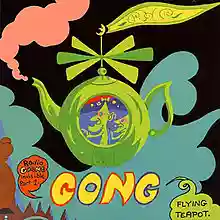
Another thing: the cover is wonderful and those little green creatures are adorable. Never as much as the teapotmobile, though. Congratulations, then!
One question: But what does "Banana, Nirvana, Manana" mean?
Loading comments slowly
Summary by Bot
Gong's Flying Teapot is a uniquely twisted and innovative progressive rock album from the 70s, blending psychedelic sounds with jazz fusion and inventive storytelling. Featuring standout drumming by Pierre Moerlen (Lawrence the Alien) and memorable tracks like 'Flying Teapot' and 'Zero The Hero,' the album remains a masterpiece of its era. The review praises the originality, musicianship, and captivating concept behind this remarkable debut of the Radio Gnome Invisible trilogy.Tracklist Lyrics Videos
Gong
Gong are a psychedelic/progressive rock band formed in Paris in 1967 by Daevid Allen and Gilli Smyth, known for surreal humor and the Radio Gnome Invisible concept trilogy (Flying Teapot, Angel's Egg, You).11 Reviews
Other reviews
By bogusman
"A music more intoxicating than definitely psychedelic: the world imagined is a musical comedy disguised as a concept album."
"An amalgamation of sounds that is anything but easily definable, with anarchic transitions between nursery rhymes, ethereal synths, and rock jazz gallops."
