
 •
Rating:
•
Rating:
THE REVIEW
A siren, an alarm. “Living, I can’t live. But my mind authorizes me to believe that a story of mine, positive or not, is something that resides within reality.” The beginning is devastating. A man postpones suicide by trying to behave “normally,” attempting not to draw attention. He buys a motorcycle, looks for a woman who, like everyone else, creams her hands and tries to be faithful, attempts to save himself by traveling far, to India or Turkey, staying in a couple hand in hand. He tries to hide, tries to “pretend to be sane.”
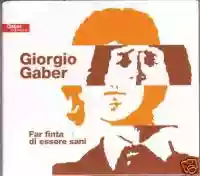
This is the title of one of the first “adult” works by Giorgio Gaber, one of his most complete and successful, deserving transition from the ironic and biting phase of Torpedo Blu and Cerutti Gino, of lighter substance but not therefore reprehensible (indeed already irresistible), to the more mature and conscious phase of the “song theater,” like “Polli da allevamento” and “Libertà Obbligatoria,” to be clear, with the full achievement of his artistic message, when contents and forms became evergreen trees of our musical history.
The year of the album is emblematic; we are in that 1973 of the oil crisis and therefore economic crisis that led to the Hobsbawnian break between the post-war golden age and the new age of decline, a rupture that culminated in the crumbling of the good intentions of 1968 and the emergence of increasingly strong doubts both about the capitalist-consumerist culture imported from the States and about the political ideals of proletarian struggles and Marxist-Leninist revolutions that made one look to the great mother Russia as a point of reference. Gaber arrives before many of his compatriots at the scene of the crime, the crime of illusions, hopes, ideas that had nourished the generations from Presley to the Led through Dylan or Joan Baez. He takes the guitar in hand and with strong doses of motivated and justified cynicism, slams reality in our faces. But conscious that this will upset us, will hurt us a lot, he sweetens a vinyl of twenty bad thoughts with his proverbial sense of humor, also inviting the reluctant listener to reflect, to reason with themselves, to enter into the narrative.
Irony transforms one of the greatest existential laments that Italian music remembers into a gigantic anecdotal fable. Mr. G. feels bad, he does not hesitate to tell us, he cries, groans over these pages of personal life, but being a human being, he also has a side that makes him react, which asks us to keep our eyes upward, to move the little head and its gears. The reality of the bourgeois man of the 20th century is meticulously subjected to the x-rays of intelligence, everything is said, pursued, described, watching the smoke coming out of cigarettes, masturbating, physical and intellectual impotence, love, love, love, but do we really know which is the true one? Old-fashioned or new way of living? They told us that we have to form open couples, rely on science, speak in English and read Gramsci, form study groups and class struggles, find the attic in the center of Rome, Milan, never scold the children, grant everything otherwise they grow up with adult complexes. But should everything be accepted blindly? Or do we have to go back to the patriarchal-peasant life, the evenings by the fireplace with the smell of sauce, beatings to the children if they do not obey? It is up to us to take stock of the situation, analyze what surrounds us (as long as it survives), and choose individually what serves us, what we need. Understand what a feeling is, what the role of work should be in our life, decide what we want to do with nature or medicines. What satisfies us now? Perhaps on our most apathetic days, we should really indulge in a nice shampoo… “SSSSSSCende l’acqua, scroscia l’acqua, calda fredda calda… giusta… schiuma… soffice, morbida, bianca… la schiuma è una cosa sacra, come una vacca indiana… SSSSSciacquo!”.
What is true democracy, are there good guys and bad guys? Maybe yes, but they are never the same, they change, and we too can become a “bad guy” without knowing it. “I’m not talking about the love that we all know a little… to love, I must know and love myself... walk in a place, eat something, feel you are in a room, use your hands, touch an object, understand its consistency, learn to feel the present in such a temporary time”. This singer-songwriter asks himself with pain, proposes solutions, seeks collective remedies, remedies for contemporary alienation. He does not want to be fake; he wants to feel master of his own body, to know who he is, if and whom he has to pray, kill, vote for. And he explains our dilemmas to us, not limiting himself to singing them, but starting to recite them, like a sweet bitter comedy created based on our lives. Times change, the format, the structure of the songs, which become small ingenious minimalist odes, surreal slices of surreal and skew music, where the high register is also drastically confused with the more colloquial, immediate one. “I lose pieces, but it’s not my fault… from the train, I lost an arm waving... I’m sorry, it had the watch... I'm so careless, I always lose everything”.
Gaber can be a poet who has nothing to envy from his rival-colleagues, but what makes him unique is his ability to wear multiple registers, continually surprising us. Here we see him as a comic cabaret artist, a high-level singer, a dramatic actor of consummate skill, a proclaimer of elusive and perfect political slogans (his party does not exist, but one we would all like to join), a striking intellectual. Italian and free like few know how to be. It is no coincidence that the last words he left us were “I don’t feel Italian, but fortunately or unfortunately I am”. Many of us should be like him. PPPPPPPPhone…
p.s.: priceless bonus track “La libertà,” for which there are no comments or even adequate compliments. We can only pay tribute by listening. And tomorrow, go out of the house a bit more aware of what we are.
Loading comments slowly
Summary by Bot
Giorgio Gaber's 1973 album 'Far finta di essere sani' marks a powerful transition into mature song theater, mixing irony and deep reflection on 20th-century bourgeois life and social dilemmas. The album confronts personal alienation and societal illusions with humor and intellect, inviting listeners to rethink democracy, love, and cultural norms. Praised for its poetic richness and multifaceted expression, it remains a landmark in Italian music history.Tracklist Lyrics Videos
Giorgio Gaber
Italian singer-songwriter and theatre author, pioneer of teatro-canzone, active from the 1950s until 2003.28 Reviews
Other reviews
By blu
"In current society, man is forced to wear a mask of perpetual satisfaction, to always pretend in relationships with others."
"A timeless album, of extraordinary beauty and depth. Recommended to all who have not yet had the chance to know this artist."
