
 •
Rating:
•
Rating:
THE REVIEW
As Above So Below.
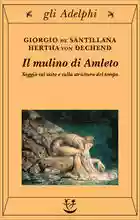
In this essay, the authors, de Santillana and von Dechend, analyze, deconstruct, investigate, and unsettle all the world's myths.
Heroes who become protagonists of epic battles and whirlpools that endlessly grind sand, grain, and gold.
Everything is analyzed (perhaps) in its true essence. The more one progresses in reading, the more convinced one becomes that it's not just legends of giants slaying their parents by tossing their genitals into the sea, or mythical argonauts in search of who knows what fleece. Rather than an ash tree planted in the center of the Maelström or great whirlpool or the so-called HAMLET'S MILL.
All myths always lead to the same destination: the stars.
If on a serene and clear night one has the fortune to observe the firmament from a place free of any artificial light pollution, one can comprehend how fortunate ancient man was.
The ability to, night after night, observe the small movements of each star must have stirred the curiosity of our ancestors who measured the angles of degrees perhaps only with their hands rather than marking them with a stone or stick. Not having yet conceived a mathematical and written language to pass on to posterity, they chose the simplest path: Myth and Memory.
It seems almost impossible today to accept the fact that the ancientest ancients (thanks Frau editor's note) had the capacity to memorize enormous amounts of data (encoded in myths) to pass on to posterity simply by learning them by heart, the continuous repetition of notions as if they were a Mantra aimed to absorb them within oneself, until they became so ancient that their original meaning was completely forgotten.
Yet others should have realized well before 1969 that all those stories and images depicting gods and heroes intent on rotating a huge blender perhaps were not to be sought on earth but all it took was to look up at the sky and see the enormous spiral that creates everything.
The most important contribution offered by the book is the explanation of the technical-linguistic conventions with which myth conveys information about precessional motion.
First of all, three simple rules exist:
the first implies that animals are stars - the second that the gods are planets - the third indicates that topographical references are metaphors for the location, usually of the sun, in the celestial sphere.
(thanks Sullivan editor's note)
The essay, not easy to understand, is full of references to the most unknown world cultures, THE EDDA, SHAKESPEARE, the ODYSSEY, the KEVALA, the epic of GILGAMESH, the KEVALA, MESOPOTAMIA rather than PRE-COLUMBIAN MEXICO, everything is analyzed and dissected until after almost 600 pages one is left bewildered and astounded, with just one question in mind: what is time?
"In my opinion, therefore, sight is the basis of our greatest benefits because we could not have said anything about the universe if we had never seen the sun, the stars and the sky.
Moreover, it is the perception of day and night, solstices and equinoxes, months and years that follow one another, that led to the invention of numbers and gave us the notion of time and the nature of reality, from which we have drawn all philosophy, a celestial gift greater than which man has never had nor will have."
Plato TIMEAUS
Loading comments slowly
Summary by Bot
This review praises Il Mulino di Amleto for its profound and detailed investigation into ancient myths, revealing their roots in astronomical observations. It highlights how myths encode precessional motion and celestial phenomena, emphasizing the ancient human capacity to use myth and memory as sophisticated knowledge systems. The essay connects diverse cultures and epic tales, leaving readers contemplating the nature of time itself.
Giorgio De Santillana - Hertha Von Dechend
Co-authors of Hamlet's Mill (Il Mulino di Amleto), a long essay linking myth and astronomy and arguing that myths encode precessional and celestial information.01 Reviews
