
 •
Rating:
•
Rating:
THE REVIEW
This is one of the rare cases in which the subtleties of a debut, despite many unfavorable factors, are not destined to remain an isolated incident but are perpetuated by a splendid second album, born after a complex and troubled gestation.
After the release of the first self-titled album in 1975, Gilgamesh, never having found a stable lineup, disbanded. This coincided with the end of Hatfield and the North, allowing Alan Gowen to merge his keyboard skills with those of Dave Stewart, thus creating the nucleus from which National Health would later develop. Phil Lee and his guitar followed Alan in his new adventure, Jeff Clyne remained in the fusion realm, forming Turning Point (a group that included him on bass, Paul Robinson on drums, Brian Miller on keyboards, Dave Tidball on saxophone, and Pepi Lemer on vocals), while Mike Travis tried to supplement his meager drummer's income by performing as a session-man (unfortunately with little success as he would leave this occupation a few years later and return to Scotland with his family).
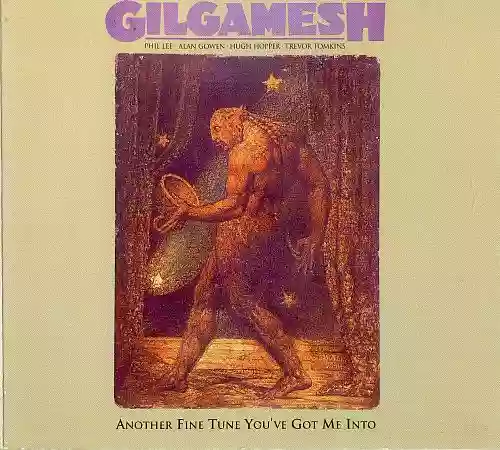
After two years, Alan, following Phil's example, who had left some time ago, also leaves National Health (though not definitively; he would return as a guest during the recording of the first album) to work on new material, for which he once again calls upon his guitarist friend. Neil Murray replaces Jeff, Trevor Tomkins substitutes Mike, and with this structure, the band (keeping the name Gilgamesh) rehearses Alan's new compositions. However, shortly before entering the recording studio, Neil leaves and Hugh Hopper, Alan's companion in the newly formed Soft Heap, is called in to take his place. Finally, in the summer of 1978, this work, which will be named "Another Fine Tune You've Got Me Into," is completed.
The album is possibly more distinctly jazz in style than the previous one, but the soft and subdued sounds and the consequent warm and relaxed atmospheres are the same that characterize the group's previous musical effort. Although they are mostly Alan's compositions, Phil's guitar finds a great prominence in this album, constantly intertwined with the keyboards that the two instruments appear as lovers, united in the sweetness of their own notes. The initial "Darker Brighter" and "Play Time" develop precisely with these premises, while the long and chameleonic "Bobberty-Theme From Something Else" allows Hugh's bass to carve out a larger space, although always mitigated by the massive use of keyboards, which surprisingly, in their elegance and lightness, never appear intrusive or excessive. In "Underwater Song," Trevor launches into a resounding drum solo at the opening of the track, followed by the delicate tones of Alan's indispensable keyboards, thus highlighting his exceptional skill on the instrument. Also in this album, as in the previous one, there are shorter tracks such as the intense and nostalgic "Waiting," performed solely by Phil with acoustic guitar, the hypnotic "Foel'd Again," based on a gloomy bass march accompanied exclusively by the keyboard, and the concluding "T.N.T.F.X.," where Phil and Trevor unleash and energetically steer the album towards its conclusion.
This work, while retaining the refinement of the debut, perhaps errs in maintaining a style too similar to its predecessor (although to speak of a lack of originality in such creative albums is practically impossible), to which it is also akin for a certain sound that might be off-putting to a listener unaccustomed to this type of music.
It's worth spending a few words on the cover, which depicts a painting by William Blake, titled "The Ghost of a Flea," created around 1820 with the support of painter and astrologer John Varley. The latter encouraged the artist to draw the subjects of his visions (William claimed to have visions from a very young age), which in this work, show us how the author came to perceive certain tiny parasites as reincarnations of bloodthirsty men, reincarnated into infinitely smaller bodies to moderate their voracity.
Loading comments slowly
Summary by Bot
Gilgamesh’s second album, Another Fine Tune You’ve Got Me Into, builds on the debut’s subtleties with refined jazz fusion compositions. Despite line-up challenges, the album showcases Alan Gowen’s keyboards and Phil Lee’s guitar in a warm, cohesive sound. The music is more jazz-oriented with expressive drum and bass moments. The cover art, featuring William Blake’s 'The Ghost of a Flea,' adds artistic depth. While similar to their first work, this album remains a creative and elegant fusion masterpiece.Tracklist Videos
Gilgamesh
Gilgamesh is a British Canterbury scene jazz-fusion group led by keyboardist Alan Gowen. They released two studio albums—Gilgamesh (1975) and Another Fine Tune You’ve Got Me Into (1978)—and the archival collection Arriving Twice (2000). Their sound blends elegant keyboard-led arrangements, lyrical guitar by Phil Lee, and refined rhythmic interplay, with appearances and ties to figures like Dave Stewart, Hugh Hopper, and Amanda Parsons.03 Reviews
