
 •
Rating:
•
Rating:
THE REVIEW
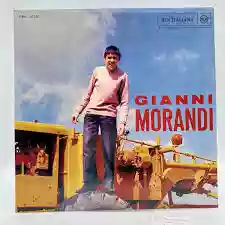
GIANNI MORANDI (1963) 5.5/10
Listening today, 63 years later, to Gianni Morandi’s first record (so-called debut, though in time-honored fashion it’s actually an anthology of 45s already successfully released, some more than others) is rather endearing. First of all, because if you listen to him sing, at times it doesn’t even sound like him: so young, so adolescent (he was 19), and then because these little “songs”—which actually aren’t that little—were often embellished by rather remarkable arrangements (here, for instance, the strings are by Ennio Morricone). Sure, listening to them today (arrangements aside) they sound so naïve as to seem almost silly, but perhaps here, more than in the musical field, we find ourselves in the sociological realm: “Andavo a cento all'ora” or “Fatti mandare dalla mamma (a prendere il latte)” are a wonderful snapshot of an Italy at the beginning of the boom that, alongside a certain prosperity, also discovered the cultural and playful aspects of the aforementioned boom: the song form. No longer tied to arias, to Beniamino Gigli and the like, but to a breezy youthful pop that made parents frown and swept the girls of that era into a hormonal frenzy.
As a first LP, it’s not bad. Twelve songs among which, in addition to those already mentioned, we find: “Il primo whisky”; “Go-kart Twist”; “Loredana”; “Che me ne faccio del latino”; “Ho chiuso le finestre”; “Meglio il madison”. All stuff that was quite successful, sometimes even supremely so. Most of the lyrics are by Franco Migliacci (or Camucia), with contributions from Marcello Marchesi, Carlo Rossi, Luciano Beretta and Luciano Salce (Pilantra). It’s quite clear that Morandi had no artistic or decision-making power: lyricists and musicians would tailor the suit for him and he tried to wear it as best as he could.
The first single was “Go-kart Twist” (on the cover there was this clean-faced boy nobody had seen before, who instantly won the crowds’ hearts), then came everything else. Including “Fatti mandare dalla mamma”, music by Luis Bacalov. In reality, the big (huge) problem with these ‘60s albums by Morandi (but also by Pavone, Mina, basically the whole “scene” back then) was that beneath the often somewhat silly (rarely funny) lyrics there were such beautiful melodies, they deserved far greater stages. Think, the following year, of the Morriconian incipit of “Non son degno di te”. And “Fatti mandare dalla mamma” (which musically is actually one of the album’s least interesting tracks) has some dreadful lines, the kind that deserve a red pencil: “tu digli a quel coso, che sono geloso”. Not to mention another contradiction: the best music is “tacked onto” the more dramatic songs, those in which Morandi sings with a broken voice, brimming with emotional suffering (“E’ colpa mia”, which is a cover; “Ho chiuso le finestre”). When he’s allowed to “unleash” his adolescent verve, he becomes almost irresistible: above all, “Che me ne faccio del latino” (which, let’s face it, generations of students pre- and post-Morandi, myself included, have wondered) with lyrics by Marcello Marchesi that are extraordinarily funny (“Ovidio nasone; Cicerone chiaccherone”) or “Sono contento”, which is really nothing much (he’s happy because he can go to the movies with Milena and show off his new shoes) but clearly marks that turning point mentioned above that characterized the season of the boom and the jukeboxes. The carefree mood of the early ‘60s that would, in contrast (though in those days, obviously, no one could imagine it), be followed by the Years of Lead of the following decade.
I’ve always been intrigued by “Il primo whisky” as well, since it’s a real tongue-twister to sing, while the celebrated “Andavo a cento all'ora” stood out for two reasons: the chunga-chunga which became a kind of catchphrase, and the fact that our protagonist “raced” to see his sweetheart at 100 km/h. In 1963, that was a shocking speed—it’s as if today someone sang “Andavo a 400 all’ora”. Third place on the charts (like “Fatti mandare dalla mamma”) and thus the birth of a star—or maybe a mini-star? Yes, because Morandi has always been a bit in-between: today he’s a likable grandpa who’s even popular with the Gen Z crowd on social networks, but he’s gone from the sweeping success of the ‘60s to the darkness of the ‘70s, through a rebirth in the ‘80s to consolidation (also on TV) in the ‘90s and early 2000s. But was he ever truly a star or has he always just been a friendly, easygoing guy?
Loading comments slowly
Summary by Bot
The review provides a critical take on Gianni Morandi's self-titled album. The writer is evidently disappointed with the quality and impact of the release. The album fails to meet expectations, especially considering Morandi's legacy. The overall impression is one of underwhelming delivery from the Italian pop icon. Listeners are cautioned about investing too much excitement in this album.Tracklist Videos
02 È Colpa Mia (00:00)
03 Fatti Mandare Dalla Mamma (00:00)
04 24 Ore Al Giorno (00:00)
05 Sono Contento (00:00)
06 Il Primo Whisky (00:00)
07 Go-Kart Twist (00:00)
08 Loredana (00:00)
09 Che Me Ne Faccio Del Latino (00:00)
10 Ho Chiuso Le Finestre (00:00)
11 Meglio Il Madison (00:00)
12 Corri Corri (00:00)
Gianni Morandi
Italian singer and entertainer from Monghidoro (Bologna), active since the early 1960s. He rose to fame with a string of hits in the ‘60s, experienced a downturn in the ‘70s, and returned to the top with the 1985 anthem Uno su mille. He has remained a fixture in Italian music and television.03 Reviews
