
 •
Rating:
•
Rating:
THE REVIEW
1. Gesualdo Bufalino (Comiso, 15.11.1920 – Vittoria, 14.06.1996) and the Diceria.
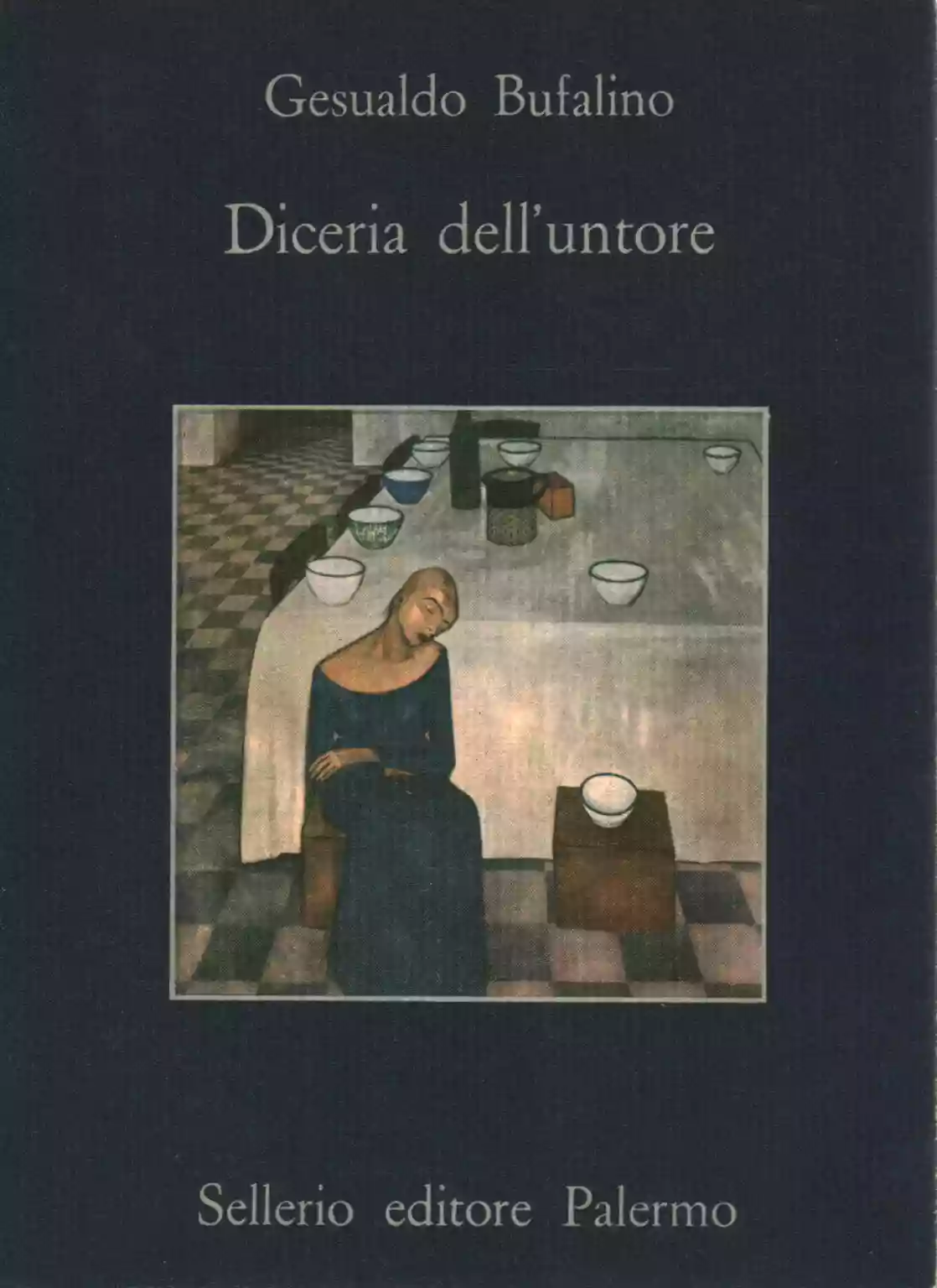
During the storms of war, Gesualdo Bufalino suffers from tuberculosis and endures a long convalescence: first in Scandiano and, subsequently, in Palermo. In 1981, his first work, Diceria dell’untore, is published. Interviewed by Leonardo Sciascia, the Comiso native recalls: the book «I thought of and sketched around '50, I wrote it in '71. Since then, an uninterrupted revision: up to the print proofs. It came from my experience as a patient in a sanatorium in Palermo: in the post-war years, when tuberculosis still killed and marked as in the nineteenth century» [1].
2. Masks and feathers
The writer uses «an archaeological, extinct language» [2], in deference, moreover, «to that Mediterranean prejudice (or at least his and mine), according to which interjection and plethora add to words – and to climates, mimics, foods – not only opulence but credit, as in magical attire, where masks and feathers, the more abundant they are, the better they exalt and strengthen each other» [3].
The pages exude morbid moods: blood, piss, and bleach. In the tragedy, the spear of the Pelide rages. Letters that repel and attract, that wound and soothe. «An excess of words, a taste for singing and pitying oneself, of which I first (you will notice) have not been able to cure» [4].
«The verbal universe is the only one I truly trust. Nomina sunt consequentia rerum? The opposite is true, and things are inventions and dreams, and words are epitaphs of dreams» [5]…
3. The castle is for sale. The shutters are detached
«In the amaranth Topolino, we go as if it's an enchantment in '46» [6]. Coff, coff. The music is interrupted and the storm arrives, foretold by the rumbling of coughs: «one felt an irrepressible spurt of red foam and death rise to the lips. An immense blood, sown with round bubbles» [7].
The Diceria narrates the coexistence of some war veterans in the Palermo sanatorium. Giovanni, Angelo, Father Vittorio, Sebastiano, little Adelmo; and then, the Gran Magro, Marta. The scythe looms over these heads. Lives that struggle, ca s’ammiscunu, on the precipice. In despair, the natur der sache surfaces.
Our fragile and tiny existences, floating on the sea of Imbrium of meaninglessness. «The game of life oscillates between misfortunes and countless fittings. You never meet who you want, but who you must or who happens, according to whether a deceitful hand shuffles, assembles, and disperses us, arranging or canceling appointments at its own pace on the canvases of its millennia» [8].
Reality, dreams, god, love, the glimpses of happiness that slip like sand from our hands. Everything is true; everything is false. «Only I am true and will be as long as I live. You, the others, are just glimmers and fictions that I feel breathing and speaking beside me. And history concerns only you, I don't know what it means. Understand me: in billions of past and future centuries, I cannot find an event more important than my death. And all the massacres and drifts of continents and bursts of stars are but a ditty and a comedy compared to this tiny and unrepeatable cataclysm» [9].
In this fog, where are you now? Where do you walk? In which night? «Angelo said that death is a screen of smoke between the living and the others. You just need to plunge your hand in to pass to the other side and find the supportive fingers of the one who loves you» [10]. Everything is true; everything is false.
* * * *
I close the book and interrupt the flow of these death omens. It is necessary to return to life. The seduction of nothingness is useless, «the half-faiths, the false flags. I would have resigned myself, what else could I do?» [11].
[1] G. Bufalino, Diceria dell’untore, Bompiani, Milan, 2016 (original ed. Diceria dell’untore, 1981), p. XVIII.
[2] Ibidem, p. 201.
[3] Ibidem, p. 11.
[4] Ibidem, p. 201.
[5] Ibidem, p. 203.
[6] P. Conte, La topolino amaranto, in Paolo Conte, RCA, 1975.
[7] G. Bufalino, Diceria dell’untore, cit., 132.
[8] Ibidem, p. 31.
[9] Ibidem, pp. 117 and 118.
[10] Ibidem, p. 21.
[11] Ibidem, p. 138.
Loading comments slowly
Summary by Bot
Gesualdo Bufalino’s debut novel, Diceria dell’untore, draws from his personal tuberculosis experience during WWII. The novel uses rich, archaic language to explore life, death, and the fragile existence of war veterans in a Palermo sanatorium. Themes of dreams, reality, and the inescapability of mortality permeate the story. The review highlights the lyrical, almost mythical quality of Bufalino’s prose and his profound meditations on meaning and oblivion.
Gesualdo Bufalino
Gesualdo Bufalino (15 November 1920, Comiso – 14 June 1996, Vittoria) was an Italian writer best known for his first-published novel Diceria dell'untore (1981). The novel draws on his experience as a patient in a Palermo sanatorium.01 Reviews
