
 •
Rating:
•
Rating:
THE REVIEW
Can you really talk critically about a film that, in just under two weeks, grosses 55 million euros and, for the moment, brings 7 million Italians to the cinema? (Current record: "Quo Vado?," 65 million gross and 9 million viewers). Will Zalone beat Zalone? In the end, it's true that box office numbers count for little and everything has to be related to inflation, but if in 1972 "The Godfather" brought 16 million Italians to the movies (but it was 1972, and there were three times as many cinemas as today), no one in Italy, for many years, has managed to mobilize crowds like this (and don’t talk to me about the first "Avatar" with prices inflated by 3D!). In a few days, Zalone will have surpassed 65 million and will end up, let me make a prediction here, at about 10 million tickets sold. Numbers that, alone, keep the Italian film industry afloat. Why does Zalone have such broad appeal? Everything’s been said (some have even compared him to Sordi, but I'd leave it): he's popular with everyone; he is "wonderfully mediocre" (to quote a line from his first movie, "Cado dalle nubi", 2009); he gets even those who never go to the movies into theaters (dads, moms, grandparents, grandchildren, uncles and aunts: all together in a big happy group); he appeals to teenagers and boomers alike; he laughs at our faults and human failings, just as Italian comedy has always required (no, he’s not Monicelli, nor Risi, nor Scola: but "Quo Vado?" may be the best Italian comedy of the last thirty years): or, simply, he’s funny.
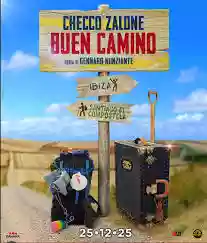
"Buen Camino" is not his most accomplished film, but not the worst either (which for me is "Sole a catinelle", 2013): it’s the story of a wealthy and jaded man (Zalone in a blond wig: don’t worry, after twenty minutes they rip it off) with a half-comatose father (the father made the money, the son lives off it happily, organizing huge Egyptian-themed parties in his Sardinian mega-villa, and, rather than the late Berlusconi, one thinks of Gianluca Vacchi) who discovers his alternative daughter has left to walk the Camino de Santiago. Forced by circumstance, he sets off too. And then all sorts of things happen.
Nunziante (Zalone’s loyal director-friend, who only bowed out of "Tolo Tolo", 2020) is, as usual, brilliant at dictating the pace of the story. His films always last 90 minutes (heresy to go further) and the rhythm is high-altitude: everything happens quickly, the gags unfold one after another and, unlike your average Christmas movie, boredom and repetitiveness make way for a quick pace and collegiate humor. Zalone is Zalone; he is always himself, even as a rich man (with the super yacht Zalonious II), with his grimaces, his face, his mimicry. Whether he mocks the new Scrooges or pokes fun at the myth of the Italian civil servant, he’s always the same guy: Luca Medici, aka Checco Zalone. I do think, though, that every once in a while the screenplay gets stuck or just misses the target. The first half, with Zalone as an obnoxious rich man, works only in bits and the laughs (judging by a packed movie house on Genoa’s harbor) seem held back; in short, the laughs come drop by drop (even though the gag about the guy living at Villa Zalone in Sardinia and claiming to be Zalone’s daughter’s father is funny: "È l’unico palestinese che occupa un territorio. Gaza, Gaza mia;" and the one about the “walkers’” shelters looking like camps isn’t bad either: "Wow, sembra di essere in un film," "Quale?," "Schindler’s List"), with some throwaway jokes tossed in at random (the 25-year-old, apparently new girlfriend of Checco, born in Mexico City but, he says, she won’t tell me which city). The second half, though, finally free from wigs and able to let Zalone be Zalone, is non-stop fun, with the last thirty minutes a barrage of laughter. Sure, you laughed more in some of his earlier movies, but still, it must be said it’s never vulgar comedy, not even when, after the finale, he transforms into flamenco dancer Joaquin Cortison and sings "La prostata inflamada" (by the way, Zalone just turned 50!).
With a couple surprises: his female co-stars are always good and well-cast, and Beatriz Arjona (the forty-something “walker” who tags along with Zalone on the grueling way) is no exception here. And in the end, well, he redeems himself and good feelings triumph (even if not everyone has a happy ending, himself included, who thought he’d end up with Arjona but she…). And Martina Colombari, aged and greyed in body and hair, as Zalone's ex-wife, is a (curious) surprise.
Then you can debate for hours the fact that Zalone monopolizes all the Italian theaters (in some small towns it’s him or nothing, and this year the new Park Chan-wook film also came out), but that's how it goes, and Zalone is a breath of fresh air for theater owners. I believe he would still have similar (maybe a little lower) figures even if he was released in fewer cinemas, but in the end—and I want to say this, without invoking illustrious comparisons to a kind of cinema that once was and never will be again—these aren’t throwaway products; they have a sense of order, a consistent logic (and even a decent, let’s put it that way, page layout).
Loading comments slowly
Summary by Bot
This review covers Gennaro Nunziante's movie BUEN CAMINO. The film receives a moderate rating of 3 out of 5. It discusses both positive and negative aspects. Offers a balanced perspective on the director's work. A helpful read for those curious about recent Italian films.
Gennaro Nunziante
Italian film director and screenwriter best known for directing Checco Zalone’s box-office comedies, including Cado dalle nubi (2009), Che bella giornata (2011), Sole a catinelle (2013) and Quo vado? (2016).04 Reviews
