
 •
Rating:
•
Rating:
THE REVIEW
Rock has been here. It was already clear that something was changing in 1953 when a young and defiant Bill Haley dragged the new generations onto the dance floor and chilled the blood of the purist bigots with the famous "Rock around the clock."
And the 1955 record debut of Elvis Presley (it was a very modest track entitled "My happiness") was the clear and unmistakeable signal of a revolutionary and partly shocking musical transformation. This revolution would have as its main axis the legendary (and today little known) Gene Vincent.
Vincent Eugene Craddock (1936-1971), known as Gene Vincent, was born in Norflok, at the heart of a harsh and wild America. At twenty, he was already something of a genius: helped by an exceptional and outstanding band (Cliff Gallup guitar, Willie Williams rhythm guitar, Dickie Harrell drums, Jack Neal double bass), he managed, at a very young age, to land at Capitol, a glorious production house at the time looking for an artist who could rival the emerging but already famous Elvis Presley. Fortune smiled on Vincent: Capitol signed them immediately, and the band would be called, at least for the very first years, Gene Vincent and his Blue Caps. Their first track to be recorded was "Be Bop a Lula", an epic and legendary piece, highly rhythmic and frenetic, a true cornerstone of all American rock music. It is a sort of nursery rhyme without apparent sense (technically, the term "Be Bop a Lula" means practically nothing) but it has an incredible and striking rhythm and liveliness, considering that the instrumental contribution is virtually nil (drums, guitar, double bass).
Gene Vincent, the singer with the "angelic" voice, sings this eternal pioneering masterpiece in a graceful and surprising way, and why not, avant-garde. Besides "Be Bop a Lula," Gene Vincent and his Blue Caps also recorded the beautiful "Woman love," a poignant and apocalyptic ballad. The two tracks immediately climbed the charts, and Gene Vincent obtained a definitive and well-deserved consecration. Yet, this charming young man with a distracted and seemingly superficial demeanor was never an easy and calm guy: a terrible motorcycle accident, caused by a fatal driving mistake, had serious and grave consequences for Vincent, such as a total fracture of the left ankle. The injury would never heal, and Vincent, over the years, would be forced to undergo numerous surgical operations, to the point of having to treat himself through the use of drugs and a metal brace around the ankle. Unintentionally, this particular artificial gadget would lead Gene Vincent to take on a characteristic stage presence (leg slightly spread) that would boast, over the years, tens of thousands of imitations.
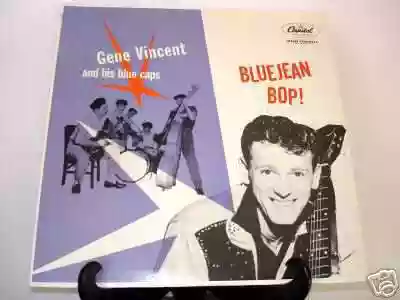
The first album of Gene Vincent and his Blue Caps is perhaps not the most musically polished album but is unquestionably the most effective at the communicative level. In addition to the already mentioned "Be Bop a Lula," noteworthy are also "Race with the devil," "Up a lazy river," and "Peg O' my heart." A curious and partly successful musical reinterpretation: Gene Vincent recovers some old American rock from the early Fifties (all between 1952 and 1955) and chisels them according to his very personal musical inclinations. Tracks destined for oblivion like "Bluejan Bop" and "Bop Street" make a strong comeback and regain new vigor and new vitality. "Bluejan Bop" is both a historic and surprising album, historical and therefore fundamental.
Although it is an album of almost fifty years ago (and this year it reaches its 50th year of age), it's quite easy to find it in some small shops: EMI reissued it, in a clean and remastered version, in the spring of 1998 adding to the original six tasty and refined bonus tracks. The price is absolutely affordable.
Loading comments slowly
Summary by Bot
Bluejean Bop by Gene Vincent is a seminal rock album from the 1950s, marked by its energetic rhythms and groundbreaking style. Featuring the iconic Be Bop a Lula and other standout tracks, it captures the spirit of early rock & roll. Despite Vincent's personal hardships, his vocal talent and unique stage presence left a lasting legacy. The album remains influential and accessible thanks to a clean remastered reissue.Tracklist Lyrics Videos
02 Jezebel (02:24)
04 Ain't She Sweet (02:29)
05 I Flipped (02:25)
06 Waltz of the Wind (02:43)
07 Jump Back, Honey, Jump Back (02:00)
08 Wedding Bells (Are Breaking Up That Old Gang of Mine) (02:31)
09 Jumps, Giggles & Shouts (02:51)
10 Up a Lazy River (02:21)
11 Bop Street (02:24)
12 Peg O' My Heart (02:36)
13 Woman Love (02:33)
16 Gonna Back Up Baby (02:26)
17 Well, I Knocked Him, Bim Bam (02:14)
Gene Vincent
American rock and roll and rockabilly pioneer; fronted Gene Vincent and His Blue Caps; broke through with Be-Bop-A-Lula (1956) on Capitol Records; influential vocalist and stage performer; Rock and Roll Hall of Fame inductee.01 Reviews
