
 •
Rating:
•
Rating:
THE REVIEW
Black screen. Then, fragmented guitar. Then, a rhythm that turns your limbs into pistons; then, the problem of leisure: what to do for pleasure. Here's the story of a girl, the queen of France who, among dead sisters, boredom, and sapphic love, lost her head to modernity. This simple story in many ways, transformed into the chronicle of the search for pleasure, of youth, in this naturalness that no longer exists or is no longer here. As if to say: fornication makes you happy, no escape from society.
And I say it: while my limbs turned into pistons, my head went straight, on the tracks built by that exclamation point of Jon King, because exclamation points are the only ones that speak to me or that I can hear.
Naturalness is not here or at least not in the sudden transfer of power, Kant would say. Perhaps in enlightened despotism, but only maybe. Perhaps in education. Or - to put it like Burke - repent and thank God for the naturalness you may find in the next life, the celestial one, because in this post-revolutionary, democratic or supposedly democratic life, with the freedom to say nothing about it, you will not find naturalness.
In short, 1979 or 1789 makes no difference: exclamation points, those who squeeze themselves to live, have always been reactionary; because it's obvious: progress is always a form of selfishness. And it has always been. Better naturalness, zero superstructure, everything straight and then BOOM.
And it goes without saying that the music of the Gang of Four - reactionary by choice from above, but also by their own abilities, a group that goes beyond the simple musical signifier - should be listened to by isolating it from what naturalness rejects.
The Peel Sessions have always been a beautiful thing, a halfway point between the crafted artificiality of a record and the alcoholic rawness of a concert. And so there is no better way to listen to them than with the bass drum that stings and the bass that rattles, in its roundness, to the unimaginable.
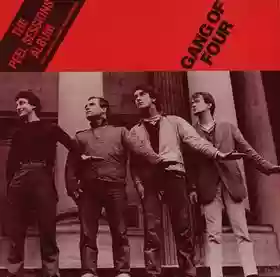
The Peel Sessions Album, released in 1990 by Strange Fruit, was recorded in three sessions, presented on the album, as naturalness requires, in strict chronological order. The first two took place in 1979, with the album not yet released, and reveal 8/13 of what will be Entertainment!. The sound is alive, it pulses.
It opens with "I Found That Essence Rare" and we find ourselves with a tight and sharp group in our ears, who seem to be walking joyously on a razor's edge. "5.45" is something alienating, like Joy Division who don’t care about delivering themselves to beauty and let themselves go to the chronicle and the guitars, the guitars - Andy Gill was a person close to God - and then it comes, the moment where King screams. Guerrilla War Struggle is a New Entertainment. Then, STOP.
Then "Natural's Not in It" - my favorite; one, among all, of my favorites - and then silence. "Not Great Men" is, more or less, the starting and ending point of the whole new-new wave that until a few months ago reigned and that no one seems to remember now; like demonic A Certain Ratio. The rhythm section of "Ether" dances on what remains of the world destroyed by Jon King's proclamations and it's a beautiful dance, there's no denying it.
In 1981, with Solid Gold out, they returned to John Peel's studios to play "Paralysed", with the bass that pierces, straight through, the walls of home. The guitar becomes even more dry and harsh - as Gill's personality demanded - and it's easy to perceive where Albini's guitar style comes from... Every man is for himself.
They record "History's Bunk", where the guitars become synths, and "To Hell With Poverty"—ecstatic and thoughtful—both of which later appear on the 1982 EP, Another Day/Another Dollar.
As if to say: a glimpse of naturalness just before losing it completely.
Loading comments slowly
Summary by Bot
The review explores Gang of Four’s Peel Sessions album as a raw and vital expression of post-punk energy, emphasizing the band’s sharp rhythms and powerful lyrical themes. It highlights the naturalness captured between studio polish and live energy, and praises key tracks like "Natural’s Not in It." Set within a broader social and philosophical context, the music reflects a reactionary yet insightful energy tied to youth and societal critique.Tracklist Lyrics
Gang of Four
Gang of Four are a British post-punk band formed in Leeds in 1976 by Jon King and Andy Gill with Hugo Burnham and Dave Allen. Known for Marxist-leaning, politically charged lyrics, angular guitar, and funk-driven rhythms, they released the acclaimed debut Entertainment! (1979) and influential follow-ups including Solid Gold (1981) and Songs of the Free (1982).08 Reviews
